
15 Jobs AI Will Replace by 2030
The 15 workflows AI agents already run, the jobs it will not touch by 2030, and a 45 job risk table built from BLS, Microsoft Research and Oxford data.
What this page is now (read this first)
The earlier version of this article was a displacement explainer: here are 15 jobs AI will take, here is why to be worried. That framing is out of date, and it does not help the person who actually has to make a decision.
If you run support, finance, operations, legal, or a clinic, you are not asking whether these jobs disappear. You are being asked, this year, to automate one of these functions. This page is written for you. For each of the 15 roles you get the same thing an implementation partner would put on a whiteboard in the first scoping call:
- the workflow as a human runs it today, step by step
- the same workflow with an agent, with every step marked automated, agent-drafted / human-approved, or human-owned
- what the human keeps
- how it breaks in production (the unglamorous part)
- what it actually takes to ship, and the one metric that tells you it worked
- the honest headcount reality
There is still a section for the individual professional in one of these roles, because the question "what should I learn" is a fair one and cutting it would be dishonest. But the spine of this page is the operating decision, not the anxiety.
One framing we will keep coming back to: rent the agent or own the agent. You can buy a point tool that automates a slice of one of these workflows, and for some functions that is the right call. Or you can have a supervised agent built into your own stack, running on your data, that your team owns and can change. Gaper builds the second kind. We will flag, in each teardown, where that choice actually matters and where it does not.
Already know which function you need to automate? You can skip the reading. A free 30-minute AI assessment maps the highest-leverage workflow for your team and scopes the smallest thing worth shipping, no obligation. Book a free AI assessment.
How AI replaces a job: the three ownership states
Before the 15, here is the legend used in every workflow below. AI does not "take a job." It takes steps. Each step lands in one of three states:
- Automated. The agent does it end to end, no human in the loop for the routine case. Data entry, classification, lookups, reminders.
- Agent-drafted, human-approved. The agent produces the output, a human signs off before it becomes real. Refunds over a threshold, journal entries, legal memos, patient-facing summaries.
- Human-owned. The agent never runs this alone. Exceptions, precedent-setting decisions, the angry enterprise account, the ambiguous clinical read, anything with legal or safety exposure.
A job is "replaced" only in the narrow sense that its automated column grows until the remaining human work no longer fills a full role in its old shape. That is transformation more often than elimination, and the difference decides whether you shrink a team or redeploy it.
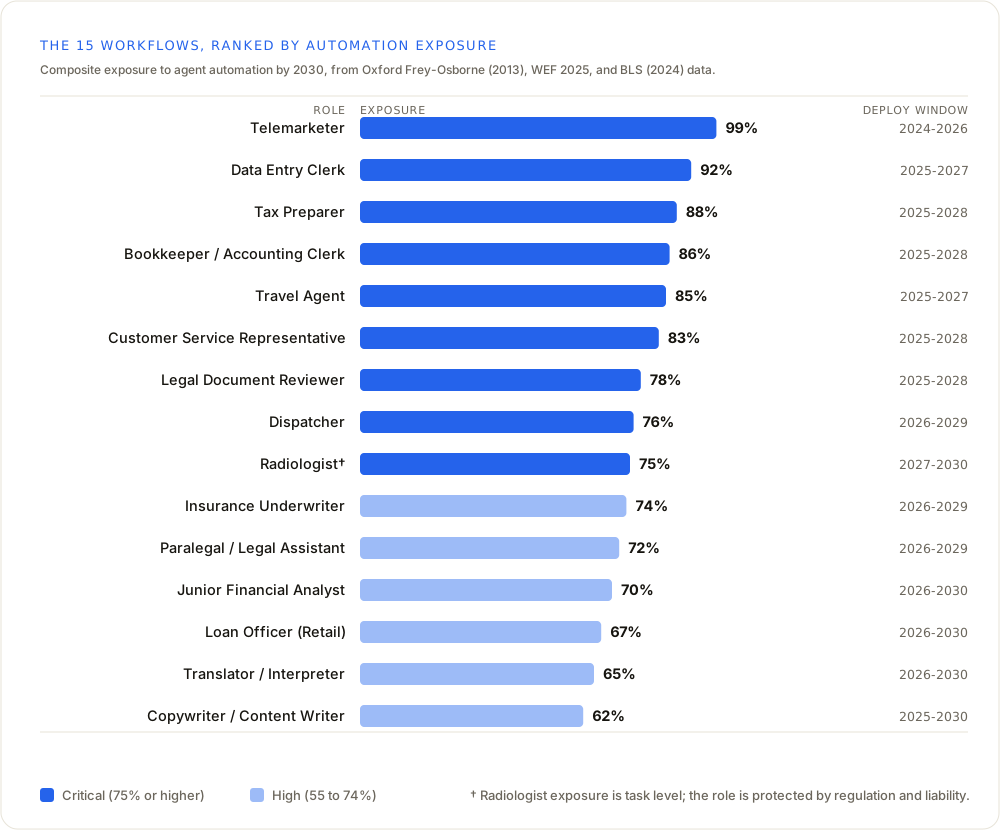
The 15 workflows, ranked
Risk scores are composite estimates from Oxford Frey-Osborne automation-probability work (2013), WEF Future of Jobs 2025, BLS Occupational Outlook (2024 to 2034 projections), and McKinsey task-level automation research. Critical means 75% or higher displacement probability by 2030, High means 55 to 74%, Moderate means 35 to 54%. Worker counts are US, updated to the latest BLS figures where a direct match exists.
Job #01: Data Entry Clerk
Also covers: data processors, administrative clerks, form processors Automation exposure: 92% · Critical US workers: ~3.8 million · Realistic deployment window: 2025-2027 Agent stack: intelligent document processing (IDP) plus an orchestration agent. Examples: Google Document AI, UiPath, Azure Document Intelligence.
The workflow today. Document arrives (email, scan, portal) → read it → identify the fields that matter → key them into the system of record → cross-check against an existing record → flag anything that does not match → mark the item processed.
The same workflow with an agent. Intake automated. Field extraction and classification automated (modern IDP clears 95%+ on structured forms). Write to the system of record automated behind a validation rule. Mismatch and low-confidence items agent-drafted, human-approved. Genuinely novel document types human-owned until the agent has seen enough of them.
What the human keeps. The judgment call on a document that does not fit any template, and the decision about what "good enough confidence" means before an entry posts unreviewed.
Failure modes. The agent extracts a confident but wrong value from a smudged field and it posts silently. Confidence thresholds set too loose and errors compound downstream. A new form layout arrives and accuracy quietly drops with no alert.
What it takes to ship. Connect the document source and the system of record, assemble a labeled sample of real documents, set a confidence gate that routes low-scoring items to a person, roughly 3 to 5 weeks to first production traffic. Measure on straight-through processing rate and error rate on posted entries, not volume.
Headcount reality. This shrinks the rote-keying headcount and shifts what is left toward exception handling and data-quality ownership. It is the clearest "elimination" case in the list.
Job #02: Telemarketer
Also covers: cold callers, appointment setters, script-based outbound reps Automation exposure: 99% (Frey-Osborne, 2013) · Critical US workers: ~500,000 · Realistic deployment window: 2024-2026 Agent stack: conversational voice agents plus a dialer and CRM.
On that 99%. This is the single most-cited number on the original page, and it is a 2013 probability estimate from Frey-Osborne, not a measured outcome. What has borne out: scripted, volume-driven outbound is now routinely run by voice agents. What has not: the number of humans in the role did not fall 99%, because the work shifted into different, higher-touch selling rather than vanishing. Keep the figure, date it, and do not present it as a headcount fact.
The workflow today. Pull a list → dial → deliver the opener → handle the first objection → qualify → book the meeting or log the disposition → repeat at volume.
The same workflow with an agent. List pull and dialing automated. Opener and standard objection handling automated with a script and a confidence threshold. Qualification agent-drafted, with the meeting-booking action automated into the calendar. Anything that turns into a real buying conversation human-owned, handed to a rep the moment intent crosses a line.
What the human keeps. The consultative conversation, the non-standard objection, and the relationship that a book-a-meeting bot cannot carry.
Failure modes. The agent optimizes for dials over quality and burns the list. It fails to disclose it is an AI where law requires disclosure (a compliance landmine). It cannot read that a "maybe" is actually a "never" and wastes follow-up.
What it takes to ship. Voice agent plus dialer plus CRM, a disclosure and consent flow reviewed by counsel, a clean escalation path to a human rep, 2 to 4 weeks. Measure on qualified meetings booked and held, never on dials or "conversations."
Headcount reality. Redeploys rather than eliminates: fewer script-readers, more closers who inherit warmer conversations.
Job #03: Tax Preparer
Also covers: tax associates, seasonal preparers, return processors Automation exposure: 88% · Critical US workers: ~72,000 · Realistic deployment window: 2025-2028 Agent stack: document ingestion plus a tax-logic engine, wired to the filing software. This is a natural fit for a finance agent like Gaper's AccountsGPT.
The workflow today. Collect source documents → classify each (W-2, 1099, receipts) → enter figures → apply the current-year rules → catch deductions and credits → assemble the return → review with the client → file.
The same workflow with an agent. Collection and classification automated. Data entry from documents automated. Rule application and first-pass deduction hunting agent-drafted. Return assembly agent-drafted, human-approved. Client review and sign-off, and any aggressive or ambiguous position, human-owned.
What the human keeps. The judgment on a gray-area position, the client conversation, and the professional liability that comes with signing a return.
Failure modes. The agent applies a rule that changed this filing year. It hallucinates a deduction the client cannot substantiate. It reconciles to the wrong prior-year figure and the error carries forward.
What it takes to ship. Document intake plus the filing platform plus a current tax-rules source, a hard human-approval gate before filing, deployment scoped around a filing season. Measure on returns per preparer and error/amendment rate.
Headcount reality. Compresses seasonal prep labor and pushes the surviving roles toward advisory and review, the higher-value end BLS itself flags as more durable.
Job #04: Travel Agent
Also covers: booking agents, corporate travel coordinators Automation exposure: 85% · Critical US workers: ~46,000 · Realistic deployment window: 2025-2027 Agent stack: a booking agent over GDS/OTA APIs plus a policy layer.
The workflow today. Take the request → search options → compare price, timing, and policy → propose an itinerary → handle changes → book → manage disruptions when a flight cancels.
The same workflow with an agent. Search, comparison, and itinerary drafting automated. Policy-compliant booking automated within guardrails. Complex multi-leg or high-cost trips agent-drafted, human-approved. Live disruption for a VIP or a stranded traveler human-owned.
What the human keeps. The high-stakes disruption at 2am, the complex trip with a dozen constraints, and the relationship with the traveler who wants a person.
Failure modes. It books a non-refundable fare against a policy that forbids it. It cannot rebook creatively during an irregular operation. It optimizes for price and ignores a stated preference.
What it takes to ship. GDS/OTA integration plus the corporate travel policy encoded as rules plus a disruption escalation path, 4 to 6 weeks. Measure on policy-compliant self-service booking rate and traveler satisfaction on exceptions.
Headcount reality. Mostly eliminates transactional booking, keeps a smaller high-touch and disruption-management function.
Job #05: Customer Service Representative
Also covers: support agents, help-desk reps, contact-center staff Automation exposure: 83% · Critical US workers: ~2.8 million (BLS 2024; projected −5% by 2034) · Realistic deployment window: 2025-2028 Agent stack: a support agent over your helpdesk, order/account system, and knowledge base. Buyer's page: AI agents for customer support.
The workflow today. Ticket lands → read history → classify intent → check the order/account system → apply policy → draft a response → escalate or resolve → log the disposition.
The same workflow with an agent. Intake, classification, and system lookup automated. Policy application and response drafting agent-drafted behind a confidence threshold. Refunds above a dollar limit agent-drafted, human-approved. Anything touching a churn-risk account or a legal threat human-owned from first touch.
What the human keeps. The angry enterprise customer, the policy exception that sets precedent, and the pattern recognition that turns 200 tickets into one product-bug report.
Failure modes. The agent deflects instead of resolves and CSAT craters. It confidently quotes a policy that changed last quarter. Escalation routing has no human on the other end at 2am.
What it takes to ship. Helpdesk plus order system plus knowledge-base integration, a cleaned-up policy corpus, an approval gate on refunds, roughly 4 to 6 weeks to first production traffic. Measure on true resolution rate, not deflection rate. If support is where you would start, a free AI assessment scopes it against your ticket data.
Headcount reality. Redeploys: fewer tier-1 agents, more people owning escalations, quality, and the knowledge base the agent depends on.
Job #06: Bookkeeper / Accounting Clerk
Also covers: AP/AR clerks, payroll clerks, junior bookkeepers Automation exposure: 86% · Critical US workers: ~1.6 million (BLS 2024; projected −6% by 2034) · Realistic deployment window: 2025-2028 Agent stack: a finance agent wired to the ledger. Gaper's AccountsGPT (QuickBooks, NetSuite, Xero, Stripe, Plaid). See AI agents for accounting.
The workflow today. Transactions arrive → categorize → reconcile against statements → run AP/AR → chase receivables → flag anomalies → prep the month-end close for the accountant.
The same workflow with an agent. Categorization and reconciliation automated. AP coding and payment scheduling automated within limits. Receivables chasing automated. Anomalies and close entries agent-drafted, human-approved. Anything material or unusual human-owned.
What the human keeps. The judgment on what counts as an anomaly worth stopping for, the relationship with the auditor, and the move up into analysis and planning.
Failure modes. The agent mis-categorizes at scale and the books look clean but are wrong. It executes a payment it should have held. It reconciles to a stale balance.
What it takes to ship. Ledger and bank/payment integrations, guardrails with a human-approval step for anything material, audit logging by default, a scoped first workflow live in about 24 hours with deeper ERP work in the first sprint. Measure on time-to-close and reconciliation exception rate. This is the difference between renting a point tool and owning an agent wired into your actual ledger, with your approval rules. Scope a finance agent in a free assessment.
Headcount reality. Rote bookkeeping shrinks; the durable path, per BLS and WEF both, is the move from record-keeping into financial planning and analysis.
Job #07: Insurance Underwriter
Also covers: risk analysts, policy underwriters (standard lines) Automation exposure: 74% · High US workers: ~107,000 · Realistic deployment window: 2026-2029 Agent stack: a risk-scoring agent over your policy admin system plus third-party data.
The workflow today. Application arrives → pull risk data → run the rating model → apply underwriting guidelines → price the policy → approve, decline, or refer → document the rationale.
The same workflow with an agent. Data pull and rating automated. Standard-lines decisions within appetite agent-drafted, human-approved. Complex, high-limit, or out-of-appetite risks human-owned. Rationale documentation automated as a byproduct.
What the human keeps. The non-standard risk, the appetite decision, and the regulatory defensibility of a decline.
Failure modes. The agent encodes a proxy that creates a discriminatory outcome (a live regulatory exposure). It approves outside appetite because a guideline was ambiguous. Its rationale reads clean but is post-hoc.
What it takes to ship. Policy admin plus rating engine plus third-party data, a fairness and compliance review of the decision logic, a referral path for anything non-standard, 6 to 10 weeks. Measure on cycle time to decision and loss-ratio stability, watched against fairness metrics.
Headcount reality. Standard-lines underwriting compresses; underwriters move toward complex risk and portfolio judgment.
Job #08: Paralegal / Legal Assistant
Also covers: legal assistants, litigation support, junior researchers Automation exposure: 72% · High US workers: ~340,000 · Realistic deployment window: 2026-2029 Agent stack: legal AI plus your document management system. Named tools: CoCounsel (Thomson Reuters), Harvey. Buyer's page: AI agents for legal.
The workflow today. Take the matter → gather documents → research the question → summarize findings → draft the memo or filing → cite-check → hand to the attorney.
The same workflow with an agent. Document gathering and first-pass research automated. Summaries and memo drafts agent-drafted. Cite-checking agent-drafted, human-approved (the sanctions risk from fake citations is real and named in court orders). Legal strategy and the final filing human-owned by a licensed attorney.
What the human keeps. The strategy, the client relationship, the attorney's signature, and the accountability for what is filed.
Failure modes. The agent hallucinates a citation and it reaches a filing (this has produced real sanctions). It misreads jurisdiction. It summarizes confidently past a nuance that changes the answer.
What it takes to ship. Legal-AI platform plus DMS integration, a mandatory human cite-check gate, matter-scoped rollout. Forrester's 2026 TEI study on CoCounsel reported roughly a one-third reduction in time on review, research, and drafting, a useful benchmark, not a promise. Measure on hours per matter and rework/correction rate.
Headcount reality. Junior research and review volume compresses; paralegals move toward case management and client-facing coordination.
Recognize your team's workflow in one of these? That is the moment to scope it, not next quarter. A free AI assessment turns "we should automate this" into a concrete first build, often live in about 24 hours. Book a free AI assessment.
Job #09: Dispatcher (Transportation / Logistics)
Also covers: fleet coordinators, load planners, routing clerks Automation exposure: 76% · Critical US workers: ~255,000 · Realistic deployment window: 2026-2029 Agent stack: a routing/optimization agent over your TMS and telematics.
The workflow today. Orders come in → match loads to vehicles and drivers → optimize routes → dispatch → monitor in transit → re-plan on disruption → confirm delivery.
The same workflow with an agent. Load matching and route optimization automated. Dispatch automated within rules. In-transit monitoring automated with alerting. Disruption re-planning agent-drafted, human-approved. A safety event or a major service failure human-owned.
What the human keeps. The safety call, the relationship with a driver, and the creative fix when the optimal route is blocked.
Failure modes. The agent optimizes for cost and violates hours-of-service or a safety constraint. It cannot handle a cascading disruption. It re-routes into a known problem because the map data was stale.
What it takes to ship. TMS plus telematics integration, safety and compliance constraints encoded as hard limits, a human override for exceptions, 6 to 10 weeks. Measure on on-time delivery and cost per mile, gated on safety compliance.
Headcount reality. Routine dispatch consolidates; humans concentrate on exceptions, safety, and driver relationships.
Job #10: Loan Officer (Retail)
Also covers: mortgage processors, consumer-credit officers Automation exposure: 67% · High US workers: ~290,000 · Realistic deployment window: 2026-2030 Agent stack: a credit-decisioning agent over your loan origination system. Finance-adjacent to AccountsGPT territory.
The workflow today. Application arrives → collect documents → verify income and assets → pull credit → run the decision model → apply lending policy → approve/decline → disclose.
The same workflow with an agent. Document collection and verification automated. Credit pull and model run automated. Standard approvals within policy agent-drafted, human-approved. Anything near a policy edge or requiring judgment human-owned. Compliant disclosures automated.
What the human keeps. The borderline application, the human conversation with an applicant, and the fair-lending accountability.
Failure modes. The model produces a disparate-impact outcome (a named regulatory exposure). It approves on unverified income. Its adverse-action reasons are not defensible.
What it takes to ship. LOS integration plus verification data plus decision model, a fair-lending and adverse-action compliance review, a human gate on edge cases, 6 to 10 weeks. Measure on time-to-decision and pull-through rate, watched on fair-lending metrics.
Headcount reality. Processing shrinks; loan officers move toward complex deals and relationship origination.
Job #11: Junior Financial Analyst
Also covers: reporting analysts, FP&A associates Automation exposure: 70% · High US workers: ~300,000 · Realistic deployment window: 2026-2030 Agent stack: a reporting/analysis agent over your data warehouse and BI. Finance fit: AccountsGPT and custom.
The workflow today. Pull data → clean it → build the model or report → run the variance analysis → write the commentary → format the deck → present to the senior analyst.
The same workflow with an agent. Data pull and cleaning automated. Standard reports and variance analysis automated. Commentary and deck agent-drafted, human-approved. The narrative, the recommendation, and the judgment on what matters human-owned.
What the human keeps. The "so what," the recommendation to leadership, and the sense for when a number is wrong rather than just surprising.
Failure modes. The agent writes confident commentary on a data error. It anchors on a spurious correlation. It formats beautifully and reasons poorly.
What it takes to ship. Warehouse and BI integration, a review gate on anything leadership-facing, 5 to 8 weeks. Measure on cycle time to reporting and analyst time redirected to decision support.
Headcount reality. Grunt-work analysis compresses; the role moves up into decision support faster than juniors used to climb.
Job #12: Radiologist (Diagnostic Imaging)
Also covers: diagnostic radiologists, teleradiology reads Automation exposure: 75% (task-level, not role-level) · High US workers: ~38,000 · Realistic deployment window: 2027-2030 Agent stack: FDA-cleared imaging AI plus PACS worklist integration. This is where Gaper does not have a product, and would not claim to. Named tools: Aidoc, and 1,000+ FDA-cleared radiology algorithms.
The honest version. By March 2026 the FDA had cleared roughly 1,163 radiology AI algorithms, about 76% of all cleared medical AI, at a pace near 30 a month. But they are cleared as assistive or concurrent reading aids, not autonomous readers. In June 2026 the FDA granted Breakthrough Device Designation to a tool that drafts chest X-ray report text, explicitly to hand capacity back to radiologists, not to replace the read. So the exposure here is task-level, not role-level.
The workflow today. Study arrives on the worklist → prioritize → read the images → detect and characterize findings → draft the report → sign → communicate critical results.
The same workflow with an agent. Worklist triage and prioritization automated. Detection and measurement agent-drafted (flags, quantifies, pre-populates). Report drafting agent-drafted, human-approved. The diagnostic read, the sign-off, and critical-result communication human-owned, with clinical and legal liability attached.
What the human keeps. The diagnosis, the ambiguous or rare finding, the liability, and the patient.
Failure modes. Automation bias: the radiologist trusts a confident AND wrong flag. The model misses an out-of-distribution finding it was never trained on. Triage de-prioritizes a subtle emergency.
What it takes to ship. This is a regulated clinical deployment, not a workflow bot: FDA-cleared tools only, PACS integration, clinical validation, and physician oversight by design. Measure on read throughput and diagnostic accuracy with the AI in the loop, never on autonomy.
Headcount reality. Radiologists are not being replaced; their reads are getting faster and their worklists smarter. The realistic 2030 outcome is more studies read per radiologist, not fewer radiologists.
Job #13: Legal Document Reviewer
Also covers: e-discovery reviewers, contract reviewers, compliance reviewers Automation exposure: 78% · Critical US workers: ~48,000 · Realistic deployment window: 2025-2028 Agent stack: legal-AI review plus your DMS/e-discovery platform. Buyer's page: /ai-agents-for-legal.
The workflow today. Receive the document set → set review criteria → read each document → classify (responsive, privileged, relevant) → tag and code → escalate close calls → produce the reviewed set.
The same workflow with an agent. First-pass classification and tagging automated. Privilege and responsiveness calls agent-drafted, human-approved. Close calls and anything privileged human-owned. Production packaging automated.
What the human keeps. The privilege judgment, the close call, and the accountability for a bad production.
Failure modes. The agent mis-codes a privileged document into a production (a serious, sometimes non-recoverable error). It applies criteria inconsistently across a large set. It is confidently wrong on a subtle relevance call.
What it takes to ship. Review platform integration, a human QC gate on privilege and on a statistical sample of the whole set, matter-scoped rollout, 4 to 8 weeks. Measure on documents per hour and privilege error rate on QC.
Headcount reality. First-pass review volume compresses hard; the surviving work is QC, privilege, and strategy.
Job #14: Copywriter / Content Writer
Also covers: content marketers, SEO writers, junior copy Automation exposure: 62% · High US workers: ~140,000 · Realistic deployment window: 2025-2030 Agent stack: a content agent over your CMS and brand guidelines. Marketing-ops adjacent to Gaper's Stefan. Page: /ai-agents-for-marketing.
The workflow today. Take the brief → research → outline → draft → edit for brand and accuracy → optimize → publish → measure.
The same workflow with an agent. Research and outline automated. First draft agent-drafted. Optimization automated. Brand voice, factual accuracy, and the final call human-owned. Publishing automated once approved.
What the human keeps. Taste, the point of view, factual accountability, and the judgment about what is worth saying at all.
Failure modes. The agent produces fluent, generic, on-brand-shaped content that says nothing and ranks for nothing. It states a fact that is wrong. It cannot tell a strong idea from a safe one.
What it takes to ship. CMS integration plus a brand and style corpus plus a human editorial gate, 3 to 5 weeks. Measure on content that performs (engagement, ranking, conversion), not volume shipped.
Headcount reality. Volume drafting compresses; the role moves toward editing, strategy, and originality, the parts an agent cannot fake.
Job #15: Translator / Interpreter
Also covers: document translators, localization specialists Automation exposure: 65% · High US workers: ~76,000 · Realistic deployment window: 2026-2030 Agent stack: a translation agent plus a human-in-the-loop review layer.
The workflow today. Receive the source → translate → adapt for culture and context → review for accuracy → handle domain-specific terms → deliver → certify where required.
The same workflow with an agent. Bulk translation automated. Cultural and contextual adaptation agent-drafted, human-approved. High-stakes (legal, medical, certified) work human-owned. Live interpretation of nuance and emotion human-owned.
What the human keeps. The high-stakes translation where a wrong word has consequences, the cultural nuance, and certified/legal work.
Failure modes. The agent produces a fluent translation that misses a legally material nuance. It mistranslates a domain term. It cannot carry tone in a sensitive context.
What it takes to ship. Translation engine plus a human-review workflow plus domain glossaries, a certification gate where required, 3 to 6 weeks. Measure on words per reviewer and error rate on review.
Headcount reality. Bulk translation compresses; humans concentrate on high-stakes, certified, and live interpretation.
Displacement risk by industry sector
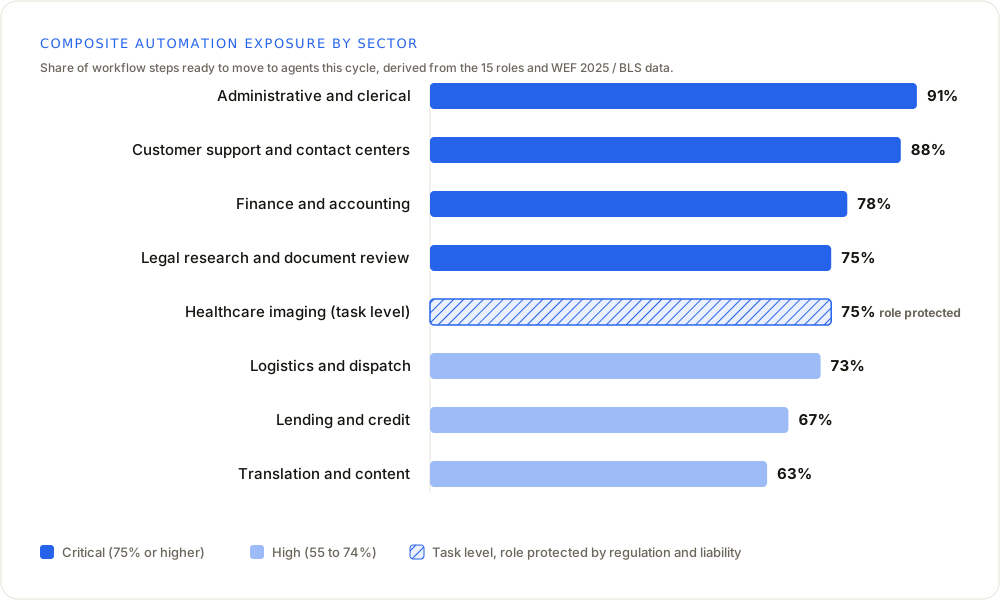
Exposure is not evenly spread. Based on the 15 roles above and the underlying WEF and BLS data, the sectors with the most workflow steps ready to move to agents this cycle are:
- Administrative and clerical, ~91%: highest. Data entry, bookkeeping, and processing are the WEF 2025 steepest-decliners.
- Customer support and contact centers, ~88%: very high, already in production at scale.
- Finance and accounting, ~78%: high in transactional and reporting work, durable in advisory.
- Legal research and document review, ~75%: high, gated hard by the human-approval and sanctions risk.
- Healthcare imaging, ~75% at the task level: the role is protected by regulation and liability.
- Logistics and dispatch, ~73%: high but slower, gated by safety compliance.
- Lending and credit, ~67%: high, gated by fair-lending compliance.
- Translation and content, ~63%: high, gated by the human-owned high-stakes work.
Numbers are composite estimates from the 15 roles above plus WEF Future of Jobs 2025 and BLS (2024) data.
Which skills survive AI disruption (for the individual)
This section is for the person in one of these 15 roles. It is shorter than it used to be, but it is not gone, because the honest answer matters.
The pattern across all 15 teardowns is the same: the automated column is execution, and the human-owned column is judgment, relationship, and accountability. So the skills that survive are the ones in that second column.
Strategic and advisory work
The move from doing the task to deciding what the task should be. A bookkeeper who becomes the person who reads the anomalies, a preparer who becomes an advisor, an analyst who owns the recommendation. AI compresses execution and raises the premium on judgment.
Relationship and communication-intensive work
The angry enterprise customer, the borderline loan applicant, the patient, the client who wants a person. Trust does not transfer to a bot, and the roles that own trust are the durable ones.
Concretely: learn to supervise agents, not compete with them. The people who thrive in these functions in 2030 are the ones who own the approval gate, the exceptions, and the metric, not the ones who do the step the agent now does.
If you are in one of these roles, the practical next step is to understand how these agents actually work. Start with how to become AI-native and what an AI agent is and how it differs from a chatbot.
Will Robots Take Over These Jobs? Physical Robots vs Software AI
Not one of the 15 workflows above is a robot story. Robots go to factories. In 2024, electronics took 24 percent of global industrial robot installations and automotive took 23 percent (IFR World Robotics 2025).
The scale is also smaller than the headlines suggest. Worldwide installations reached 542,076 units in 2024, below the 2022 record of 552,946 (IFR). The number has been roughly flat for four years.
Capital explains the gap, but the two sides are measured differently, so read them carefully. US businesses spent $12,960 million on robotic equipment in 2022, which was 1.1 percent of all equipment spending that year (US Census ACES). That is a share of dollars.
The software figure is a share of firms, and it is four years newer. Among US firms with 250 or more employees, 37 percent reported using AI (US Census BTOS). Across all businesses it was 17 to 20 percent. That survey was collected between December 2025 and May 2026.
Different units, different years, same direction.
Which jobs physical robots actually reach
Cashiers are the one large-scale physical displacement in the US data. BLS projects a loss of 200,600 jobs, a 6 percent decline, and names self-service checkout stands and online sales as the cause (BLS).
Assemblers and fabricators are next, and the direction is still up. BLS projects 1 percent growth on 1,799,500 jobs, with collaborative robots reducing demand for some tasks rather than removing the occupation (BLS).
Warehouse material handling barely moves. Hand laborers and material movers are projected to grow 4 percent from 2025 to 2035 (BLS). Warehouse robots arrived, and warehouse work still grew.
Farm work shifts rather than disappears. Agricultural workers decline 2 percent on 831,900 jobs, and BLS expects mechanisation to move people into equipment operator roles (BLS). Only about 19,500 agricultural robots sold worldwide in 2024, a 6 percent contraction (IFR).
That list is short, and there is a reason. Frey and Osborne wrote in September 2013 that "Robots are still unable to match the depth and breadth of human perception." Perception and manipulation were their first engineering bottleneck, and they judged it unlikely to be resolved within a decade or two (Oxford Martin, 2013).
Production occupations overall show the result. BLS projects little or no change in production employment from 2025 to 2035, in the most robot-saturated sector on earth (BLS).
Why robot timelines run long
Amazon took twelve years to put one million robots across more than 300 facilities (Amazon). That is the best-resourced deployer on earth.
A software agent reaches the same desk without a floor plan, a vision rig or an integrator. No published source measures how long that takes. Treat any figure you read, including ours, as a vendor commitment rather than a finding.
Amazon also reports that its advanced robotics sites need 30 percent more employees in reliability, maintenance and engineering roles (Amazon). That is a company claim about its own sites, not an independent study.
The declines sit elsewhere. BLS attributes softer labor demand in sales, design and administrative support to AI software, including generative tools (BLS Monthly Labor Review).
So the honest answer is a split. Robots change assembly lines, warehouses and checkout counters. Software changes desks. Data entry, tax prep, underwriting, paralegal work and copywriting are desk jobs.
Jobs AI Will Not Replace by 2030
The group least reachable by generative AI is the fastest growing group in the economy. Healthcare support grows 13.3 percent through 2035, faster than any of the 22 major occupational groups (BLS Employment Projections).
Microsoft Research scored that same group lowest of all 22 on AI applicability, at 0.05, covering 7,063,540 workers (Microsoft Research).
That score is measured, not forecast. It comes from 200,000 real Bing Copilot conversations. Exposure tracks desk work. The paper finds only a weak link to pay. The link to education is small but real. Occupations needing a Bachelor's degree average 0.27, against 0.19 for those below it (Microsoft Research).
The highest scores sit in sales, computer and administrative roles. One limit matters, and the authors state it plainly: "Note that our measurement is purely about LLMs: other applications of AI could certainly affect occupations involving operating and monitoring machinery, such as truck driving."
Two of the sources below predate generative AI. Frey and Osborne published on September 17 2013, using a Gaussian work classifier over 702 occupations. Their probabilities are estimates from that method, not measured outcomes, and every figure below carries the year.
Nurse Practitioners and Registered Nurses
Nurse practitioners are the single fastest growing US occupation for 2025 to 2035, at 41.0 percent (BLS Table 1.3). Registered nurses add 194,700 jobs over the same decade, a 5.6 percent rise (BLS Table 1.4).
Frey and Osborne ranked registered nurses 46th of 702 occupations, at 0.009 probability of computerisation (Oxford Martin, 2013). Low exposure and high absolute growth, in one job.
Home Health and Personal Care Aides
This occupation adds 847,300 jobs by 2035, more than any other in the US (BLS Table 1.4). Median pay is $35,800. Safe does not mean well paid, and hiding that would be dishonest.
Ophthalmic Medical Technicians and Massage Therapists
Two occupations appear on both the BLS fastest growing list and Microsoft's lowest applicability list. Ophthalmic medical technicians score 0.01 (Microsoft Research) and are projected to grow 21.4 percent (BLS Table 1.3).
Massage therapists score 0.01 (Microsoft Research) and grow 15.3 percent (BLS Table 1.3). Two independent methods, asking opposite questions, reach the same answer.
Therapists and Therapy Assistants
Frey and Osborne rank recreational therapists safest of all 702 occupations, at 0.0028 (Oxford Martin, 2013). Occupational therapists sit at 0.0035, audiologists at 0.0033.
BLS projects physical therapist assistants up 23 percent and occupational therapy assistants up 21 percent (BLS). The work is hands on a body.
Mental Health and Social Work Roles
Mental health and substance abuse social workers rank fourth safest of 702, at 0.0031 (Oxford Martin, 2013). Healthcare social workers sit at 0.0035 in the same 2013 ranking.
Microsoft found low impact scope for tasks involving outside people, such as conferring with clients and verifying personal information (Microsoft Research). The boundary is answerability to another human, not difficulty.
Electricians, Solar Installers and Wind Turbine Technicians
Some of this demand is downstream of AI. BLS expects electricity demand to rise, in part because of AI and the data centres behind it. It links job growth in that industry to power generation, transmission and distribution (BLS).
Solar and wind growth is a separate build-out story.
Solar photovoltaic installers grow 37 percent, wind turbine service technicians 30 percent, and industrial machinery mechanics 18 percent (BLS). Electricians add 75,900 jobs, a 9.2 percent rise (BLS Table 1.4).
Water Treatment Operators and Machinery Roles
Water treatment plant and system operators score 0.00 on Microsoft's AI applicability scale, the floor (Microsoft Research). A language model cannot open a valve. The LLM-only caveat above still applies here.
Data Scientists and Information Security Analysts
Safe does not mean low-tech. Data scientists grow 34.6 percent and information security analysts 21.0 percent (BLS Table 1.3).
Both sit in Computer and Mathematical, the second highest scoring of Microsoft's 22 occupational groups at 0.30, behind Sales and Related at 0.32 (Microsoft Research). Both are growing far above the 3.5 percent all-occupations rate. Exposure and growth are not opposites.
AI Replacement Risk by Job Title
This table uses a different scale from the teardowns above. The bands here are Critical, High and Moderate, matching the page's own vocabulary. They are drawn from BLS employment projections and measured task overlap. They are not the percentage exposure scores used in the 15 workflow sections.
Three rows are marked physical because the automation reaching them is hardware, not AI software.
| Job title | Exposure band | What automation does today | What stays human |
|---|---|---|---|
| Telemarketers | Critical | Dials, scripts, qualifies, logs the call | Complex objection handling, relationship accounts |
| Data entry keyers | Critical | Reads documents, types the record, flags mismatches | Exception review, source disputes |
| Tax preparers | Critical | Extracts forms, applies rules, drafts the return | Signature, representation, judgment calls |
| Bookkeeping and accounting clerks | Critical | Codes transactions, reconciles, closes the month | Controls, audit defence, fraud judgment |
| Customer service representatives | Critical | Answers tier one, refunds, updates records | Angry, unusual and high-value cases |
| Legal document reviewers | Critical | First-pass review, clause extraction, issue flags | Privilege calls, strategy, sign-off |
| Dispatchers, except police, fire, and ambulance | Critical | Assigns, routes, updates ETAs | Crisis rerouting, safety calls |
| Word processors and typists | High | Drafts, formats, versions, proofs | Final sign-off on legal wording |
| Telephone operators | High | Routes, transcribes, answers first contact | Escalations and distress calls |
| Switchboard operators | High | Routes calls and logs messages | Site knowledge, judgment on urgency |
| File clerks | High | Classifies, indexes, retrieves | Records retention decisions |
| Payroll and timekeeping clerks | High | Calculates runs, reconciles hours, files reports | Pay disputes, policy exceptions |
| Order clerks | High | Enters, confirms and tracks orders | Disputes, supply exceptions |
| Insurance underwriters | High | Scores risk, pulls data, drafts the decision | Edge-case declines, appeals, regulator contact |
| Loan officers | High | Collects documents, scores files, drafts terms | Adverse action explanations, exceptions |
| Office clerks, general | High | Schedules, files, drafts routine correspondence | Physical office work, discretion |
| Secretaries and administrative assistants | High | Calendars, inboxes, meeting notes, travel | Gatekeeping, trust, in-person support |
| Interpreters and translators | High | Draft translation at volume and speed | Certification, nuance, live legal and medical work |
| Paralegals and legal assistants | High | First-pass document review, citation checks, drafts | Privilege calls, attorney supervision, client contact |
| Copywriters and content writers | High | First drafts, variants, briefs, meta text | Positioning, original reporting, legal claims |
| Travel agents | High | Search, itineraries, rebooking, confirmations | Complex trips, disruption handling, duty of care |
| Junior financial analysts | High | Model building, variance notes, deck drafts | Assumptions, judgment, presenting to the board |
| Cashiers (physical) | High | Self-service checkout hardware and online ordering | Age checks, theft, service recovery |
| Graphic designers | Moderate | Layout variants, resizing, asset production | Brand direction, art direction, client work |
| Sales representatives | Moderate | Research, outreach drafts, CRM hygiene, follow-up | Negotiation, trust, complex deals |
| Software developers | Moderate | Code generation, tests, review comments, docs | Architecture, ownership, on-call judgment |
| Data scientists | Moderate | Query writing, cleaning, first-pass analysis | Problem definition, causal reasoning, defence of results |
| Information security analysts | Moderate | Alert triage, log summarisation, drafting reports | Incident command, threat calls, disclosure |
| Radiologists | Moderate | Worklist triage, detection flags, draft report text | The diagnostic read, the sign-off, critical-result communication |
| Assemblers and fabricators (physical) | Moderate | Collaborative robots on repeatable stations | Fine assembly, changeovers, quality judgment |
| Agricultural workers (physical) | Moderate | Automated tractors, robotic harvesters, irrigation | Field judgment, livestock, irregular terrain |
| Registered nurses | Low | Charting, handover summaries, scheduling | Assessment, procedures, patient presence |
| Nurse practitioners | Low | Documentation and reference lookup | Diagnosis, prescribing, examination |
| Home health and personal care aides | Low | Scheduling and care-plan paperwork | Bathing, mobility, companionship |
| Nursing assistants | Low | Shift notes and vitals logging | Lifting, turning, bedside care |
| Phlebotomists | Low | Label printing, order management | Venipuncture on a real arm |
| Ophthalmic medical technicians | Low | Records and pre-visit intake | Imaging, measurement, patient handling |
| Massage therapists | Low | Booking, notes, marketing | The entire treatment |
| Physical therapist assistants | Low | Exercise plan drafting, progress notes | Hands-on therapy, gait work, motivation |
| Occupational therapy assistants | Low | Documentation and plan tracking | In-person rehabilitation, home assessment |
| Recreational therapists | Low | Program paperwork | Group facilitation, behavioural judgment |
| Mental health and substance abuse social workers | Low | Notes, referrals, resource lookup | Counselling, risk assessment, crisis response |
| Water treatment plant and system operators | Low | Monitoring dashboards and reporting | Valves, sampling, plant response |
| Roofers | Low | Estimates and scheduling | Every part of the roof |
| Electricians | Low | Quoting, code lookup, scheduling | Wiring, inspection, fault finding |
| Wind turbine service technicians | Low | Diagnostics and maintenance logs | Climbing, repair, torque work |
Critical and High bands come first from BLS projected declines through 2035. Word processors fall 34.4 percent, data entry keyers 25.5 percent and telemarketers 21.4 percent. Order clerks fall 17.5 percent, payroll clerks 15.9 percent and file clerks 15.8 percent (BLS Table 1.5).
The largest absolute declines corroborate them. Cashiers lose 200,600 jobs, office clerks 156,200 and customer service representatives 141,800. Secretaries lose 114,100 and bookkeeping clerks 85,600 (BLS Table 1.6).
Some High rows are not projected to shrink but show the heaviest measured task overlap. Interpreters and translators top Microsoft's list at 0.49 while BLS projects 2 percent growth, and paralegals sit at 0.94 in Frey and Osborne (2013) against a flat BLS projection. High means the workflow is reachable, not that the headcount is falling.
Sales, design and copywriting rows rest on the federal attribution instead. BLS names "sales, design, and administrative support" as the fields where AI adoption is expected to dampen labor demand (BLS Monthly Labor Review). Software developers are banded on growth, at 174,700 added jobs and 10.2 percent (BLS Table 1.4).
Low bands come from two independent sources that agree. Microsoft's measured scores put care, cleaning and machinery roles at 0.00 to 0.05 (Microsoft Research).
Frey and Osborne (2013) put therapy, nursing and social work at 0.0028 to 0.009 of 702 occupations (Oxford Martin, 2013).
Some rows carry no score in either study, such as electricians and wind turbine technicians. Those are banded on BLS projected growth alone.
Growth and exposure are independent. A fast-growing occupation can still have a high share of automatable tasks. That is why data scientists and information security analysts appear both in the safe section above and at Moderate here.
No percentage of "replacement" is given for any row, because no published source measures that. Bands reflect projected employment change and measured task overlap, nothing more.
One more calibration from the same agency: "The historical record does show that technology impacts occupations, but that these technological changes tend to be gradual and not sudden" (BLS).
PLACEMENT
Insert all three sections between the existing "Which skills survive AI disruption" H2 and the "How Gaper shows up" section, strictly above the "Frequently asked questions" heading. Content placed after an FAQ heading is discarded by the template and never renders. Verify on the rendered route, not the markdown.
How Gaper shows up
Gaper is an AI-native implementation partner. We build and deploy supervised production agents that you own, running in your stack, on your data, with your approval rules, and we help your organization become AI-native. We are not a marketplace selling engineers and not a vendor selling seats.
Across these 15 functions, that shows up in three honest ways:
- Where we have a product, we say so. AccountsGPT runs the finance workflows above (bookkeeping, tax prep, junior analysis, lending-adjacent) wired to your ledger, live in about 24 hours for a first scoped workflow. Stefan covers marketing-ops and content operations. Our industry pages for customer support and legal map to those teardowns.
- Where we do not have a product, we build one to fit. Data entry, underwriting, dispatch, translation: there is no off-the-shelf Gaper agent, so we build a supervised one into your systems and hand you ownership.
- Where we would not claim to help, we do not. Diagnostic radiology is a regulated clinical read. We are not in that business, and this page will not pretend otherwise.
The recurring decision under all of this: rent the agent or own it. For a narrow, common workflow, a point tool may be the right rent. For a workflow that touches your systems of record, your data, and your risk, owning a supervised agent is usually the better call, because you can change it, audit it, and keep the leverage.
We deploy supervised agents into your own stack, on your data, wired to the systems these workflows already run on (QuickBooks, NetSuite, Epic, Greenhouse, your helpdesk), with a human approval gate on anything material. A first scoped workflow is often live in about 24 hours, and you own the agent.
Book a free AI assessment and we will map which of these workflows is the highest-leverage place to start, and scope the smallest thing worth shipping. Free, 30 minutes, no obligation. Or talk to an AI architect if you want to go straight to the technical shape of it.
Frequently asked questions
Which job has the highest AI automation probability in this list?
Which skills are expected to survive AI disruption through 2030?
What is the difference between job elimination and job transformation?
Why are bookkeepers at higher automation risk than accountants?
How long does it actually take to deploy an agent for one of these workflows?
Should we build a custom agent or buy an off-the-shelf tool?
What happens to the team when we automate one of these functions?
What compliance review does this need?
How do we know the automation is actually working?
How do we keep a human in the loop without losing the efficiency?
What jobs will AI not replace by 2030?
Which jobs are safest from AI and robots?
What jobs will robots take over by 2030?
Will AI replace nurses and healthcare workers?

Ready to turn AI into execution?
Book a free assessment of one workflow. We map it, make an honest build versus buy call before any code, and if an off the shelf product covers the job we will tell you so.