
Philadelphia

Hire top developers in Philadelphia, Pennsylvania through Gaper’s intelligent matchmaking platform.
Key Takeaways
- Philadelphia's tech ecosystem spans healthcare/pharma, fintech, edtech, enterprise software - each with distinct developer needs
- Deploy complete development teams without months of traditional hiring friction
- Leverage Gaper's AI agents (Agent Kelly, AccountsGPT, Agent James, Agent Stefan) alongside human developers for hybrid project delivery
- City-specific expertise across healthcare/pharma, fintech, and more for Philadelphia, Pennsylvania businesses
How It Works
1
Share Your Requirements
Tell us about your project, tech stack, and team size. Takes under 5 minutes.
➔
2
Review Matched Developers
Get a curated shortlist of Philadelphia-ready engineers.
➔
3
Start Building
Onboard your team and begin development. No long-term contracts required.
| Factor | Local Philadelphia Hire | Gaper |
|---|---|---|
| Matching Process | Internal interviews | AI-matched to your stack |
| Contract Flexibility | Full-time commitment | Flexible (weekly/monthly) |
| Scaling Speed | Weeks per developer | Add devs in 48 hours |
| Estimated Annual Savings | Baseline | Save 60-70% on dev costs |
Healthcare/pharma companies in Philadelphia require developers with deep understanding of industry-specific compliance requirements, data security standards, and domain workflows. Gaper's vetting process includes industry-specific technical assessments to ensure every engineer meets these specialized demands.
Why Philadelphia is Becoming a Major Tech Hub for Software Development
Philadelphia's transformation from an industrial powerhouse to a thriving technology center has been nothing short of remarkable. The city now ranks among the top 15 tech ecosystems in the United States, with over 2,000 tech companies calling the region home. This growth has created an unprecedented demand for skilled software developers, making Philadelphia one of the most competitive markets for tech talent in the country.
The city's strategic location between New York and Washington D.C. provides unique advantages for businesses seeking software development talent. Companies can access East Coast markets while enjoying significantly lower operational costs compared to Silicon Valley or Manhattan. Major corporations like Comcast, Independence Blue Cross, and Urban Outfitters have established substantial tech operations in Philadelphia, creating a ripple effect that attracts startups and mid-market companies looking for experienced developers.
However, this rapid growth has created a significant challenge: the local talent pool cannot keep pace with demand. While Philadelphia is home to excellent universities like the University of Pennsylvania, Drexel University, and Temple University, the competition for skilled developers has driven salaries to unprecedented levels. Many companies find themselves paying $120,000+ for mid-level developers, with senior talent commanding $160,000 or more annually. This is where solutions like Gaper.io's AI implementation platform become invaluable, providing production AI agents that handle routine tasks so human developers can focus on strategic initiatives.
The healthcare and fintech sectors, in particular, have seen explosive growth in Philadelphia. With major health systems like Penn Medicine and Jefferson Health investing heavily in digital transformation, the demand for developers with healthcare experience has skyrocketed. Similarly, the presence of financial institutions and emerging fintech startups has created specialized demand for developers with regulatory compliance knowledge and financial services experience.
The Hidden Costs of Hiring Software Developers in Philadelphia
When Philadelphia businesses calculate the cost of hiring software developers, they often focus solely on salary figures -a critical mistake that can lead to budget overruns and project delays. The true cost of hiring a full-time developer in Philadelphia extends far beyond the base compensation, encompassing recruitment, benefits, infrastructure, and the significant hidden expenses that many companies overlook until it's too late.
Recruitment alone can cost between $15,000 to $25,000 per developer hire when factoring in recruiter fees, job board postings, interview time, and the opportunity cost of vacant positions. Philadelphia's competitive market means the average time-to-fill for a software developer position is 42 days, during which projects stall and deadlines slip. Benefits packages for competitive positions typically add another 25-30% to the base salary, including health insurance, retirement contributions, paid time off, and professional development allowances.
Infrastructure costs present another significant expense that companies frequently underestimate. Each developer requires hardware ($3,000-$5,000 initially, then $1,500 annually for upgrades), software licenses ($2,000-$8,000 annually depending on tools), office space ($12,000-$18,000 annually in Philadelphia's tech corridors), and IT support. For a mid-level developer earning $120,000 annually, these additional costs can push the true employment cost to $180,000-$200,000 per year.
The scalability challenge compounds these issues. Philadelphia startups often need to rapidly scale their development teams during funding rounds, then potentially downsize based on market conditions. Traditional hiring models make this expensive and disruptive. Forward-thinking companies are turning to hybrid models that combine selective full-time hires with on-demand access to elite talent through platforms like Gaper.io. This approach allows businesses to stand up project teams while using AI agents to handle routine tasks, creating significant cost savings without compromising quality.
Need Philadelphia-Ready Developers Fast?
Access engineers with local industry expertise.
- Healthcare/pharma: Specialized developers with domain expertise in healthcare/pharma for Philadelphia businesses
- Fintech: Specialized developers with domain expertise in fintech for Philadelphia businesses
- Edtech: Specialized developers with domain expertise in edtech for Philadelphia businesses
- Enterprise software: Specialized developers with domain expertise in enterprise software for Philadelphia businesses
- Cross-industry: Full-stack, DevOps, and cloud architects available for any Philadelphia project
Navigating Philadelphia's Competitive Developer Market: Strategies That Work
Philadelphia's software development market has become increasingly sophisticated, requiring companies to adopt strategic approaches that go beyond traditional recruitment methods. The most successful businesses in the region have learned to combine multiple talent acquisition strategies, leveraging both local resources and innovative platforms to build world-class development teams efficiently and cost-effectively.
The local talent landscape is dominated by graduates from prestigious institutions, creating both opportunities and challenges. University of Pennsylvania and Drexel University produce highly skilled computer science graduates, but these candidates often have multiple offers from major corporations and well-funded startups. Smaller companies and early-stage startups frequently find themselves priced out of this market or unable to compete with the comprehensive benefits packages offered by established players.
Successful Philadelphia companies have developed a three-pronged approach to talent acquisition. First, they maintain relationships with local universities through internship programs, hackathons, and guest lectures, creating pipelines for junior talent. Second, they participate actively in Philadelphia's vibrant tech community through meetups, conferences, and organizations like Philly Startup Leaders and Tech Philly. Third, and most importantly, they supplement their core teams with on-demand access to senior talent through carefully selected partners.
The rise of remote and hybrid work models has fundamentally changed the dynamics of Philadelphia's tech market. Companies can now access global talent pools while maintaining their Philadelphia headquarters, but this requires new approaches to team management, project coordination, and quality assurance. The most effective solution combines the stability of local leadership with the flexibility of distributed teams, supported by AI-powered tools that streamline communication and project management.
This is where Gaper.io's model becomes particularly powerful for Philadelphia businesses. Rather than competing for the same limited pool of local talent, companies can reach specialized engineers globally. The platform's AI agents handle routine tasks like project scheduling, initial code reviews, and documentation, allowing human developers to focus on complex problem-solving and innovation. This hybrid approach has enabled Philadelphia startups to compete effectively with much larger companies while maintaining lean operational structures.
Traditional recruiting methods - posting jobs, screening resumes, conducting multiple interview rounds, negotiating offers, and onboarding - can take 3-6 months for senior positions. In fast-moving markets, this timeline often means losing competitive advantages or missing critical project deadlines.
Industry-Specific Development Needs in Philadelphia's Market
Philadelphia's diverse economic landscape creates unique software development requirements across multiple industries, each demanding specialized expertise and domain knowledge. Understanding these sector-specific needs is crucial for businesses looking to build effective development teams and compete successfully in their respective markets.
The healthcare sector dominates Philadelphia's tech landscape, with major health systems like Jefferson Health, Penn Medicine, and Children's Hospital of Philadelphia driving significant innovation in medical technology. Healthcare software development requires deep understanding of HIPAA compliance, HL7 standards, electronic health record integration, and patient data security protocols. Developers working in this space must navigate complex regulatory requirements while building user-friendly interfaces for medical professionals. The demand for developers with healthcare experience has created a premium market where specialized talent commands 20-30% higher salaries than general software development roles.
Financial services represent another critical sector, with companies ranging from established institutions to innovative fintech startups. These organizations require developers skilled in regulatory compliance frameworks, payment processing systems, fraud detection algorithms, and high-frequency trading platforms. The technical complexity of financial software, combined with strict regulatory oversight, makes finding qualified developers particularly challenging. Many Philadelphia financial services companies struggle to balance the need for experienced talent with budget constraints, especially when competing against New York-based firms.
The education technology sector has exploded in Philadelphia, driven by the presence of major universities and a growing number of EdTech startups. These companies need developers who understand learning management systems, student information systems, accessibility standards, and educational content delivery platforms. The unique requirements of educational software -including the need to serve diverse user groups from students to administrators -require developers with both technical skills and educational domain expertise.
Manufacturing and logistics companies in Philadelphia are increasingly investing in digital transformation initiatives, requiring developers skilled in IoT integration, supply chain management systems, and industrial automation. These projects often involve legacy system integration and require developers comfortable working with both modern web technologies and older enterprise systems. The challenge lies in finding developers who can bridge the gap between traditional manufacturing processes and modern software architecture, a specialized skill set that commands premium rates in the Philadelphia market.
The three dominant team models each carry distinct advantages for Philadelphia businesses: Book a free AI assessment
- Remote-first teams: Access to global talent pools, lower overhead costs, and 24/7 development cycles across time zones
- Hybrid models: Combine on-site collaboration with remote flexibility for the best of both worlds
- On-site teams: Ideal for projects requiring intensive collaboration, security compliance, or client-facing roles
Building Scalable Development Teams: Philadelphia Success Stories
Philadelphia's most successful companies have mastered the art of building development teams that can scale efficiently with business growth while maintaining high code quality and innovative capacity. These organizations have learned to balance the benefits of local talent with strategic use of distributed teams, creating hybrid models that deliver exceptional results at sustainable costs.
One prominent Philadelphia healthcare startup faced the challenge of scaling from 3 to 15 developers in six months to meet regulatory deadlines for their medical device software. Traditional hiring would have required 6-8 months and significant investment in recruitment, training, and infrastructure. Instead, they adopted a hybrid model, hiring 2 senior local developers as team leads while augmenting their capacity with specialized remote developers experienced in medical device regulations and FDA compliance processes. This approach allowed them to meet their deadlines while building internal expertise for long-term sustainability.
A Center City fintech company provides another compelling example of strategic team scaling. Facing pressure from investors to accelerate product development while maintaining strict security standards, they needed to add specialized blockchain developers and cybersecurity experts -roles extremely difficult to fill locally. Rather than relocating to a larger tech hub or accepting significant delays, they created a distributed team structure with local product managers and architects working alongside remote specialists. The key to their success was implementing robust project management tools and establishing clear communication protocols that ensured seamless collaboration across time zones.
The education technology sector offers particularly interesting case studies in team scaling. A Philadelphia-based EdTech startup serving K-12 schools needed to rapidly expand their development capacity during the COVID-19 pandemic as demand for their platform increased by 400%. They couldn't afford the 3-6 month hiring cycle for traditional recruitment, nor could they risk compromising quality with inexperienced developers. Their solution involved partnering with platforms that provide vetted talent and AI-powered project management tools.
What these success stories have in common is the strategic use of technology platforms that provide immediate access to specialized talent while maintaining quality standards. Gaper.io has played a crucial role in many Philadelphia scaling success stories, providing companies with access to engineers who can integrate seamlessly with existing teams. The platform's AI agents handle routine tasks like code formatting, basic testing, and documentation, allowing human developers to focus on complex problem-solving and innovation. Companies report being able to scale their effective development capacity by 200-300% while reducing per-project costs by 40-60% compared to traditional hiring models.

Agent Kelly
Healthcare scheduling automation - ideal for Philadelphia's healthcare/pharma companies

AccountsGPT
Financial automation and reporting - built for Philadelphia's fintech sector

Agent James
HR and recruitment automation for companies scaling in Philadelphia

Agent Stefan
Marketing ops and campaign automation for Philadelphia's enterprise software businesses
- Recruiting fees: Agency commissions, job board postings, and internal recruiter time add up to $15K-$30K per hire
- Onboarding overhead: Training period, equipment, software licenses, and reduced productivity during ramp-up
- Operational costs: Office space, benefits, management overhead, and HR administration
- Risk costs: Failed hires compound all of the above - and 30% of new hires leave within the first year
Technology Stack Trends and Expertise Demands in Philadelphia
Philadelphia's technology ecosystem reflects a sophisticated blend of enterprise-grade stability and cutting-edge innovation, creating specific demands for development expertise that vary significantly across industries and company stages. Understanding these technology trends is essential for businesses looking to build competitive development teams and stay ahead of market demands.
React and Node.js continue to dominate Philadelphia's web development landscape, particularly among startups and mid-market companies building customer-facing applications. However, the enterprise sector shows strong preference for Angular and .NET frameworks, reflecting the influence of large corporations and their established technology stacks. This creates an interesting dynamic where developers with enterprise experience command premium rates, while those focused on startup technologies face more competition but also more opportunities for rapid career growth.
Cloud infrastructure expertise has become non-negotiable across all sectors, with AWS maintaining the largest market share in Philadelphia's enterprise segment, followed closely by Microsoft Azure. Healthcare organizations particularly favor Azure due to its comprehensive compliance certifications and integration with existing Microsoft enterprise tools. Google Cloud Platform usage is growing rapidly among startups and companies with significant AI/ML requirements, creating demand for developers skilled in TensorFlow, BigQuery, and Google's AI services.
The healthcare sector's technology demands deserve special attention given their dominance in Philadelphia's market. HL7 FHIR integration capabilities are increasingly required for any healthcare-related development work, while knowledge of HIPAA compliance implementation can add $20,000-$30,000 to a developer's annual salary. Telemedicine platforms have created demand for WebRTC expertise, while electronic health record integration requires understanding of systems like Epic, Cerner, and Allscripts. Finding developers with both technical skills and healthcare domain knowledge remains one of Philadelphia's most challenging recruitment scenarios.
Artificial intelligence and machine learning capabilities are rapidly becoming standard requirements rather than specialized skills. Philadelphia companies increasingly expect their development teams to incorporate AI features, from simple chatbots to complex predictive analytics. Python expertise with libraries like TensorFlow, PyTorch, and scikit-learn has become essential for many roles, while understanding of AI ethics and bias prevention is increasingly important for healthcare and financial services applications.
The challenge for Philadelphia businesses lies not just in finding developers with these technical skills, but in assembling teams that combine deep technical expertise with domain knowledge and the ability to work effectively in agile, distributed environments. This is where innovative workforce solutions become invaluable. Gaper.io's platform provides access to developers who combine cutting-edge technical skills with industry-specific experience, while AI agents like Agent Stefan for marketing and Agent Kelly for healthcare can handle specialized tasks that would otherwise require extensive domain training for new team members.
ROI Analysis: Traditional Hiring vs. Modern Workforce Solutions in Philadelphia
Philadelphia businesses operating in today's competitive landscape must carefully evaluate the return on investment of their talent acquisition strategies, particularly as the cost of traditional hiring continues to escalate while project timelines become increasingly compressed. A comprehensive ROI analysis reveals significant differences between conventional employment models and modern workforce solutions that combine elite talent access with AI-powered efficiency.
Traditional hiring in Philadelphia presents substantial upfront and ongoing costs that many businesses fail to fully account for in their financial planning. A senior software developer position with a $140,000 annual salary typically requires $18,000-$25,000 in recruitment costs, including agency fees, job board postings, and interview time. The true employment cost reaches $210,000-$230,000 annually when factoring in benefits (30%), payroll taxes (8%), office space ($15,000), equipment and software licenses ($8,000), and productivity ramp-up time (typically 2-3 months at reduced efficiency). For a team of five developers, this represents an investment of over $1 million annually, with significant sunk costs if market conditions require downsizing.
The time-to-productivity factor significantly impacts ROI calculations in Philadelphia's fast-paced market. New hires typically require 60-90 days to reach full productivity, during which they consume resources while contributing minimal value. For project-based work or companies with fluctuating development needs, this ramp-up time can represent 20-30% of the total employment period, severely impacting project margins and delivery timelines. Additionally, specialized projects often require developers to learn new technologies or domain-specific knowledge, extending the ramp-up period and reducing overall efficiency.
Modern workforce solutions present a dramatically different ROI profile, particularly when combining vetted talent access with AI-powered productivity tools. Platforms like Gaper.io enable Philadelphia businesses to access specialized developers who can begin contributing immediately, eliminating the productivity ramp-up period that traditionally erodes project margins. The real ROI advantage comes from improved project velocity and reduced risk.
The scalability benefits provide additional ROI advantages that become more pronounced as businesses grow. Traditional hiring models require companies to either maintain excess capacity (reducing ROI during slow periods) or accept delivery delays during peak demand periods. Modern workforce solutions allow businesses to scale development capacity up or down within days rather than months, optimizing resource allocation and improving cash flow management. Companies report being able to take on 40-60% more projects annually while maintaining the same fixed cost base, directly improving profitability and competitive positioning.
AI integration represents the most significant ROI multiplier in modern workforce solutions. When routine tasks like code review, testing, documentation, and project scheduling are handled by AI agents, human developers can focus entirely on high-value activities. This effectively increases development team productivity by 25-40% while reducing the total cost of project delivery. Philadelphia companies using this hybrid approach report project completion times 30-50% faster than traditional models, enabling them to serve more clients and capture greater market share.
AI Agents + Elite Developers for Philadelphia Businesses
Combine Gaper's AI agents with specialized human developers for your industry.
Transform Your Philadelphia Development Strategy Today
The Philadelphia technology market presents unprecedented opportunities for businesses willing to embrace innovative approaches to talent acquisition and team building. As the local market becomes increasingly competitive and expensive, companies that continue relying solely on traditional hiring models will find themselves at a significant disadvantage in terms of cost, speed, and access to specialized expertise.
The most successful Philadelphia businesses are already adopting hybrid workforce strategies that combine the best aspects of local talent with global expertise and AI-powered efficiency. These companies report not only significant cost savings -often 40-60% reduction in development costs -but also improved project outcomes, faster time-to-market, and enhanced ability to scale rapidly based on market demands. The competitive advantage gained through these modern approaches often proves decisive in securing funding, winning enterprise contracts, and establishing market leadership positions.
Your development strategy should reflect the realities of today's market while positioning your company for future growth. This means moving beyond the limitations of local talent pools and embracing solutions that provide immediate access to specialized expertise, whether you need healthcare compliance specialists, fintech security experts, or cutting-edge AI developers. The question isn't whether to evolve your approach, but how quickly you can implement solutions that will drive your competitive advantage.
Gaper.io's implementation platform offers Philadelphia businesses the combination of experienced engineers and production AI agents they own outright. With engineering talent and production AI agents your company owns, you can tackle any project requirements while maintaining the cost structure of a lean startup. The platform's specialized AI agents -from Agent Kelly for healthcare scheduling to AccountsGPT for financial operations -handle routine tasks that would otherwise consume valuable developer time and project budgets.
Don't let traditional hiring limitations constrain your growth potential. Philadelphia's most innovative companies are already leveraging these advanced workforce solutions to build better products, serve more clients, and capture larger market shares. The opportunity to transform your development strategy and unlock significant competitive advantages is available today, but market conditions suggest that early adopters will establish insurmountable leads over companies that delay this transition.
Ready to revolutionize your Philadelphia development strategy? Get a Free AI Assessment today and discover how Gaper.io can transform your team's capabilities while reducing costs and accelerating delivery timelines. Join the growing number of successful Philadelphia businesses that have discovered the power of combining elite global talent with AI-powered efficiency.
Hire AI Agents in Philadelphia
Go beyond traditional developer hiring. Deploy AI agents purpose-built for Philadelphia's top industries including healthcare/pharma and fintech.
Agent Kelly - The Appointments Pro
Built for hospitals and clinics, Kelly syncs effortlessly with calendars to schedule, manage, and optimize appointments - perfect for Philadelphia's healthcare/pharma sector.
AccountsGPT - Your AI Finance Assistant
Your accountant, analyst, and report writer in one. From sales forecasting to report generation, AccountsGPT automates the mundane accounting tasks - ideal for Philadelphia's fintech companies.
Agent James - Your HR Recruiter
James is your talent scout! Matching CVs, writing accurate job posts, and helping HR teams hire faster with precision - built for Philadelphia's growing tech workforce.
Agent Stefan - Your Marketing Strategist
From campaign strategy to performance tracking, Stefan helps you plan, launch, and optimize marketing like a full-stack growth team - tailored for Philadelphia's enterprise software industry.
🔥 High demand: Philadelphia developers are booking fast. 29 teams matched this month alone.
⏰ Limited availability: Senior full-stack and AI/ML engineers are in high demand for Q2 2026 projects.
Ready to Build Your Philadelphia Development Team?
Get matched with engineers who fit your stack. No long-term contracts, no hiring headaches.
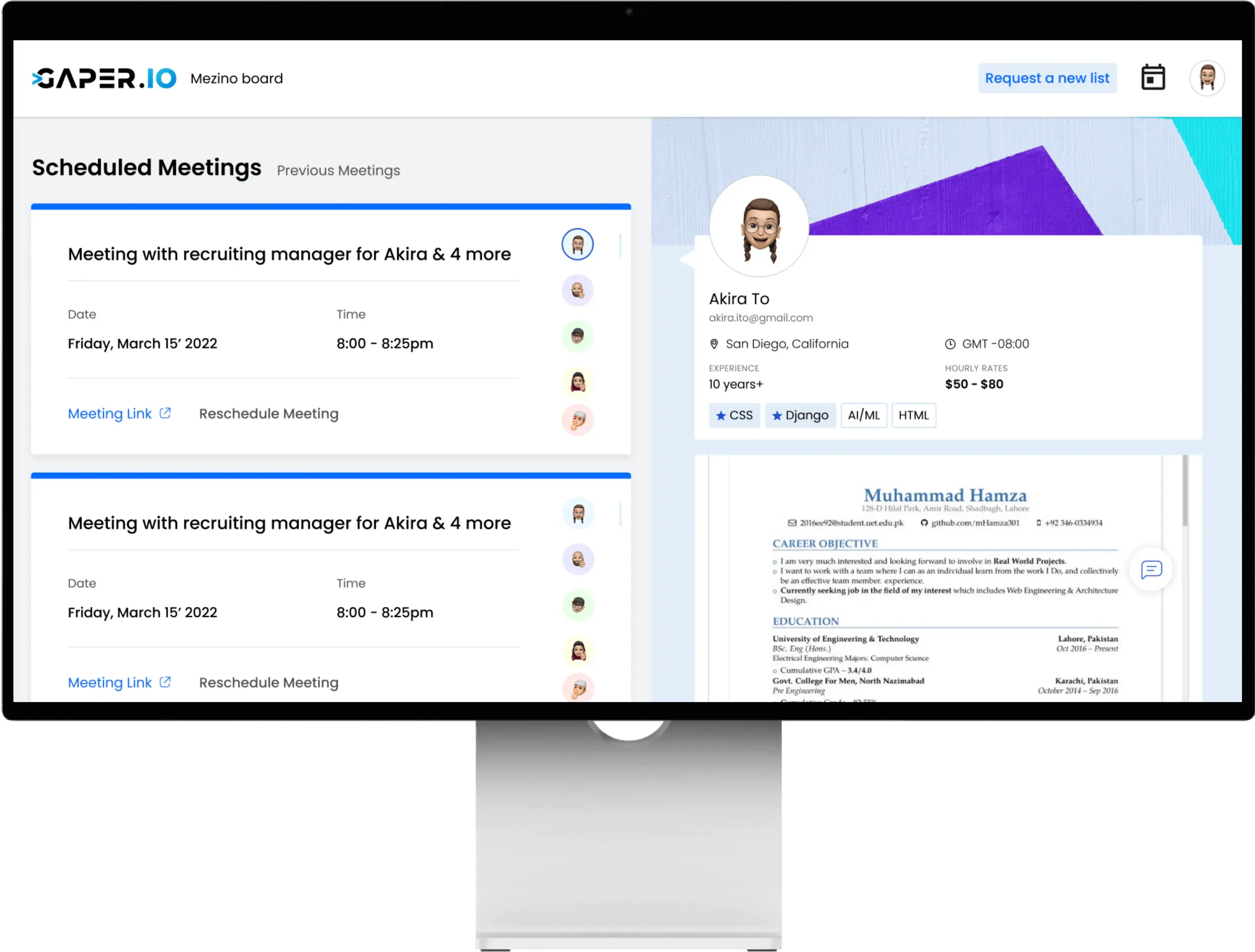
How our matchmaking works?
Get Matched in 48 Hours

Understanding your development project
Explain to us what you need and don’t shy away from giving even the smallest details
Find the best developers for your business
Get matched with qualified developers for your project

Hire the best developers for your business
Hire developers and engineers when you are ready! It can be in as less as 48 hours
Hire the Best Software Developers in Philadelphia, Pennsylvania with Gaper and Save on Hiring Costs
Browse through hundreds of profiles and find your dream match
Hiring Guides
[
Published - April 15, 2026
Why Staffing Agencies Are Leaving Traditional HR Software](https://gaper.io/why-staffing-agencies-are-leaving-traditional-hr-software/)
[
Published - April 8, 2026
Build a Private Insurance Platform Instead of Paying Monthly SaaS Fees](https://gaper.io/build-a-private-insurance-platform-instead-of-paying-monthly-saas-fees/)
How hiring developers with Gaper works
Advantages of hiring developers from Gaper
Our global network allows you the opportunity to access and hire top talent from across the globe. Engineers and developers can be hired for any tech stack that your business has a need for.

Our Engineers have worked for
Our Engineers have worked for

Hire the top Developers from all around US

Austin
Texas is one of the biggest names in technology; Apple, Amazon, and Google reside and have a workforce highly skilled in software development and engineering.

Anchorage
Some of the most successful software developers are based in Alaska, which is gradually becoming a state that leads the way in technology.

Oklahoma City
Oklahoma is home to some of the biggest companies in technology from AT&T to Oracle leading the way for the future growth of this field.

Miami
Florida has become one of the fastest-growing technology sectors in the US. Florida houses the finest talent pool of computer programmers and coders.

Kansas City
Kansas is growing with its investment in the technology field thereby producing some of the best engineers in the world.

Newyork
New York has become a technology hub and home to thousands of startups. New York is now the second-largest startup ecosystem in the world driving innovation in the digital world.
There is an estimated 15% raise in the hiring rates for software engineers every 3 years around the globe.

Frequently asked questions
Why has hiring software developers become so competitive in Philadelphia?
What are the hidden costs of hiring a developer in Philadelphia beyond salary?
What technology stacks are most in demand in Philadelphia?
How does combining AI agents with developers improve ROI for Philadelphia companies?

Ready to turn AI into execution?
Book a free assessment of one workflow. We map it, make an honest build versus buy call before any code, and if an off the shelf product covers the job we will tell you so.