
Your WISP was written before AI, and the IRS sample never mentioned it
IRS Publication 5708 has zero references to artificial intelligence. If your firm built its WISP from the sample, it no longer describes what you do.
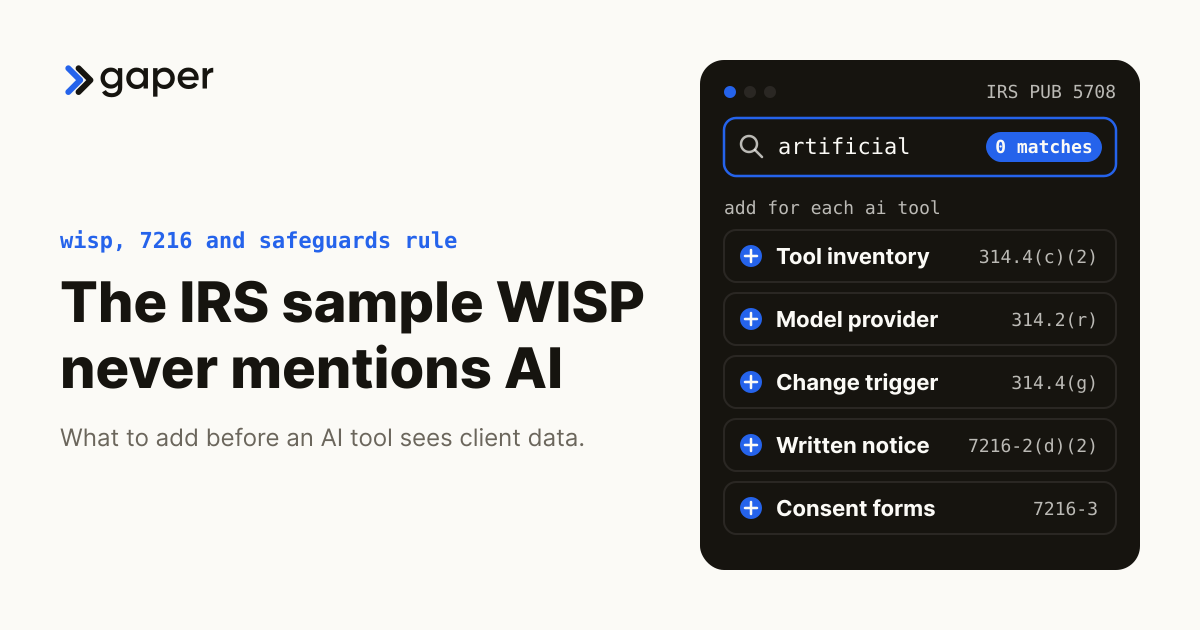
If your firm built its written information security plan from the IRS sample, the plan does not describe the disclosure your firm is about to start making. Publication 5708 contains no reference to artificial intelligence anywhere in its 29 pages. That is not a criticism of the sample. It is a gap you now own.
This is information, not legal advice.
Does the IRS sample WISP cover artificial intelligence?
No. IRS Publication 5708, Creating a Written Information Security Plan for your Tax and Accounting Practice, revision 8-2024, contains zero occurrences of the phrase "artificial intelligence" and no standalone use of "AI" across all 29 pages.
The sample is a good document. It covers devices, passwords, access, physical security and incident response. It was simply not written for a practice that sends client data to a third party model, because that was not what practices were doing.
A firm that adopted the sample verbatim has a plan that is silent on the single largest change to its data flows in years.
What the sample says about itself
It says it is a starting point, in terms firms often skip past. Publication 5708 states it is "not intended to replace your own research, to create reliance or serve as a substitute for developing your own plan based upon the specific needs and requirements of your business or firm."
That sentence is doing real work. Adopting a sample does not transfer responsibility to the IRS, and the document says so in its own words. If the plan does not match the practice, the plan is the problem.
Does adding an AI tool trigger a WISP update?
Yes, if the tool will receive client data. The FTC Safeguards Rule at 16 CFR 314.4(g) requires you to adjust your program for any material changes to your operations or business arrangements, and a new model provider handling that data changes both. The trigger is the deployment itself, not your next annual review.
The sample already commits you to it: its data security coordinator reviews the WISP at least annually or whenever a material change in business practices affects the security or integrity of records containing PII. IR-2026-92, the IRS and Security Summit reminder of 18 August 2026, still points small practices to Publication 5708 and does not mention AI.
Size does not excuse it: 314.4(g) is not among the four requirements 16 CFR 314.6 lifts for firms under 5,000 consumers, as our guide to that exception explains.
Does section 7216 stop your firm using AI?
No, and the belief that it does is a common misreading. Section 7216 is a consent statute, not a prohibition. 26 CFR 301.7216-3(a)(1) provides that a preparer "may not disclose or use a taxpayer's tax return information prior to obtaining a written consent from the taxpayer", and then says directly: "A tax return preparer may disclose or use tax return information as the taxpayer directs as long as the preparer obtains a written consent from the taxpayer as provided in this section."
Anyone telling you that 7216 cannot be consented away is wrong on the text. The consent route exists. It has conditions, and the conditions are where firms fail.
The consent "must be knowing and voluntary", and conditioning your services on the taxpayer giving it generally makes it involuntary and therefore invalid, except in the narrow case at (a)(2) of disclosure to another preparer for assistance or auxiliary services.
When do you not need consent at all?
When the disclosure fits the preparer-to-preparer rule, and that rule has a hard edge that is easy to miss. 26 CFR 301.7216-2(d)(1) permits disclosure to another preparer in the United States for preparing a return or providing auxiliary services, "so long as the services provided are not substantive determinations or advice affecting the tax liability reported by taxpayers."
The regulation then defines the limit: "A substantive determination involves an analysis, interpretation, or application of the law."
Apply that to an agent. One that extracts figures, reconciles documents or routes data is doing processing. One that reads a fact pattern and tells your staff how a provision applies is analyzing, interpreting or applying the law. The first may sit inside (d)(1). The second does not, and no amount of describing it as a productivity tool changes the character of the work.
The written notice that is easy to miss
There is a specific, checkable obligation when you hand data to a technology contractor, and it is routinely skipped. 26 CFR 301.7216-2(d)(2) permits disclosure to a person under contract "in connection with the programming, maintenance, repair, testing, or procurement of equipment or software used for purposes of tax return preparation" only to the extent necessary, "and only if the tax return preparer ensures that all individuals who are to receive disclosures of tax return information receive a written notice that informs them of the applicability of sections 6713 and 7216 to them and describes the requirements and penalties of sections 6713 and 7216."
Ensures. Not mentions in a contract recital. If your implementation partner's engineers can see production return data, that notice is your obligation, and it has to reach the individuals.
The same paragraph settles who they become: "Contractors receiving tax return information pursuant to this section are tax return preparers under section 7216 because they are performing auxiliary services in connection with tax return preparation."
Does owning the deployment take the vendor out of it?
No. Ownership changes where the logs, credentials and hosting region sit. It does not remove a party from the analysis.
26 CFR 301.7216-1 defines a tax return preparer to include "Any person who is engaged in the business of providing auxiliary services in connection with the preparation of tax returns, including a person who develops software that is used to prepare or file a tax return and any Authorized IRS e-file Provider."
A firm that builds and maintains an agent touching return data is inside that definition on its own terms. So is the model provider, on the same reasoning. If a vendor tells you that a client owned deployment means there is no third party, treat that as a reason to look harder, not a reason to relax.
Does the sample WISP list your model provider as a service provider?
No. The IRS sample's sharing paragraph names tax authorities, the tax software vendor, bookkeeping, payroll, other practitioners, counsel, business advisors and IT support, and its glossary gives janitorial, IT and document destruction firms as examples. On the text, a model provider serving you directly fits 16 CFR 314.2(r), so add it.
The definition at 314.2(r) covers anyone that receives, maintains, processes or is otherwise permitted access to customer information through services it provides directly to you. Because processing is listed separately, a provider that computes on client data and keeps no copy is still inside the text. If you reach the model through another vendor's product, that vendor is your service provider, and the safeguards you require of it by contract should cover what it sends to the model.
The sample's default points the same way: any third party that needs access must meet the WISP's standards, with only tax software vendors, e-file transmitters and tax authorities carved out. Its outline asks for policies on the cloud hosting provider and other services connected to stored PII, but names no model provider.
On the 314.2(r) reading, 314.4(f) applies to a model provider serving you directly as to any vendor: select it for its ability to maintain safeguards, require them by contract, and reassess it periodically. The firm that built your agent belongs on the list too if it can reach client data, and owning the agent does not remove a duty. 314.4(c)(4) requires secure development practices for in-house developed applications and procedures for evaluating, assessing or testing the security of externally developed ones, so an owned agent sits under one or the other, just as a rented tool does.
The one disclosure consent cannot authorize, and its exception
Social security numbers going offshore on a Form 1040 series return, unless a specific safeguard is used. 26 CFR 301.7216-3(b)(4)(i) bars a US preparer from obtaining consent to disclose a taxpayer's SSN to a preparer located outside the United States for those returns.
The exception at (b)(4)(ii) permits it "only if the tax return preparer within the United States discloses the SSN to a tax return preparer outside of the United States through the use of an adequate data protection safeguard as defined by the Secretary in guidance published in the Internal Revenue Bulletin", and verifies the maintenance of those safeguards in the consent request itself.
This is the paragraph to read before selecting a hosting region. If your agent runs outside the United States and sees Form 1040 data, this is directly in your path.
What a valid consent actually requires
More formality than a general engagement letter clause carries, and the details are disqualifying rather than cosmetic.
Consent must come before the disclosure or use, with no retroactive consent at (b)(1). A single document cannot authorize both uses and disclosures, at (c)(1), so they need separate documents, and each disclosure or use must be "specifically and separately" identified. A consent covering an entire return must tell the taxpayer they can request a more limited disclosure, at (c)(2). You must give the taxpayer a copy at the time of execution, at (c)(3). And if the consent does not state a duration, at (b)(5) it runs for one year from signature.
A broad "we may use technology vendors" clause in an engagement letter satisfies almost none of this.
For Form 1040 series clients, Rev. Proc. 2013-14 also sets the format and wording, and our 7216 consent guide walks through the checklist. Have counsel check any template against the current regulation.
What to add to your WISP
Name the systems, the data and the people. Which agents are in use, on which engagements, and what categories of tax return information they can reach. Where the processing happens, including the hosting region, because of the SSN rule above. Who the contractors are, and the date you sent the 6713 and 7216 written notice to their personnel. Which disclosures you treat as covered by 301.7216-2(d)(1) and why you concluded they are not substantive determinations. Where your consent forms live, and who checks them.
Then add the change trigger: what happens to this plan when a model, a prompt or a scope changes. That trigger is the 314.4(g) duty set out above; our AI security guide for accounting firms covers what else the FTC Safeguards Rule requires.
Give that trigger an owner: an AI steering committee that approves each new tool can record the WISP change in the same approval, before the tool touches client data.
Last, add the Safeguards Rule lines the sample lacks or leaves generic: it has no change management procedure, and its inventory, Attachment E, is a hardware inventory. Put the change management procedure that 314.4(c)(7) requires in the change trigger above. Add each tool to the inventory of data and systems that (c)(2) asks you to identify and manage. Record its encryption in transit and at rest or, where encryption is infeasible, the compensating control your Qualified Individual reviewed and approved under (c)(3), with name and date. Under (c)(8), log which staff sent which client data to it.
The encryption line does double duty. Under 314.2(m), unauthorized acquisition of unencrypted customer information is a notification event, and data counts as unencrypted if an unauthorized person accessed the key. At 500 or more consumers, 314.4(j) requires notice to the FTC as soon as possible and no later than 30 days after discovery.

Ten lines to record for each AI tool, with the rule each one answers to.
Where this is unsettled
Three questions have no clean answer today, and firms should document their reasoning rather than pretend to certainty.
The first is whether a model provider's use of inputs for training is a "use" of tax return information within the meaning of 7216 when the provider is itself a preparer under the definitions above. The text reaches it. There is no published guidance applying 7216 to that fact pattern.
The second is where the line falls between processing and a substantive determination for an agent whose output a human reviews before it reaches the return. A reasonable firm can argue the human made the determination. The regulation does not say so, and a firm that cannot show the human actually did the work has a weak version of that argument.
The third is on the Safeguards side: the 314.2(r) point above is a reading, not a ruling. We know of no FTC guidance or enforcement action applying 314.4(f) to a general purpose model provider. Record your diligence and why you judged it enough.
Where Gaper fits
Gaper is the AI-native implementation partner that deploys supervised AI agents you own. For accounting firms we build them inside the firm's own cloud, so the hosting region, the firm's own retention settings and the access logs are things it can set and evidence itself. The model provider's own retention and training terms still come from its contract, which is why it stays on your service provider list. Ownership does not take Gaper or the model provider outside the 7216 definitions or the Safeguards Rule's service provider definition, so your consent, notice and vendor oversight obligations are unchanged. General enquiries go to hello@gaper.io.
What this means for your firm
Open your WISP and search it for the word artificial, then for the name of every tool your staff currently paste client data into, because if the plan does not describe what the practice does, the plan is evidence against you rather than for you. Decide, in writing, which uses you treat as processing under 301.7216-2(d)(1) and which require consent, and build the consent forms to the separate document and specific identification rules rather than to an engagement letter clause. If an outside contractor can see return data, send the 6713 and 7216 written notice to their individuals this week and keep proof you did.
Free assessment. No commitment. General enquiries: hello@gaper.io
Frequently asked questions
Does the IRS sample WISP cover artificial intelligence?
Does section 7216 stop your firm using AI?
When do you not need consent at all?
Does owning the deployment take the vendor out of it?
Does adding an AI tool trigger a WISP update?
Does the sample WISP list your model provider as a service provider?
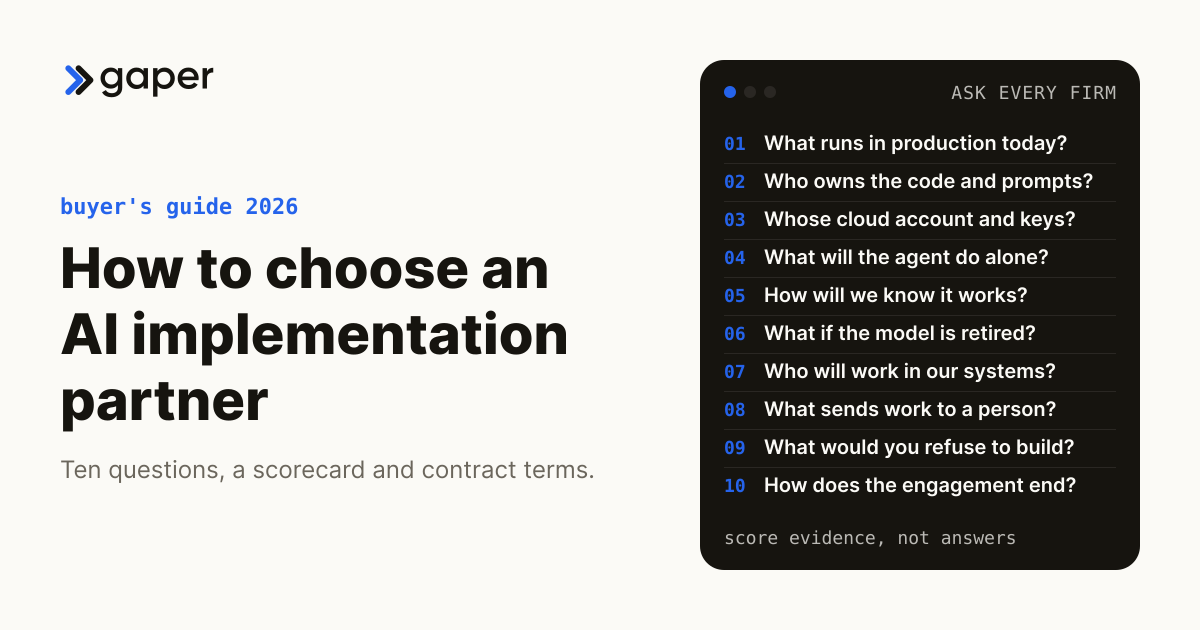
How to Choose an AI Implementation Partner: Questions to Ask Before You Sign
IndustryAI Agent Data and Privacy: What Enterprises Need to Know Before Production
A practical guide to AI agent data privacy for enterprises: what agents touch, where data leaks, and the controls that get a pilot safely into production.
Jun 23, 2026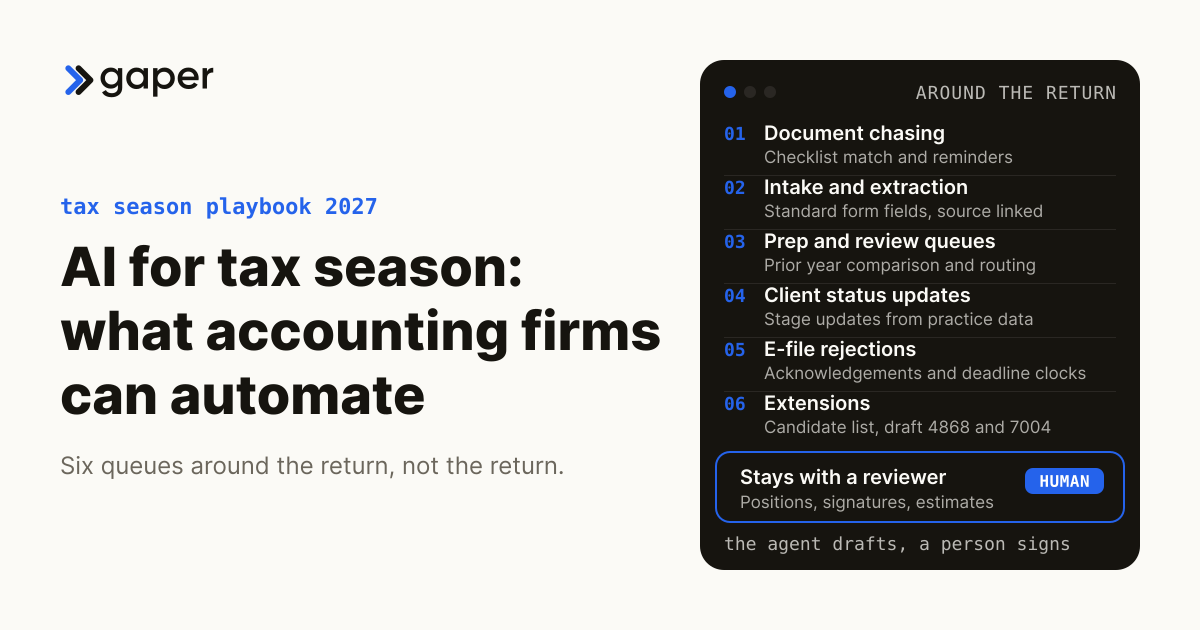
AI for Tax Season: What Accounting Firms Can Automate Before the Next Deadline
Ready to turn AI into execution?
Book a free assessment of one workflow. We map it, make an honest build versus buy call before any code, and if an off the shelf product covers the job we will tell you so.