
Automation Does Not Cut Your Invoice. It Cuts Your Renewal.
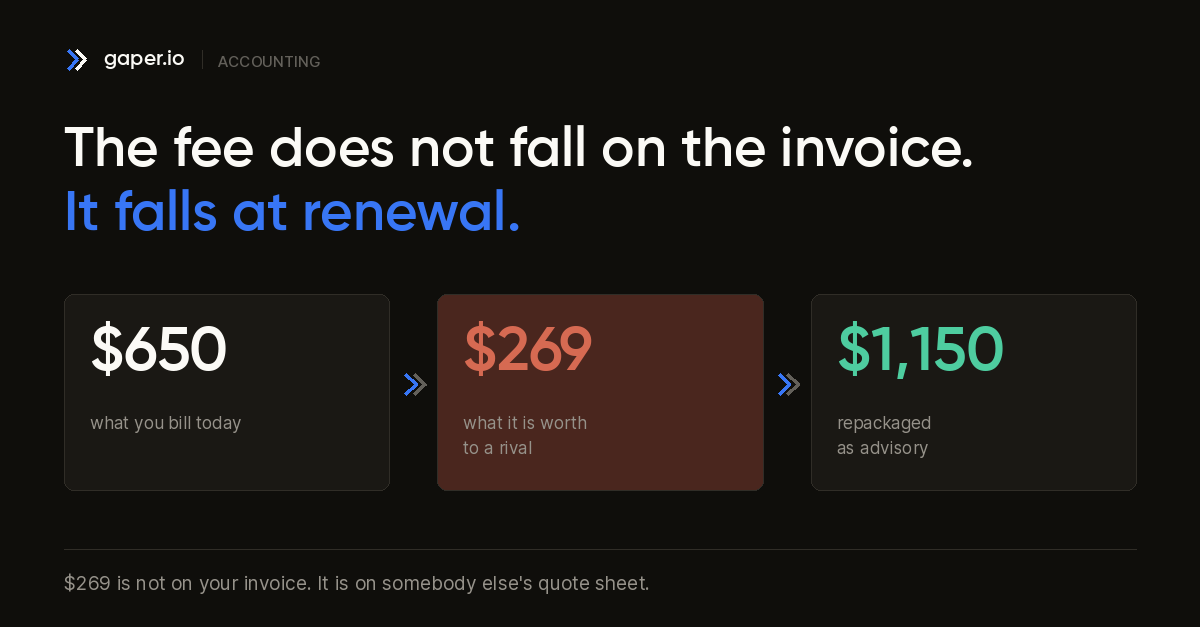
Automate a bookkeeping engagement and the invoice stays at $650. The $269 shows up on a competitor quote sheet instead, and you meet it when the letter comes up.
An AI project can do everything it promised and still leave a firm poorer.
One disclosure before the numbers. Every figure here is modeled, not measured: derived from a stated delivery cost, a stated realized rate and our published tier ranges. None of it is a survey average, and where a number would have to be invented to make a point, the point is made without it.
On work you still bill hourly, cleanup, 1099 season, a CAS onboarding, automation cuts the invoice immediately. Most of your book is not that. It has been fixed monthly fee for years, so automating a bookkeeping engagement changes nothing on the invoice. Nothing happening is not the same as nothing being wrong.
Take one such client. $650 a month, 7.5 delivery hours, 51.5% gross margin at a $42 fully loaded delivery hour, blended, not all senior onshore staff. If your staff accountant costs more, every margin below drops, though the gaps between the three outcomes hold. The automated margins below also carry the cost of running the agent, so they will not equal hours times $42.
Now automate the categorization, the chasing, the cleanup, the parts that are rules wearing a person's clothing. Delivery falls to 3.1 hours. Hold the effective rate you already charge that client, $650 across 7.5 hours, and 3.1 hours is a $269 job.
$269 is not on your invoice. It is on somebody else's quote sheet. The fee does not fall when the hours fall, it falls at renewal, when your client's brother-in-law tells him bookkeeping is automated now, or when the firm across town builds the same agent and competes on price. A fixed fee holds the price until the letter comes up again, not forever. The erosion is competitive, not mechanical.
What is actually inside 3.1 hours
Review, mostly. The agent proposes categorizations and flags exceptions; a human accepts, corrects, investigates and clears them. Somebody still signs the close. That review time is inside the 3.1. If a vendor's number excludes review, it is a demo, and yours will land higher.
You have lived through bank feed rules. The tool did not remove the work, it moved it from doing to checking, and checking is harder to push down the org chart. Whether 7.5 truly becomes 3.1 in your firm you verify by timing a workflow, not by reading an article.
Realization will not tell you
Value the same work at a $165 realized advisory rate and run realization.
Before: 7.5 hours, standard value $1,238, you bill $650. Realization 52.5%.
After: 3.1 hours, standard value $512, you bill $269. Realization 52.5%.
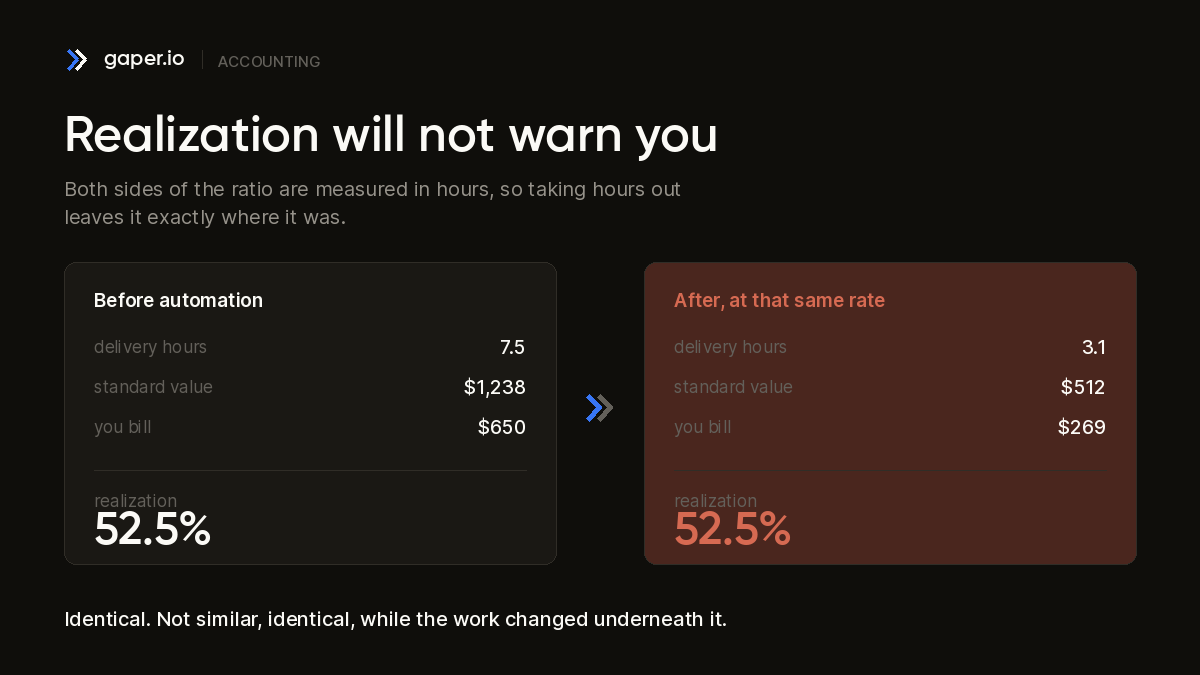
Not similar. Identical. Both sides of the ratio move with the hours, so it holds steady while the value walks out of the building. Valuing categorization at an advisory rate is generous to the point of wrong, but both sides are wrong the same way, which is why it is blind. Watch a different gauge: revenue per delivery FTE, annually. Dollars over people, hours on neither side, so it moves when fees erode and headcount does not.
The same automation, three outcomes
The technology is not the variable. The contract is.
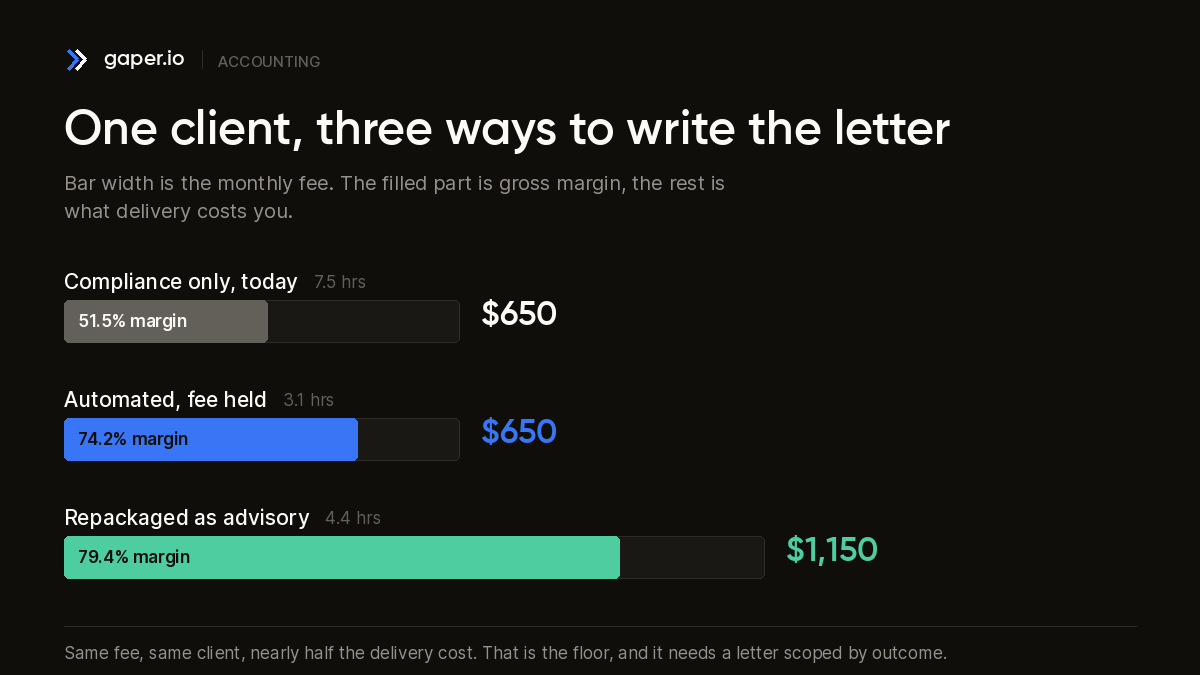
Compliance only. $650 fee, 7.5 delivery hours, 51.5% gross margin. Today.
Automated delivery, fee held. $650 fee, 3.1 delivery hours, 74.2% gross margin. The floor, and it asks one thing: a fixed fee letter scoped by outcome rather than hours, signed before the agent goes live.
Repackaged as advisory. $1,150 fee, 4.4 delivery hours, 79.4% gross margin. Standard value at $165 is $726. Realization goes from 52.5% to 158%. That does not mean you won, it means your rate card was written for the delivery model you just replaced.
The advisory version uses more delivery time, not less
4.4 hours against 3.1. The machine absorbs the categorization and the chasing, and some of the reclaimed time goes back as interpretation, the part a client pays a premium for. A mix shift, not a cost reduction.
It is also not a drafting exercise. Moving a client from $650 to $1,150 is a sales campaign, a role redesign and a lot of partner time. I have no credible conversion rate and will not invent one. The refusers tend to be the price sensitive clients whose margin you needed most, so build your case on the fee-held column.
Margin peaks one rung below the prestigious tier
- Compliance: $450 to $900 a month, 55% to 65% margin
- AI-enabled bookkeeping: $900 to $1,600, 70% to 78%
- AI controller: $2,000 to $3,800, 72% to 80%
- Fractional CFO: $4,500 to $8,500, 65% to 75%
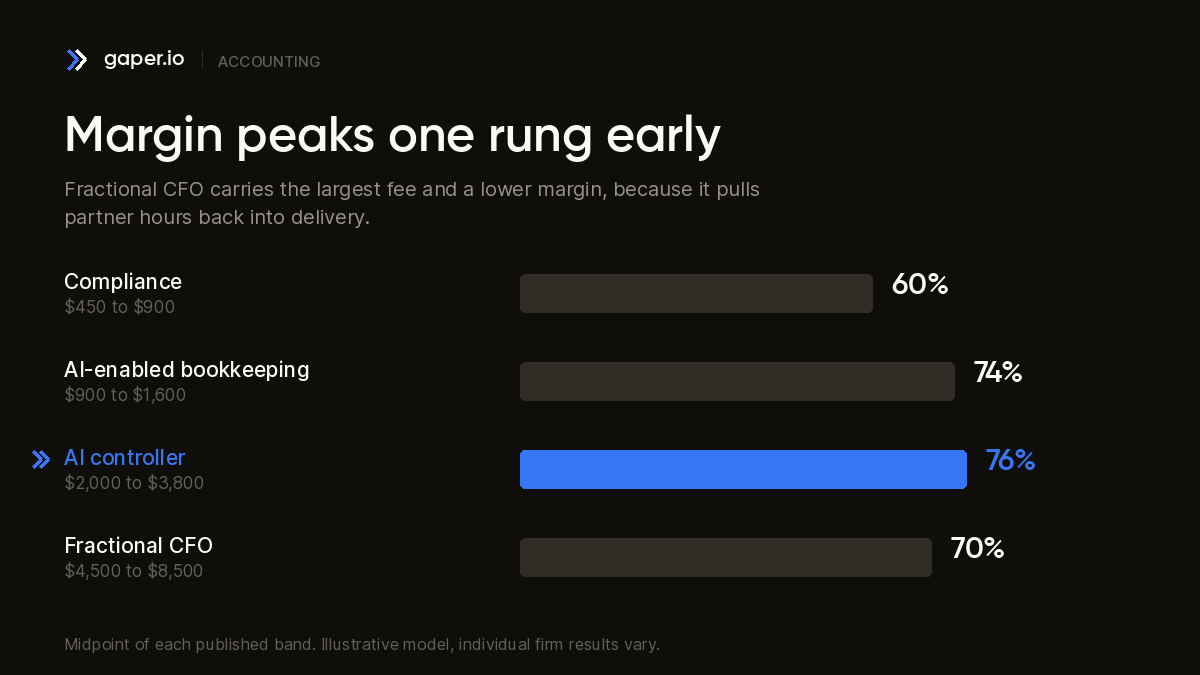
Not at fractional CFO. At controller, because CFO work pulls partner hours back into delivery, and partner hours are the most expensive thing a firm owns.
The slide with the plus sign in it
You have been handed a version of this: AI frees 857 hours a year, worth $99,000 of advisory capacity plus $72,000 in avoided hiring, for $171,000 of first year value.
The parts are sound. A nine person firm at roughly $1.35M spends about 4,100 hours a year on categorization, chasing, cleanup, 1099s and close prep. Agent-eligible means high volume, rule shaped, with a definition of correct, not whatever a partner finds boring. About 38% qualifies, 1,558 hours; year one capture is 55% of that, 857 hours.
Do not use my firm. Divide 4,100 by nine, test that per-head figure against your time reports tonight, then multiply by the people who actually deliver. No admin, not you.
Those hours are worth either about $99,000 as advisory capacity, at 70% conversion at $165, or about $72,000 as one avoided staff accountant. Either. Never both. Approve a project on $171,000, watch it honestly deliver one of the two, and it has met its potential and still failed the case you signed. Nobody gets fired for the arithmetic. Someone gets fired for the variance.
Now the half nobody says out loud. Redeployment assumes you can sell advisory work; avoided hiring assumes you were going to hire. If you are flat this year, not hiring, and already employing the people whose hours just got freed, the honest first year value is zero. Not small. Zero, until you sell something new or let somebody go. If you cannot commit to one in writing, do not start yet. And no, there is no customer story here instead: every case study you have been shown was a win.
Freeing 857 hours is a personnel event too. Somebody hired to categorize is now asked to interpret, and some will not. Decide who reviews and who advises before the build.
The fee conversation, scripted
Your client will say it is automated now, so charge me less. Do not defend your hours, you will lose. Change the unit.
"You were never buying hours. Manual entry runs about one error per 300 entries. This runs closer to one per 10,000, and you now get a variance review every month instead of a file."
If he pushes, quote the compliance-only version at the compliance-only price and let him choose. Some will take it, and now you know your price buyers before your competitor does.
It is September
Busy season is coming, and a workflow takes four to eight weeks to build, putting go-live and its shaky first month against year end and 1099 prep. So split the list. Before January, time one workflow honestly and rewrite one engagement letter. Both are free, neither touches production, and both come before any code. Reversed, you underwrite your client's savings out of your own margin. Build in May, after pricing the alternative: a product at $1.20 per document beats a $12,000 to $34,000 build below roughly 1,000 documents a month.
Then ask every vendor: what happens to my revenue if I install this and change nothing about pricing? The honest answer is nothing this year, then erosion at renewal. Anyone who says it falls next month has not read your engagement letters. Anyone who says it rises has not read your P&L.
Where I fit, briefly
I work at Gaper, an AI-native implementation partner. We build and deploy production AI agents; the unit of work is a workflow, not a seat. Our accounting agent is AccountsGPT.
On ownership, since every vendor uses the same words: you get the repository, the prompts, the connection configuration and the runbook, in your accounts, not ours. Somebody owns it after handover, and when the model version changes that is your person or a priced support arrangement. Ask us in writing, and ask the others. Every engagement opens with a free assessment of one workflow, build versus buy call included.
Pull a year of renewals and find the ones where the client asked what exactly he was paying for. Those are the engagements the agent is coming for first, and those are the letters to rewrite. It is free, it needs no vendor, and it is done before the first 1099 lands.
Thirty minutes, no commitment. We map one workflow, make the build or buy call, and scope the smallest thing worth shipping.
Frequently asked questions
Does automating bookkeeping reduce what I can charge?
Why does my realization rate not show the change?
What should I do before automating anything?
Where does margin peak across accounting service tiers?

Ready to turn AI into execution?
Book a free assessment of one workflow. We map it, make an honest build versus buy call before any code, and if an off the shelf product covers the job we will tell you so.