
How to Scale an Accounting Firm Without Hiring More Staff
A nine person firm reclaims about 857 hours in year one. That is either $99,000 of advisory capacity or a $72,000 avoided hire, never both. Scaled by firm size.
Every AI proposal an accounting firm receives contains a number of hours saved. Almost none of them survive contact with how the hours actually behave.
What happens to the hours AI frees up in an accounting firm?
They become one of two things, never both. Freed hours can be redeployed into billable advisory work, or they can avoid a hire you would otherwise make. In our illustrative model of a nine person firm, about 857 hours come back in year one, worth roughly $99,000 as advisory capacity or $72,000 as an avoided salary. Not $171,000.
That last sentence is the entire point of this article, and it is the line most vendors cross.
Where the hours come from
Reclaimed hours are not evenly spread. They come from a short list of tasks that are high volume, rule heavy and mercifully dull, which is exactly what makes them automatable and exactly why nobody enjoys defending them.
| Line | Value |
|---|---|
| Firm-wide hours per year on categorization, chasing, cleanup, 1099s, close prep | 4,100 |
| Agent-eligible share of those hours | 38%, or 1,558 hours |
| Realistic capture in year one | 55%, or 857 hours |
Modeled on a nine person firm with roughly $1.35M in revenue. Illustrative model based on the assumptions shown. Not a guarantee of results. Individual firm results vary.
Two of those rows deserve scrutiny, because they are where optimistic proposals inflate.
Only 38 percent is eligible. The rest of that 4,100 hours involves judgment, client contact, or handling something genuinely unusual. An agent can prepare it and flag it. It cannot own it.
You capture 55 percent of the eligible hours in year one, not 100 percent. The gap is real work: connecting systems, correcting the agent when it is wrong, building the review habit, and the fact that nobody changes how they close the books in February. Any model that assumes full capture from month one is describing a demo.
What this looks like at your firm size
The nine person model above is the one we can show working end to end, so everything here is scaled from it rather than from a separate set of assumptions. The scaling is deliberately naive: hours per accountant held constant, then multiplied by headcount. Read the rows as an order of magnitude, not a quote.
| Firm size | Accountants assumed | Hours reclaimed in year one | Path 1, advisory capacity | Path 2, avoided salary |
|---|---|---|---|---|
| Solo | 1 | 95 | $11,000 | $8,000 |
| 2 to 10 | 6 | 571 | $66,000 | $48,000 |
| 11 to 50 | 30 | 2,857 | $330,000 | $240,000 |
| 51 to 200 | 125 | 11,903 | $1,375,000 | $1,000,000 |
Scaled linearly from the nine person case: 857 hours, $99,000 as advisory capacity, $72,000 as an avoided salary. Each band uses the midpoint of its range. Illustrative model based on the assumptions shown. Not a guarantee of results. Individual firm results vary.
Three things about that table are worth saying out loud, because the naive scaling hides them.
Solo firms should read Path 2 as fractional, not as a hire. Ninety five hours is about two working weeks. It does not avoid a salary, it avoids the specific fortnight in March when you were going to work every evening. That is worth something, but it is not $8,000 of cash you can point at.
The middle band is where the arithmetic is most reliable. A six to thirty person firm has enough volume for the rule heavy tasks to be genuinely repetitive, and not so much structure that work has already been specialized away into roles the model does not describe.
Above about fifty accountants the linear assumption breaks down, and it breaks in both directions. Large firms have usually offshored or systematized some of these tasks already, so there is less left to reclaim per head. They also have workflows a small firm never touches, such as multi entity consolidation, where the reclaimable hours are larger than this model suggests. If your firm is in the top band, treat the row as a prompt to measure rather than a projection to trust.
The two paths, and why you must pick one
Once you have 857 hours back, there are exactly two things to do with them.
Path 1: redeploy into billable advisory work. Not all 857 hours convert. Realistically about 70 percent become billable, at a realized rate around $165. That is roughly $99,000 of new revenue capacity, and it only materializes if you have clients willing to buy advisory work. The hours are necessary but not sufficient.
Path 2: avoid a hire. If you were going to bring in a staff accountant for busy season, those hours mean you do not. One fully loaded staff accountant is about $72,000. This is the safer path and it books immediately, with no dependency on selling anything.
The two are alternatives. The same hour cannot be billed to a client and also not-spent on a salary. Adding them together produces a $171,000 figure that is simply wrong, and it is the single most common credibility failure in AI ROI marketing. If a proposal on your desk does this, the rest of its arithmetic deserves the same suspicion.
Which path is right for your firm
The honest answer depends on something that has nothing to do with AI: whether you can sell advisory work.
Pick Path 2 if your client list is mostly compliance-only, your partners are already at capacity on client relationships, or you have tried to sell advisory before and it stalled. Avoiding a hire is a real, bankable result and there is no shame in taking it. It also happens to be the path that funds year two.
Pick Path 1 if you already have clients asking you questions the monthly package does not answer. That demand is the signal. Without it, redeployed hours become idle hours, and idle hours look like a failed investment even though the automation worked exactly as promised.
Most firms should plan Path 2 in year one and Path 1 in year two. The capacity has to exist before you can sell it, and the sales motion takes longer to build than the automation does.
The hours nobody counts
Two effects sit outside the table and both matter more than they look.
Error rates fall sharply. Manual data entry in accounting produces roughly one error per 300 entries. Automated processing brings that closer to one per 10,000. The saving is not the entry time, it is the rework, the awkward client conversation, and the audit exposure that never happens.
Busy season stops being a cliff. The hours reclaimed are concentrated in exactly the tasks that spike in Q1. A firm that reclaims 857 hours evenly across the year reclaims considerably more than that during the eight weeks when it cannot buy capacity at any price. Whether those hours actually leave the busy-season calendar, or get absorbed by scope creep, is the subject of our piece on busy season burnout.
What this does to hiring
It does not eliminate roles. It changes which role you hire next.
The firm that would have hired a third staff accountant to absorb volume hires a client-facing advisor instead, because volume is no longer the constraint. That is a different job description, a different salary band, and a different kind of person. Firms that automate and then hire the same profile they always hired end up with expensive people doing work an agent already handles. Which skills to train for, hire for or hand off is the subject of our guide to the AI skills gap in accounting firms.
The other half of that arithmetic is what the automation costs in the first place. We publish those bands, one workflow at $12,000 to $34,000 to build and $270 to $950 a month to run, in AI implementation cost for accounting firms.
Reclaimed hours also change what the engagement is worth to a competitor, which is a separate problem from what to do with the hours. That one is covered in Automation does not cut your invoice, it cuts your renewal.
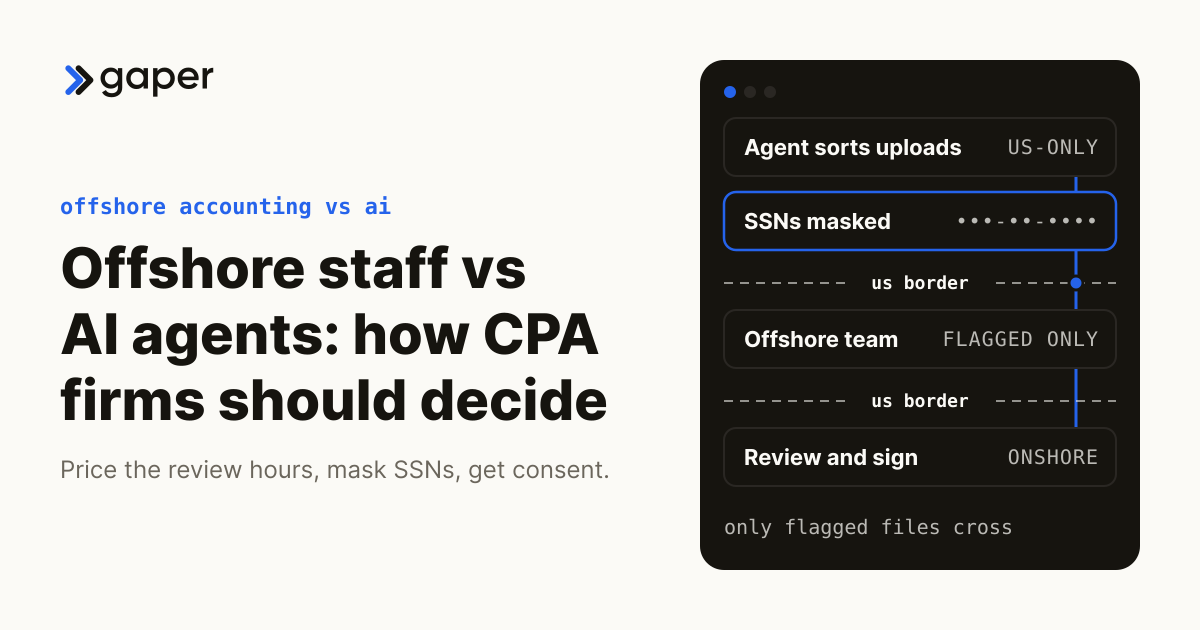
If the hire you are weighing is offshore capacity rather than a new seat, we compare the two routes, including the Section 7216 consent an offshore team needs, in offshore accounting staff vs AI agents.
Before you accept anyone's hours-saved number
Ask three questions of any proposal, including ours.
- What share of our total hours do you claim are eligible, and which tasks specifically?
- What capture rate are you assuming in year one, and why that number?
- Are you counting redeployed revenue and avoided hiring as separate benefits?
If the answer to the third is yes, halve the headline figure and start the conversation again.
The full economics, including what the reclaimed capacity is worth once it is repackaged and sold, are laid out in our guide to AI for accounting firms. If you want the eligible-hours question answered against your actual workflows rather than a model, the free assessment does that.
Frequently asked questions
What happens to the hours AI frees up in an accounting firm?
Can we count redeployed revenue and avoided hiring together?
Why is year-one capture only 55 percent of eligible hours?
What share of an accounting firm’s hours can AI actually take?
Does AI mean an accounting firm stops hiring?
Ready to turn AI into execution?
Book a free assessment of one workflow. We map it, make an honest build versus buy call before any code, and if an off the shelf product covers the job we will tell you so.