
Offshore Accounting Staff vs AI Agents: How CPA Firms Should Decide
Offshore staff or AI agents for your CPA firm? Compare true cost once review is counted, turnaround, 7216 offshore consent, SSN masking and a hybrid.
Use AI agents for high-volume preparation work that arrives as documents and follows rules, and keep trained people, onshore or offshore, for unstructured files and anything that needs judgment. Either way a credentialed reviewer at your firm reviews and the signing preparer signs, and that review time is the cost most comparisons leave out. Both routes also raise Section 7216 consent questions once client data is seen or processed outside the United States.
Should a CPA firm use offshore accounting staff or AI agents?
Decide per workflow, not per firm. High-volume, document-driven work with standard inputs favors an agent, low-volume or unstructured work favors trained people onshore or offshore, and a small firm should usually switch on the automation already inside its tax and ledger software before paying for either.
By service line, the lean looks like this.
| Service line | Lean | 7216 and data note |
|---|---|---|
| Individual tax (1040) | Hybrid: agent prepares, people review | Rev. Proc. 2013-14 consent for any offshore step, SSNs masked |
| Business returns | People first, agent for extraction | Engagement-letter consent allowed for non-1040 clients |
| Client accounting services | Agent first, for recurring rule-bound volume | 7216 turns on data furnished for return preparation; AICPA confidentiality applies either way |
| Audit support | People, with agent help on schedules | Providers and technology belong in your SQMS No. 1 quality system |
| Admin and document chasing | Agent first, a person for calls | Client names count once furnished for return prep |
Why did CPA firms offshore, and what does it cost once review is counted?
Mostly for capacity. The 2025 National MAP Survey from the AICPA's PCPS and CPA.com found 29% of responding firms offshoring, rising to 74% of firms with $10 million or more in net client fees. The true cost is the vendor fee plus the onshore hours spent reviewing, correcting and sending work back.
In the same 2025 survey, among firms that outsource, 51% outsource individual tax, 42% business tax, 38% client accounting services, 28% audit and 15% administrative work. Most use a third-party vendor (72%), and 65% send work to India and 33% to the Philippines.

So price the whole line, not the invoice.
| Cost line | Offshore team | AI agent |
|---|---|---|
| Production | Vendor fee per person or per return | Build once, then hosting, model usage and maintenance |
| Onshore review | Reviewer hours per return, varying by preparer | Reviewer hours per item, concentrated on exceptions |
| Rework | Send-back loops across a time zone | An exception queue, plus fixes to rules or prompts |
| Compliance | 7216 consents, client notice, vendor oversight | The same, plus choosing where processing happens |
Review is where the numbers hide. The 2025 MAP Survey puts median manager compensation at $99,000 for fiscal 2024, about $48 an hour across 2,080 hours before benefits and payroll tax, and its 2024 median billing rate for managers at $198 an hour. Each hour a manager spends reviewing offshore work costs at least $48, and closer to $198 if it displaces billable time.
Measure reviewer minutes per return for a month before pricing anything; our AI implementation cost bands cover the agent side.
What can AI agents take off the desk that offshore staff handle today?
The structured preparation layer: sorting client documents, extracting figures into workpapers or tax software input, categorizing transactions against your rules, drafting reconciliations and chasing missing documents. That overlaps with the tax and client accounting work at the top of the MAP Survey's outsourcing list.
The Gaper Ownership Map sorts this work into three tiers, and the tier decides who answers for the outcome.
| Work | Tier | Who answers for it |
|---|---|---|
| Document intake, naming, sorting, duplicate checks, missing-document reminders | Automated | The agent, with routine sampling |
| W-2, 1099 and K-1 extraction, transaction categorization, reconciliation and workpaper drafts, client emails | Agent-drafted, human-approved | A preparer or reviewer who approves each item |
| Tax positions, unusual items, client advice, review sign-off, the signature | Human-owned | Your signing preparer or a credentialed reviewer |
Offshore teams usually work the first two tiers; an agent can take the first outright and draft the second, with a named approver on each draft. See human-in-the-loop AI for that gate, and automating tax workpaper preparation for the split on tax files.
What still needs a person, onshore or offshore?
Judgment, messy files and the signature. The AICPA's Statements on Standards for Tax Services, effective 1 January 2024, list AI among the tools a member may rely on, but say tools should be used "not to supplant the member's professional judgment" (1.4.8).
The member also stays responsible for the completed work (1.4.7). Unstructured work is where a trained preparer earns the seat: a new client's first year, photographed documents with notes in the margin, a carryover that does not tie. An offshore preparer with a few seasons on your files handles these well, and an agent should flag them, not guess.
Supervision applies to both. Interpretation 1.300.040 of the AICPA Code of Professional Conduct says a member using a third-party service provider "must adequately plan and supervise" its work, and for an accounting and auditing practice, SQMS No. 1, required by 15 December 2025, added requirements for service providers and technological resources.
Do you need Section 7216 consent to use offshore staff?
Yes, before anyone located outside the United States sees a client's tax return information, even by logging in to systems hosted in the US. Under 26 CFR 301.7216-2(c)(2), that includes your own employees abroad, and the preparer-to-preparer allowance in 301.7216-2(d)(1) covers only preparers in the US.
Remote access counts. In Example 3 under 301.7216-2(d)(3), an offshore contractor's employee only views return information on a US server, with downloading and printing blocked, and the firm still needs consent first. The general rule is 301.7216-3(a): unless section 7216 or 301.7216-2 specifically authorizes a disclosure, the taxpayer's written consent comes first.
Four details trip firms up:
- The form depends on the client. For Form 1040 clients the consent must follow Rev. Proc. 2013-14, including a mandatory statement that information may be "disclosed to a tax return preparer located outside the United States". For other taxpayers, 301.7216-3(a)(3)(iii) allows any format, including an engagement letter, and Example 2 in (a)(3)(iv) covers offshore affiliates.
- It can be a condition of the engagement. Consent normally cannot be a condition of service, but 301.7216-3(a)(2) excepts disclosure to another preparer who assists with the return, and Rev. Proc. 2013-14 section 5.04(1)(b) supplies the wording.
- It expires. Consent must come before disclosure, and one that states no duration lasts one year from signature, so plan an annual cycle.
- Penalties count per disclosure. Section 6713 sets $250 for each disclosure or use, capped at $10,000 a calendar year, and a knowing or reckless section 7216 violation is a misdemeanor carrying up to a $1,000 fine, a year in prison, or both, plus costs of prosecution. Since the Taxpayer First Act of 2019, disclosures tied to identity theft carry $1,000 each, capped at $50,000 a year, and a criminal fine of up to $100,000.
When the offshore team is a third-party vendor, as it is for most firms, AICPA interpretation 1.150.040 says to inform the client, "preferably in writing", before sharing confidential information, and 1.700.040 says to either contract with the provider for confidentiality, with reasonable assurance about its procedures, or get the client's specific consent. The FTC Safeguards Rule at 16 CFR 314.4(f) requires you to select capable providers, bind them by contract and assess them periodically, as our guide to what the security rules require explains.
This is information, not legal advice; have counsel review your consent documents before you rely on them.
Can you send a 1040 client's SSN to an offshore team?
Generally not. Under 301.7216-3(b)(4), a US preparer may not obtain consent to disclose a Form 1040 client's SSN to a preparer outside the US, and "must redact or otherwise mask the taxpayer's SSN" first. The main exception, 301.7216-3(b)(4)(ii), needs an adequate data protection safeguard at both ends, verified in the consent request.
Rev. Proc. 2013-14 section 5.07 defines that safeguard as a management-approved security program, maintained by both preparers, that conforms to one of six listed frameworks, among them IRS Publication 1075. Two of the listed items have aged. Item (1) is the Commerce Department Safe Harbor "or a successor program", and the EU Court of Justice struck down Safe Harbor in 2015. Item (2) cites the EU Data Protection Directive only as an example, and the GDPR replaced it in 2018. Ask counsel which current framework your provider maps to.
So mask by default. Redacting SSNs before a file crosses the border is mechanical work, a sensible first job for an agent inside your own US environment.
Does an AI tool that processes data abroad raise the same 7216 question?
It can, and the cheapest cloud settings can route requests abroad. Microsoft's deployment guidance says data on Global deployment types "may be processed in any Azure region", and AWS's Bedrock documentation (2026) says global cross-Region inference routes requests worldwide for approximately 10% savings.
The IRS Office of Professional Responsibility's June 2026 AI guidance (Issue Number 2026-19) flags the section 6713 and 7216(a) penalties for AI use and tells practitioners to handle client data "using only secure, enterprise-approved AI". It does not say where processing may happen or whether a model provider is a preparer, and we are not aware of IRS guidance or a court decision that does, so treat processing abroad as a disclosure abroad.
That posture costs little. Pin processing to a US-only setting, such as an Azure US Data Zone or a Bedrock US geographic inference profile, mask SSNs before any model call, and get the consent anyway. We explain why in Section 7216 and AI tools.
Owning the agent does not remove the question. 301.7216-1(b)(2)(i)(B) counts providers of auxiliary services, including developers of return preparation software, as tax return preparers. Under 301.7216-2(d)(2), a contractor who programs, maintains or tests that software may receive return information only to the extent the work needs, and only if every individual receiving it gets written notice of sections 6713 and 7216. Ownership changes control: you choose the region, hold the logs and set the masking step.
How do turnaround, review burden and quality control compare?
Offshore teams offer an overnight cycle, because India and the Philippines sit roughly 9.5 to 13 hours ahead of US Eastern time, while agents process documents as they arrive. Error patterns differ: people make varied mistakes that depend on who prepared the file, and an agent repeats one mistake until someone fixes the rule behind it.
The overnight cycle has a catch: each question sent back costs a day. Offshore capacity must also be hired and trained before the peak, while an agent scales until reviewer hours run out. Consistent errors cut both ways: one correction fixes every future file, but an unsampled flaw reaches every client, so an agent needs sampling as surely as an offshore team needs a reviewer.
Should AI agents replace your offshore team?
Not wholesale. The arrangement that holds up is a hybrid: the agent does the automated work and drafts the rest, and a named person approves each draft. If you keep an offshore team, its job moves from first-pass preparation to working the exception queue.
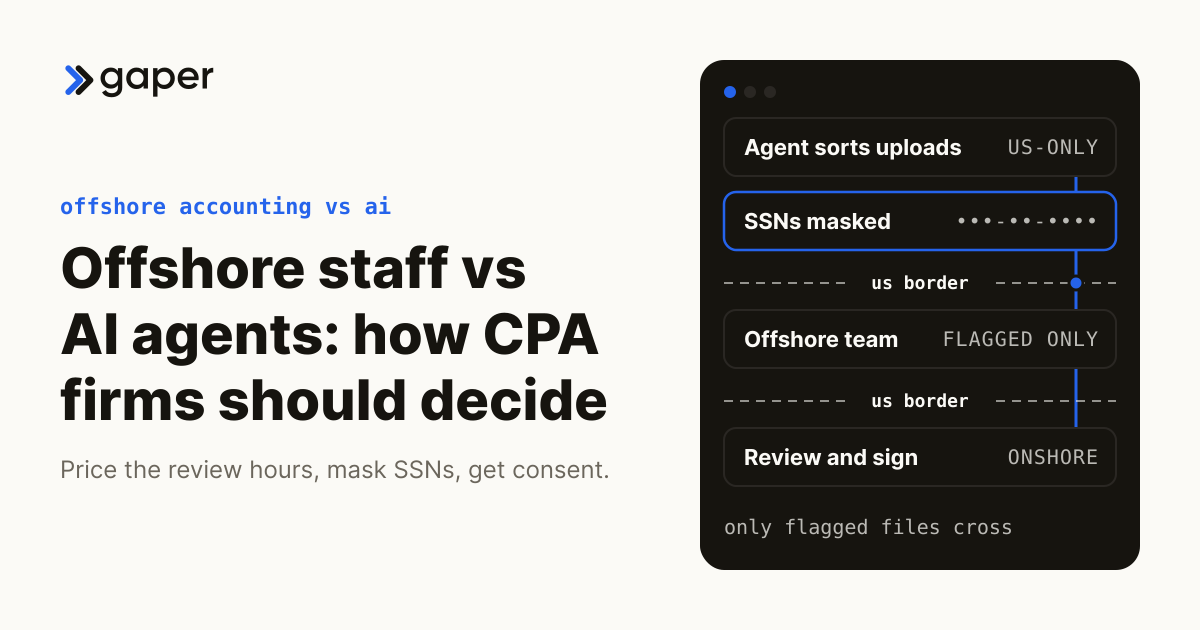
Reference build: illustrative, not a client engagement. A firm that sends 1040 input preparation offshore keeps its client portal and the agent in a US-only cloud environment. The agent sorts uploads, masks SSNs, extracts figures into an input sheet and flags anything that does not match last year. The offshore team, under a Rev. Proc. 2013-14 consent, works only the flagged files, and an onshore senior reviews every return before the signing preparer signs. Nothing here removes a consent; it narrows what crosses the border.

Gaper is the AI-native implementation partner that deploys supervised AI agents you own, through the Gaper method: Assess, Scope, Build, Supervise, Hand over. We baseline reviewer minutes first, because 40% of firms in the 2025 MAP Survey said they had not yet worked out how to track efficiencies from new technology, and hand over the code, prompts and runbook after a supervised cycle. AccountsGPT is our accounting agent, and a free AI assessment maps one of your workflows against both options.
Is a virtual assistant, an offshore preparer or an agent better for admin work?
Use an agent for the repetitive part and a person for the conversations, and treat both as handling tax return information. Under 301.7216-1(b)(3), that includes a client's name, address and identifying number when furnished for return preparation.
Example 1 under 301.7216-1(b)(2)(vi) treats a preparer's secretary who types return information as a tax return preparer for section 7216 purposes, so a virtual assistant abroad who handles W-2s is very likely in the same consent position as an offshore preparer. Split the work by task: an agent sends reminders, checks uploads and updates status, while a person makes the calls. If that person is offshore and sees client documents, get consent first.
Where to start, by firm size
These bands are our rule of thumb from scoping work, not survey findings.
| Firm size (net client fees) | Sensible starting point |
|---|---|
| Under $1.5 million | Buy first: the automation in your tax and ledger software, consented offshore help for peaks |
| $1.5 million to $5 million | One agent on your highest-volume workflow, offshore kept for overflow |
| $5 million to $10 million | Agents on the structured layer, offshore reassigned to exceptions |
| $10 million and up | Agents in front of the offshore team to mask, sort and pre-fill |
Then run the Rent-vs-Own test. If the process knowledge, test cases and audit trail would leave with the vendor when the contract ends, you are renting capacity: fine for overflow, while the structured layer you run every season is usually worth owning. For the hours you free up, see how capacity behaves after AI; for the wider picture, our guide to AI for accounting firms.
Thirty minutes, no commitment. We map one workflow, make the build or buy call, and scope the smallest thing worth shipping.
Frequently asked questions
Should a CPA firm use offshore accounting staff or AI agents?
Why did CPA firms offshore, and what does it cost once review is counted?
What can AI agents take off the desk that offshore staff handle today?
What still needs a person, onshore or offshore?
Do you need Section 7216 consent to use offshore staff?
Can you send a 1040 client's SSN to an offshore team?
How to Scale an Accounting Firm Without Hiring More Staff
A nine person firm reclaims about 857 hours in year one. That is either $99,000 of advisory capacity or a $72,000 avoided hire, never both. Scaled by firm size.
Aug 16, 2026
The 10 AI Agents Every Startup Founder Should Know in 2026
AI Skills Gap in Accounting Firms: What to Train, Hire, or Hand Off
Ready to turn AI into execution?
Book a free assessment of one workflow. We map it, make an honest build versus buy call before any code, and if an off the shelf product covers the job we will tell you so.