
Busy Season Burnout: Will AI Give Your Accountants Their Hours Back?
AI can stretch busy season the way remote work stretched the workday. How CPA firm partners decide where freed hours go, curb scope creep and measure hours.
Not by default. Remote work saved people their commute and a large share of that time went back into work, and the early evidence on AI shows the same pattern: saved minutes become more tasks, not shorter days. AI will cut busy season burnout only if managing partners decide in advance where the freed hours go, stop scope creep, redesign the review layer and measure hours worked instead of tasks automated.
What does busy season burnout cost a firm?
It costs quality, retention and next year's capacity. Peer-reviewed studies link busy season hours to burnout and to auditors' own sense that quality is slipping, and the profession's 2026 surveys rank workload, retention and talent among the top constraints firms face.
- Burnout rises with the season. In a 2002 study in Behavioral Research in Accounting, Sweeney and Summers measured public accountants at a national firm before busy season and again at its end. Self-reported weekly hours rose from 49 to about 63, and burnout climbed to levels the authors say the research literature rarely reports. It is an old study, but newer evidence points the same way.
- Quality slips past a threshold. In a survey of more than 700 auditors in Accounting Horizons (2019), Persellin, Schmidt, Vandervelde and Wilkins found auditors working on average five hours a week beyond the point where they believe audit quality starts to deteriorate, and often 20 hours beyond it at the peak of busy season.
- Workload is a top issue now. In the AICPA's 2026 PCPS CPA Firm Top Issues Survey (629 respondents, April to May 2026), managing staff workload and capacity ranked No. 3 for firms with 11 to 30 professionals, and every size group except sole practitioners listed staff retention as a top issue for the next five years.
- Talent limits capacity. In the Thomson Reuters Institute's 2026 State of Tax Professionals Report (600 respondents from tax, audit and accounting firms, 64% of them in the US, first quarter of 2026), 40% said their firm's capabilities are constrained or at risk because of talent issues, rising to 51% at midsize firms of 4 to 29 professionals.
For a partner, burnout is not a wellness line item. It shows up in the file, in who resigns in May, and in which clients you can accept next year.
Did remote work give people their time back?
Partly. Remote work removed the commute, but large studies found the workday stretching across more of the day and a big share of the saved time flowing back into the job. The tools saved time, nothing decided where it went, and work absorbed much of it.
- The workday stretched. Using meeting and email metadata from 3.1 million users in 16 metropolitan areas, DeFilippis and colleagues (NBER, 2020) found that the span from the first to the last email or meeting of the day grew by 48.5 minutes, or 8.2%, in the weeks after lockdowns. The authors note this does not prove people worked more hours.
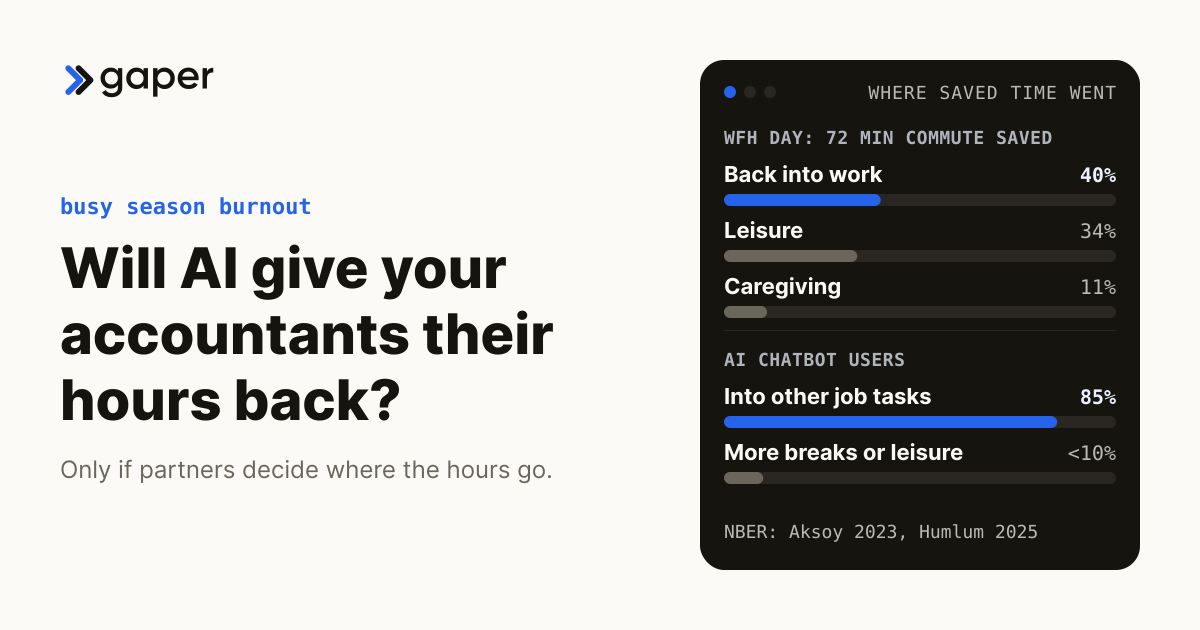
- Two fifths of the saved commute went back to work. Surveying full-time workers in 27 countries, Aksoy, Barrero, Bloom, Davis, Dolls and Zarate (NBER, 2023), later published in AEA Papers and Proceedings, found that a day worked from home saved 72 minutes of commuting on average. Workers put 40% of that into their primary and secondary jobs, 34% into leisure and 11% into caregiving.
Where the workday ends is a decision, not a feature of the tools. Laptops and video software did not make that decision, and an AI agent will not either.
Why can AI make busy season longer, not shorter?
Because the early evidence shows saved time being spent on more work. People who save time with AI mostly move it into other tasks, take on scope that used to belong to someone else, and let work spill into their pauses. In a firm that bills by the hour inside a compressed season, every pressure points the same way.
- Saved time gets reallocated, not returned. Humlum and Vestergaard (NBER Working Paper 33777, May 2025, revised March 2026) linked a late 2024 survey of 25,000 Danish workers across 7,000 workplaces, in 11 AI-exposed occupations that include accountants, to administrative labor market records. Some 85% of chatbot users said they moved saved time into other job tasks, and fewer than 10% took more breaks or leisure. The study found no measurable change in recorded hours or earnings.
- Work intensifies. In an eight-month study of a 200-person US technology company, Berkeley Haas researchers Ranganathan and Ye found employees worked faster, took on a broader scope and stretched work into more hours of the day, often without being asked (Harvard Business Review, February 2026; Berkeley Haas summary). It is one company, but any partner will recognize the mechanism.
- The savings are modest and easy to lose. In a November 2025 St. Louis Fed analysis of the Real-Time Population Survey of US adults aged 18 to 64, Bick, Blandin and Deming found that workers' self-reported generative AI time savings equal 1.6% of all work hours, and caution that the productivity gain may be smaller if saved time goes to lower-value tasks.
Then add the firm's incentives. In the Thomson Reuters Institute's 2026 State of Tax Professionals Report, 78% of respondents said their firms primarily bill by the hour, so an hour an agent saves is an hour of revenue lost unless someone refills it.
Which busy season tasks can AI agents take off the desk?
The high-volume, rule-heavy work around the return: chasing and sorting client documents, populating workpapers from standard source forms, and first drafts of routine client emails. Positions, review sign-off and advice stay with people. The harder question is where the time drifts once those tasks go.
The table uses the Gaper Ownership Map: every step is Automated, Agent-drafted, human-approved, or Human-owned, where the agent never runs it alone.
| Busy season task | Ownership Map tier | Where the saved time drifts if nobody decides |
|---|---|---|
| Templated reminders for missing documents and unreturned organizers | Automated | Late clients accepted because intake now feels handled |
| Sorting, naming and indexing uploaded source documents | Automated | More returns squeezed in before the deadline |
| Populating workpapers from W-2s and 1099s (K-1s stay manual in the first season) | Agent-drafted, human-approved | A longer review queue for seniors and managers |
| Tailored follow-ups on missing items, status updates, extension notices and routine client replies | Agent-drafted, human-approved | More client requests answered inside the same fee |
| Positions taken, signing, advice, engagement acceptance | Human-owned | Where partner hours should go, not where they get squeezed |
For workpapers, including why K-1s wait, see our guide to automating tax workpaper preparation. To place your own workflows, the accounting workflow automation matrix classifies common accounting workflows by how much an agent can own and the review gate each needs.
Where should the freed hours go?
Decide before the agent goes live, in writing, with a number. There are three destinations: shorter weeks, advisory work, or a hire you no longer need. Shorter weeks do not show up as new revenue or an avoided salary, so unless a partner names that goal, it loses to the other two by default.
Our capacity guide works through the two paths that do show up on a P&L, billable advisory capacity or an avoided hire, and why you cannot count both. The third path is the one that addresses burnout.
In the Thomson Reuters Institute's 2026 State of Tax Professionals Report, 30% of respondents said their firm had moved tasks from tax and accounting professionals to staff without similar qualifications in the past year. Among those respondents, the primary driver was freeing professionals for advisory work (39%) or busy season capacity constraints (33%), and improving work-life balance was the primary driver for 5%. The question is about delegation, not AI, but it shows that when firms free up professionals' time on purpose, shorter weeks are rarely the aim.

When firms free up professionals' time on purpose, work-life balance is rarely the driver. Source: Thomson Reuters Institute, 2026 State of Tax Professionals Report.
Some firms do pick shorter weeks on purpose. The Thomson Reuters Institute reported in March 2025 that Sassetti, a 50-person firm in Oak Brook, Illinois, was cutting its maximum tax season hours from 65 to 58 as part of a five-year program, on the way to a 50-hour goal it calls The Path to 50. The cap is the decision; tools are one way to meet it.
A workable version for your firm:
- Set a weekly cap for the peak weeks before the season, by role, and publish it.
- Assign every expected hour to one destination, the cap first, then advisory work or capacity, so no hour is counted twice, and record the split where your AI steering committee can see it.
- Treat a breach of the cap as an incident, the way you would treat a missed deadline: find out which work refilled the hours.
Thomson Reuters' 2026 Future of Professionals report for tax and accounting (538 responses from professionals in tax and audit firms in 40 countries, about a third from US firms, March and April 2026) argues AI "makes busy seasons more manageable" for smaller practices. The same report says the key decision is whether freed capacity goes to growth, work-life balance or advisory work, since drifting into all three dilutes each.
How do you stop scope creep from eating the saved hours?
Price it and gate it. Scope creep arrives from two directions: clients who expect more for the same fee once turnaround gets faster, and staff who fill freed time with work nobody asked for. Engagement letter cutoffs, priced extras and one hours budget for all new work stop both.
On the client side, faster preparation invites more requests and later documents inside a fixed fee. Write cutoff dates into the engagement letter, price work outside the letter instead of absorbing it, and consider a late-document fee, which Sassetti's managing partner described in 2025 as surge pricing. What to charge once AI changes your cost base is covered in pricing AI-enabled accounting services.
On the staff side, the Berkeley study found people took on work that was once someone else's job, or that nobody would have tried before, often voluntarily. That energy is valuable in July. In March, it breaches the cap. Route any new internal project during the season through the same hours budget as client work.
Will seniors become the new bottleneck?
They can, unless the review layer is redesigned. Agents shift effort from preparing to checking, and checking sits with the scarcest people in the firm at the worst time of year. Drafts reach seniors and managers sooner, so their queue grows as the staff queue shrinks.
Persellin's auditors were past their own quality threshold before any agent arrived, and a stream of agent drafts recreates that compression one level up. Put the seniors' and managers' review queue on the same weekly cap as everyone else, and set rules so their hours go to items that need judgment rather than rereading every draft. Then watch the age of that queue each week: when items start waiting longer, the cap is about to be breached one level up.

Each leak is closed by a decision made before the season, not by the agent.
For the evidence on review time, see our accounting hub's answer on whether automation cuts review time or just moves it. Who reviews, which habits they need and what to train is the subject of the AI skills gap in accounting firms.
What should partners measure instead of tasks automated?
Hours worked by each person in the peak weeks, against last season. Tasks automated, documents processed and adoption rates can all rise while people work the same weeks, which is what a 2025 NBER study of 25,000 Danish workers found: reported time savings, unchanged recorded hours.
| Instead of | Measure | Why |
|---|---|---|
| Tasks or documents processed by the agent | Hours worked per person in the peak weeks, against the prior season | The goal is a shorter week, not a busier agent |
| Estimates of hours saved | Evening and weekend time logged | Work moves into pauses before it shows up as longer days |
| Returns completed | Age of the review queue for seniors and managers | Shows whether the bottleneck moved up a level |
| Agent accuracy alone | Hours spent correcting agent drafts | Correction time quietly cancels savings |
| Adoption rate | Leave taken after the deadline, and resignations in the following quarter | Resignations and recovery leave lag the season, so they show what it cost |
Baseline these on the season you just finished. Without a baseline, every claim about hours is an opinion.
Reference build: a document intake agent with an hours budget
Reference build: illustrative, not a client engagement.
A 1040 practice deploys an agent that reads uploaded client documents, checks them against last year's list and drafts tailored follow-up emails for anything missing, each approved by a staff member before it is sent. The checklist match is Automated, the tailored follow-ups are Agent-drafted, human-approved, and accepting a late client is Human-owned.
It is a burnout build rather than a throughput build because the hours budget comes first: the firm records intake hours per person in last season's peak weeks and sets next season's target before the build starts. The metric is hours worked by the intake team in the peak weeks, plus follow-up loops per client. No outcome is claimed here.
Because the agent reads return information, the Section 7216 consent question has to be settled before any client data reaches it. Owning the agent changes where data runs and what is logged, not the consent duty. If intake is where your season breaks, scope a document intake agent in 30 minutes, starting from the hours budget it has to hit.
How Gaper approaches a busy season build
Gaper is the AI-native implementation partner that deploys supervised AI agents you own. We build one workflow at a time inside your systems, with human approval on anything material. For a busy season build, that means starting from the Ownership Map and the hours budget, not from a list of tasks to automate.
The Gaper method runs Assess, Scope, Build, Supervise, Hand over, and you own the code, prompts, evaluation set, runbook and audit trail. Run the Rent-vs-Own test first: if an off-the-shelf intake tool covers the workflow cleanly, rent it and put the effort into the cap. The tool was never the hard part of busy season. Deciding what the hours are for is.
Thirty minutes, no commitment. We map one workflow, make the build or buy call, and scope the smallest thing worth shipping.
Frequently asked questions
What does busy season burnout cost a firm?
Did remote work give people their time back?
Why can AI make busy season longer, not shorter?
Which busy season tasks can AI agents take off the desk?
Where should the freed hours go?
How do you stop scope creep from eating the saved hours?
Ready to turn AI into execution?
Book a free assessment of one workflow. We map it, make an honest build versus buy call before any code, and if an off the shelf product covers the job we will tell you so.