
AI Skills Gap in Accounting Firms: What to Train, Hire, or Hand Off
The AI skills gap in accounting is review, exceptions and workflow ownership. Map each skill to an Ownership Map tier and decide to train, hire or hand it off.
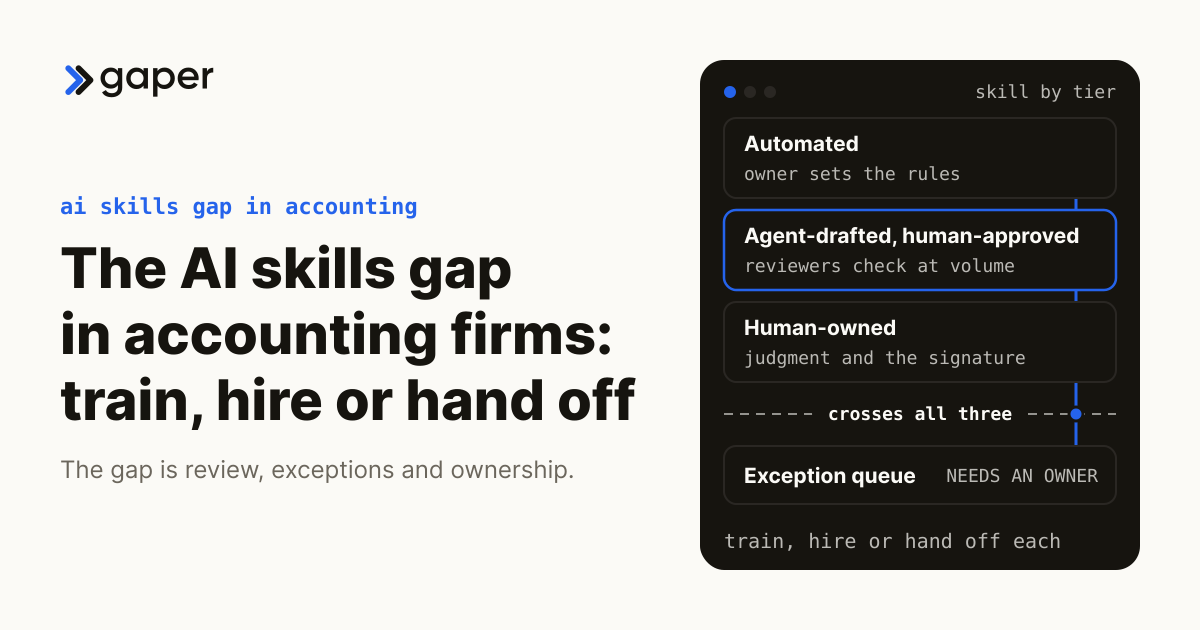
The AI skills gap in accounting is not about prompting. Once agents draft the work, a firm needs people who can review agent output at volume, clear the exceptions an agent cannot resolve, and own a workflow from intake to sign-off, and the surveys below show most firms have not yet built structured AI training for any of it. This guide is for managing partners: it maps each tier of the Gaper Ownership Map to the skill it needs, shows which roles change first, and gives you a train, hire or hand off table.
What is the AI skills gap in accounting?
It is the distance between the work agents now draft and the people trained to check, correct and own that work. The gap sits in review, exception handling and workflow ownership, not in using a chat window, and it widens as agents take on more of the preparation.
- Skills already cap growth. In the Thomson Reuters Institute's 2026 Tax Firm Advisory Services Report (December 2025), 52% of respondents cited staff skills gaps among colleagues as their biggest challenge in expanding advisory work (advisory skills, not AI skills specifically), ahead of client resistance to paying for advice at 47%.
- Confidence runs ahead of training. In the AICPA PCPS and CPA.com 2025 National MAP Survey, 88% of responding firms were confident or not concerned (56% somewhat or very confident) about adapting to AI and automation over the next three years, yet the AICPA's release (September 2025) notes most had yet to develop structured training.
- Vendor data agrees. Karbon's 2026 State of AI in Accounting Report (January 2026, nearly 600 professionals worldwide) found fewer than half of firms invest in AI training and only 21% have an AI policy or strategy. Karbon is a software vendor; read it as direction.
- Agents are next. In the Thomson Reuters 2026 AI in Professional Services Report (surveyed late 2025), 14% of tax firm respondents said their firm already uses agentic AI and about 63% were planning or considering it, against 15% and 53% across all 1,514 respondents.
Why doesn't tool training close the gap?
Because tool training teaches which buttons to press, and the gap is judgment about output. A 2010 Human Factors review found experts and novices both miss errors in automated suggestions, and that instructions alone do not fix it, so firms have to design the review as well as train the reviewer.
Education has always trailed the tools. CPE and vendor tutorials teach the product, not how your agent fails on your clients' files, so that learning happens inside the firm and is a partner decision, not an HR one.
The review is Parasuraman and Manzey's, in Human Factors (2010): automation bias appeared in naive and expert users alike, and complacency set in when people juggled several tasks, a fair description of busy season. What that means for how juniors learn to review is set out in how AI assists bookkeepers.
So put controls in the workflow, not only the classroom: route low-confidence items to a person by rule.
Training still matters, and the IRS expects it. In Issue Number 2026-19 (24 June 2026), the Office of Professional Responsibility reads the Circular 230 competence rule, section 10.35, to require understanding how your AI works, where it is limited and whether its output is fit to use. Under section 10.36, it says firm procedures must include staff training on AI use.
Cadence is the weak point. In the Thomson Reuters 2025 Generative AI in Professional Services Report (1,702 professionals across the same fields, early 2025, its most recent survey to ask), 64% had received no generative AI training at work. One session at launch cannot keep up with an agent that changes whenever its model or prompt does.

Which skills does each tier of the Ownership Map need?
Each tier needs a different skill. Automated steps need an owner who sets the rules and watches the monitoring, and agent-drafted, human-approved steps need reviewers who check at volume. Human-owned steps need judgment, plus the ability to explain AI-assisted work to clients and regulators.
The Gaper Ownership Map sorts every workflow step into Automated, Agent-drafted, human-approved, or Human-owned, where the agent never runs it alone.
| Tier | Typical steps at a tax or CAS practice | Skill the firm needs | Who usually holds it |
|---|---|---|---|
| Automated | Document request reminders, file naming and indexing, exact-match bank lines | Workflow ownership: rules, thresholds, exception rates, and pulling a drifting step back to review | A manager or operations lead |
| Agent-drafted, human-approved | Transaction coding below a confidence threshold, workpaper population, first drafts of notice responses and client emails | Review at volume: tracing to source, sampling clean items, knowing failure patterns, logging every correction | Seniors and managers |
| Human-owned | Signing the return, positions taken, advice, engagement acceptance, Section 7216 consent decisions | Professional judgment, and explaining how AI-assisted work was checked to a client, a peer reviewer or the IRS | Managers and partners |
One skill crosses all three tiers: exception handling. Every agent leaves a queue of items it could not resolve, and someone has to fix each item and decide whether the fix belongs in the rule. A queue with no owner becomes a backlog.
An agent-drafted step moves to Automated only on measured accuracy, proposed by the workflow owner and approved by the steering committee; Human-owned steps do not move.
What does a good reviewer of agent output do differently?
They check the source document, not the agent's summary of it. They sample items the agent marked clean, know where this agent tends to fail, and record every correction so the next version is tested against it. Speed comes from knowing where to look, not from reading faster.
Five habits do most of the work:
- Trace to source. Open the 1099 or the bank statement, not the extracted table.
- Sample the clean pile. Review a fixed random sample of items the agent did not flag; silent errors surface there.
- Know the failure patterns. In tax extraction, K-1s and poor scans are common ones.
- Log corrections as test cases. Each one joins the evaluation set the agent is retested against before any change ships.
- Stop the line. Seeing the same error twice means escalating to the workflow owner, not fixing it a third time.
What belongs in the file afterward is set out in our tax workpaper preparation guide.
Then budget the hours. Review time moves rather than disappears, as the accounting hub's answer on review time shows, so plan reviewer capacity before the season.
Which roles change first when agents arrive?
Staff accountants change first, because agents absorb the preparation that filled their day. Seniors become the main reviewers, managers become workflow owners, and partners keep the human-owned decisions plus accountability for how the whole system is checked.
- Staff accountant. CPA.com's 2025 AI in Accounting Report (June 2025) says entry-level roles increasingly require AI fluency alongside accounting fundamentals, with early-career staff building "AI oversight" capabilities instead of routine tasks. Assign complexity on purpose: rotate juniors through the exception queue, where the hard problems now sit.
- Senior. Moves from preparing to reviewing agent drafts at volume, with the authority to stop the line.
- Manager. Becomes the workflow owner: thresholds, the exception queue, approving prompt or rule changes, and planning reviewer hours.
- Partner. Owns the human-owned tier and the client conversation about how AI-assisted work is checked and priced.
The same report names emerging roles such as AI operations managers and AI QA reviewers; at a smaller firm, expect them to start as duties inside existing jobs. Which role to hire next is covered in how to scale an accounting firm without hiring more staff.

Should you train, hire or hand off each skill?
Train the skills that depend on knowing your clients and your standards: review, exception handling and judgment. Hire when one person will own several agents as a real job. Hand off the build itself, the code, integrations and evaluations, when you need one workflow done and owned by your firm afterward.
| Skill | Train when | Hire when | Hand off when |
|---|---|---|---|
| Reviewing agent output | By default; add the five habits and seeded errors | Rarely; domain knowledge is the hard part to buy | Never the sign-off |
| Exception handling | By default, seniors and juniors in rotation | Queues across several agents justify a dedicated operations role | Rule fixes during a build, documented for your owner |
| Workflow ownership | One manager or operations lead per workflow | You run several agents and need one lead across them | Initial setup only, with owner training |
| Building and integrating agents | Rarely worth it at a smaller firm | AI is a standing program with a pipeline of builds | One workflow at a time, to a partner who hands over code and runbook |
| Compliance judgment (7216, WISP, Safeguards) | Every reviewer needs the basics | No one in the firm can serve as Qualified Individual (16 CFR 314.4(a) requires one now; it may be an employee, an affiliate or a service provider) | Legal questions go to your counsel, not the vendor |
| Client conversation about AI-assisted work | Partners | No | No |
In Thomson Reuters' 2025 survey, its most recent to ask, only 2% of respondents said their organization made generative AI knowledge a requirement in current hiring practices. Few employers screen for the skill yet, so build your own test: a review exercise on a file with seeded errors.
Before handing off a build, run the Rent-vs-Own test: rent a point tool for narrow, common work; own a supervised agent when the work touches systems of record, client data or risk. If a workflow fits more than one column, a free AI assessment maps it before anyone writes code.
Where skills planning sits in firm AI governance
Skills planning sits with each workflow owner, who sees what that workflow's reviewers miss, and the steering committee approves one training plan per workflow; firm-level ownership is covered in how to set up an AI steering committee. A larger firm may give the agenda to a Chief AI Officer, but accountability stays with the individuals who hold principal authority for the firm's tax practice under 31 CFR 10.36, the section OPR applied to AI in Issue Number 2026-19.
Track two numbers: the error rate reviewers find in agent-drafted work, which measures the agent, and the share of seeded errors reviewers catch, which measures the training. A falling catch rate means the training is not working.
What compliance does every reviewer need to know?
Three things. A reviewer needs to know whether Section 7216 requires client consent before return information reaches an AI tool (unsettled for model APIs, so get it), the firm's WISP under the FTC Safeguards Rule, and the IRS reading of Circular 230 that AI-created work is reviewed before it reaches a client or the IRS.
Someone who knows only the tool cannot catch a breach of any of them. This is information, not legal advice.
- Section 7216 consent. Using or disclosing return information outside the exceptions needs the taxpayer's consent under 26 CFR 301.7216-3(a), in the format Rev. Proc. 2013-14 sets. For a 1040 client, consent cannot cover sending the SSN to a preparer outside the United States, apart from the narrow safeguard exception in 301.7216-3(b)(4)(ii). Owning the agent changes where data runs and what is logged; it does not remove the consent duty. See Section 7216 consent for AI tools.
- WISP and the Safeguards Rule. Tax and accounting professionals are financial institutions under the Gramm-Leach-Bliley Act and need a written information security plan, as the IRS repeated in IR-2026-92 (18 August 2026). 16 CFR 314.4(f) requires overseeing service providers, and on the 314.2 definition an AI vendor that receives or processes client data reads as one. See what to add to your WISP for AI.
- The Circular 230 review duty. The same OPR guidance reads the due diligence rule, section 10.22, to require reviewing all AI-created documents before delivery to a client or the IRS, verifying facts, citations and calculations.
A one-quarter plan to close the gap on one workflow
Pick one workflow, not the whole firm. The plan assumes the agent exists, bought or piloted, and covers people, not the build. Run it outside busy season, when reviewers can practice on old files.
| Weeks | Focus | What gets done |
|---|---|---|
| 1 to 4 | Map and name | Sort each step into the three tiers, name the workflow owner, and record two baselines on a past file: the agent's error rate and the share of seeded errors reviewers catch. |
| 5 to 8 | Train on your own files | Review past files with seeded errors. Set the clean-item sample. Write the exception playbook: the common exceptions and who clears each. |
| 9 to 12 | Measure and decide | Compare both numbers with the baselines, choose train, hire or hand off for each missing skill, and report to the steering committee. |
How does Gaper hand over a workflow your team can run?
Gaper is the AI-native implementation partner that deploys supervised AI agents you own. An engineer builds one workflow inside your systems, then hands over the code, runbook, evaluation set and owner training, so your people can run it without us.
Our forward-deployed engineers embed with your team, scope one workflow from your existing process and build the agent in your repo, with evaluations, guardrails and human approval on risky actions. It runs in supervised production in your cloud with an audit trail and a named owner. The Gaper method runs Assess, Scope, Build, Supervise, Hand over. If you prefer, we keep operating it under an SLA.
Gaper is not a staffing agency; handing off means a defined workflow, not people for your seats. If an off-the-shelf product already covers the workflow cleanly, we will say so, and you should buy it.
Thirty minutes, no commitment. We map one workflow, make the build or buy call, and scope the smallest thing worth shipping.
Frequently asked questions
What is the AI skills gap in accounting?
Why doesn't tool training close the gap?
Which skills does each tier of the Ownership Map need?
What does a good reviewer of agent output do differently?
Which roles change first when agents arrive?
Should you train, hire or hand off each skill?
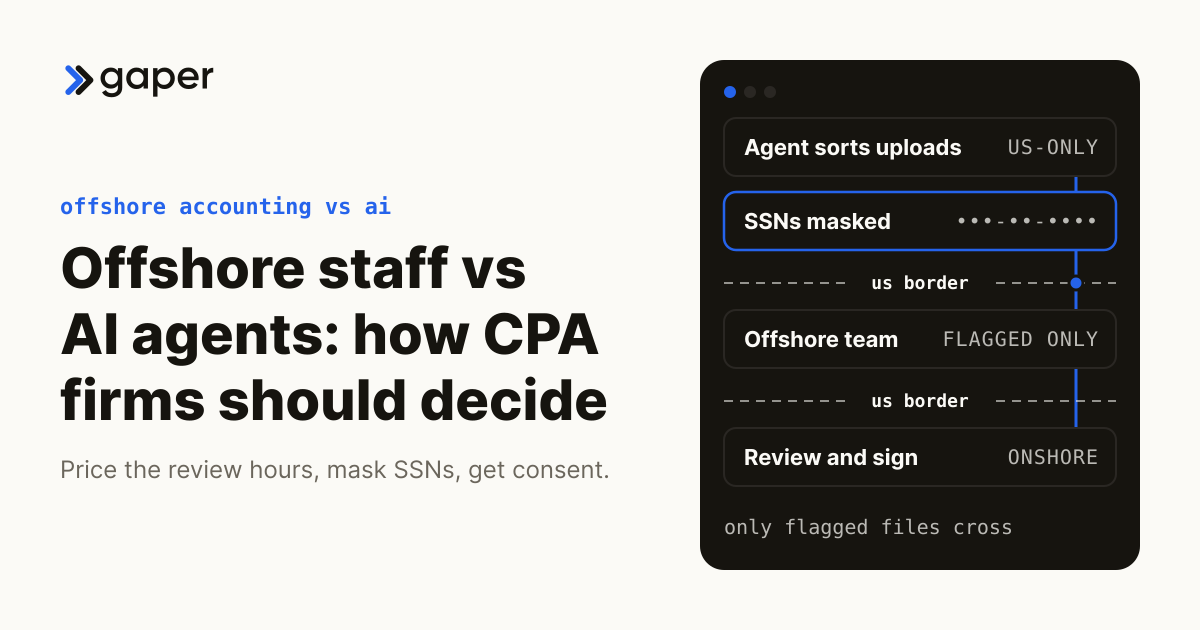
Offshore Accounting Staff vs AI Agents: How CPA Firms Should Decide
IndustryAI Implementation Cost for Accounting Firms (2026 Bands)
One AI workflow costs an accounting firm $12,000 to $34,000 to build and $690 to $2,630 a month to run, once you count the reviewer. Full tables and when to buy instead.
Sep 4, 2026
A New Era of Expense Management for Mid-Size Accounting Firms
Ready to turn AI into execution?
Book a free assessment of one workflow. We map it, make an honest build versus buy call before any code, and if an off the shelf product covers the job we will tell you so.