
Algorithmic Trading in Python: A 2026 Implementation Guide
Algorithmic trading in Python: which backtesting frameworks are still maintained, how overfitting kills strategies, and why regulators require human approval.
TL;DR: Algorithmic Trading in Python
Algorithmic trading in Python has moved from a niche practice at major hedge funds into something a small fintech, prop shop, or independent quant can run in production. The language's ecosystem, from backtesting frameworks to broker APIs, lets you research, test, risk-manage, and deploy strategies without a C++ team. But writing the strategy is the easy part. The expensive, repetitive, judgment-adjacent work is the loop around the strategy: data validation, backtest sweeps, overfitting checks, risk review, the deployment approval, live monitoring, and audit trails. That loop is where AI agents belong, and in trading, the human approval gate that agents must respect is not a nice-to-have, it is a regulatory requirement.
- Python is the most in-demand language in the 2025 Stack Overflow Developer Survey, used by 57.9% of developers and the most desired language for the third year running, driven by AI, data science, and quant work.
- The global algorithmic trading market was about $21.06 billion in 2024 and is projected to reach $42.99 billion by 2030 at a 12.9% CAGR (Grand View Research).
- A moving-average crossover takes an afternoon to write. A governed research-to-production pipeline that a regulator will accept takes far longer, and that is the part worth automating.
- The maintained framework picture has shifted: the original Zipline is defunct, Backtrader's development has slowed, and faster or more actively maintained options (zipline-reloaded, VectorBT, NautilusTrader) now matter.
- In trading, the human-in-the-loop approval gate is mandated by supervision and market-access rules, which makes it the one domain where "agent drafts, human approves" is the compliant design, not a compromise.
Educational content, not investment advice. This article explains how to build and operate algorithmic trading systems. It does not recommend any strategy, security, parameter, or capital amount, and nothing here is a prediction of returns. Trading involves substantial risk of loss. Compliance requirements below are summarized for orientation only; verify them with qualified securities counsel before you deploy anything.
What algorithmic trading in Python is
Algorithmic trading in Python means using Python to define, test, and run trading rules that a computer executes without a human placing each order. The rules can be simple (buy when the 50-day moving average crosses the 200-day) or complex (a machine-learning model scoring hundreds of features), but the shape is the same: a signal generates an order, subject to risk limits and controls, executed through a broker API.
Why Python for quantitative finance
Python won quant research because the ecosystem is unmatched: pandas and NumPy for data, scikit-learn and PyTorch for models, and a deep bench of backtesting and broker libraries. It is not the fastest language, and the lowest-latency execution still lives in C++ and FPGAs, but for research, backtesting, and anything slower than microsecond execution, Python is the default. That is why it is used by 57.9% of developers in the 2025 Stack Overflow survey and remains the most desired language.
What Python is good at, and what it is not
Python is excellent for the research-to-production loop: ingesting data, engineering features, backtesting, and deploying strategies that trade on second-to-daily horizons. It is not where you build a latency-sensitive market-making engine. Be honest about which problem you have before you pick the stack.
Python backtesting frameworks compared
The framework you pick shapes everything downstream. The landscape changed since this guide first published, so here is the current, honest picture.
| Framework | Best for | Maintenance status (2026) | Learning curve | Cost |
|---|---|---|---|---|
| zipline-reloaded | Daily-bar equity factor research, Pipeline API | Active community fork (Stefan Jansen); the original Quantopian Zipline is defunct | Steep (bundle ingestion, Pipeline paradigm) | Open source |
| Backtrader | General event-driven backtesting, broker integrations | Aging; development has slowed, still widely used | Moderate | Open source |
| VectorBT | Fast vectorized backtests, large parameter sweeps | Active; fastest option for sweeps | Moderate to steep | Open core (PRO is paid) |
| NautilusTrader | Intraday, order-book, live crypto/FX | Active; strong live-trading focus | Steep | Open source |
| QuantConnect | Cloud backtesting, hosted data, live deployment | Active managed platform | Moderate | Free tier plus paid |
How to choose. For daily equity factor research, zipline-reloaded or VectorBT. For fast, wide parameter sweeps, VectorBT. For live intraday or order-book strategies, NautilusTrader. For a hosted, data-included environment, QuantConnect. Backtrader remains a reasonable teaching and event-driven engine, and it is what the tutorial below uses, but if you are choosing fresh for a fast or actively maintained stack, weigh the newer options. If a strategy is worth real capital, the framework is the least of your concerns next to the operational loop around it.
Building your first Python trading algorithm, step by step
This tutorial builds a working strategy in Backtrader. Every block is runnable. Verified against Backtrader 1.9.78, Python 3.11, and scikit-learn 1.4. Backtrader is chosen here for clarity, not because it is the fastest engine.
Step 1: Data acquisition and preparation
Start with a simple moving-average strategy so the mechanics are clear before the logic gets interesting.
import backtrader as bt
import datetime

class MyStrategy(bt.Strategy):
    params = (('maperiod', 15),)

    def __init__(self):
        self.dataclose = self.data.close
        self.sma = bt.indicators.SimpleMovingAverage(
            self.data, period=self.params.maperiod)

    def next(self):
        if not self.position:
            if self.dataclose[0] > self.sma[0]:
                self.buy(size=100)
        else:
            if self.dataclose[0] < self.sma[0]:
                self.close()

cerebro = bt.Cerebro()
cerebro.addstrategy(MyStrategy)

data = bt.feeds.YahooFinanceData(
    dataname='AAPL',
    fromdate=datetime.datetime(2020, 1, 1),
    todate=datetime.datetime(2025, 1, 1))

cerebro.adddata(data)
cerebro.broker.setcash(100000.0)
cerebro.addsizer(bt.sizers.FixedSize, stake=100)
cerebro.run()
print(f'Final Portfolio Value: {cerebro.broker.getvalue()}')
Note: free data feeds are fine for learning, not for research you will trade. Vendor feed quality, survivorship bias, and corporate-action adjustments matter more than the strategy, which is exactly why data validation is the first agent workflow later on.
Step 2: Signal generation with indicators and machine learning
Combine indicators into a signal. Backtrader's Bollinger Bands expose their lines as top, mid, and bot.
class AdvancedStrategy(bt.Strategy):
    params = (('rsi_period', 14), ('bb_period', 20))

    def __init__(self):
        self.rsi = bt.indicators.RSI(self.data, period=self.params.rsi_period)
        self.bb = bt.indicators.BollingerBands(self.data, period=self.params.bb_period)
        self.macd = bt.indicators.MACD(self.data)

        # Buy when RSI is oversold AND price is below the lower Bollinger Band.
        self.signal = (self.rsi < 30) & (self.data.close < self.bb.lines.bot)

    def next(self):
        if self.signal[0]:
            if not self.position:
                self.buy(size=50)
        elif self.position and self.rsi[0] > 70:
            self.close()
A machine-learning variant scores features instead of using fixed thresholds. This version defines its Bollinger Bands so bb_lower and bb_upper actually exist (the earlier draft of this article referenced them without defining them, and the block would not run).
from sklearn.ensemble import RandomForestClassifier
import numpy as np

class MLStrategy(bt.Strategy):
    def __init__(self):
        self.features_buffer = []
        self.model = RandomForestClassifier(n_estimators=100, random_state=42)
        self.trained = False
        self.rsi = bt.indicators.RSI(self.data)
        self.bb = bt.indicators.BollingerBands(self.data, period=20)

    def next(self):
        close_prices = self.data.close.get(size=20)  # last 20 closes
        if len(close_prices) < 5:
            return

        bb_lower = self.bb.lines.bot[0]
        bb_upper = self.bb.lines.top[0]
        bb_position = (self.data.close[0] - bb_lower) / (bb_upper - bb_lower)

        features = np.array([
            close_prices[-1] / close_prices[-5],  # 5-day return
            self.rsi[0] / 100,                     # normalized RSI
            bb_position
        ])

        if len(self.features_buffer) < 100:
            self.features_buffer.append(features)
            return

        if not self.trained:
            X = np.array(self.features_buffer)
            y = np.array([1 if self.data.close[-i] > self.data.close[-i - 1] else 0
                          for i in range(len(self.features_buffer))])
            self.model.fit(X[:-1], y[1:])
            self.trained = True

        prediction = self.model.predict([features])[0]
        if prediction == 1 and not self.position:
            self.buy()
        elif prediction == 0 and self.position:
            self.close()
Honest note on machine learning: a model that looks brilliant in backtest is usually overfit. Markets are non-stationary, so a pattern that held last year decays, sometimes fast. This is alpha decay, and it is why the overfitting and robustness review later in this article is a real workflow, not a formality. Backtest returns are not realized returns.
Step 3: Backtesting and performance metrics
Wire in analyzers and read the metrics that matter.
cerebro = bt.Cerebro()
cerebro.addstrategy(AdvancedStrategy)
cerebro.broker.setcash(100000)
cerebro.broker.setcommission(commission=0.001)  # 0.1% commission

# Track performance
cerebro.addanalyzer(bt.analyzers.SharpeRatio, _name='sharpe')
cerebro.addanalyzer(bt.analyzers.DrawDown, _name='drawdown')
cerebro.addanalyzer(bt.analyzers.Returns, _name='returns')

data = bt.feeds.YahooFinanceData(
    dataname='AAPL',
    fromdate=datetime.datetime(2020, 1, 1),
    todate=datetime.datetime(2025, 1, 1))
cerebro.adddata(data)

results = cerebro.run()
strat = results[0]

print(f"Sharpe Ratio: {strat.analyzers.sharpe.get_analysis()}")
print(f"Max Drawdown: {strat.analyzers.drawdown.get_analysis()['max']['drawdown']}")
print(f"Total Return: {(cerebro.broker.getvalue() / 100000 - 1) * 100}%")
The six metrics to read, and rough thresholds for orientation (not targets, not advice):
- Sharpe ratio: risk-adjusted return. Above ~1.0 is worth attention, above ~2.0 is strong, and suspiciously high usually means a bug or lookahead.
- Sortino ratio: like Sharpe but penalizing only downside volatility.
- Maximum drawdown: the worst peak-to-trough loss. Decide your ceiling before you deploy.
- Win rate: percentage of winning trades, meaningless without payoff size.
- Profit factor: gross profit over gross loss. Above ~1.5 is generally considered healthy.
- CAGR: compound annual growth rate, read alongside drawdown, never alone.
Step 4: Risk management and position sizing
Risk controls are the difference between a strategy and a way to lose money quickly. This class enforces a drawdown ceiling and sizes positions off account risk. It defines its own signal and guards against sizing before an entry exists.
class RiskManagedStrategy(bt.Strategy):
    params = (
        ('max_account_drawdown', 0.20),  # stop trading if down 20%
        ('risk_per_trade', 0.02),        # risk 2% of account per trade
        ('stop_pct', 0.02),              # 2% stop loss
        ('take_pct', 0.05),              # 5% take profit
    )

    def __init__(self):
        self.entry_price = None
        self.account_high = self.broker.getvalue()
        self.sma = bt.indicators.SimpleMovingAverage(self.data, period=20)
        self.signal = self.data.close > self.sma  # simple trend filter

    def notify_order(self, order):
        if order.status == order.Completed and order.isbuy():
            self.entry_price = order.executed.price

    def next(self):
        current_value = self.broker.getvalue()
        self.account_high = max(self.account_high, current_value)
        drawdown = (self.account_high - current_value) / self.account_high

        # Hard halt if the drawdown ceiling is breached.
        if drawdown > self.params.max_account_drawdown:
            return

        if self.signal[0] and not self.position:
            # Size off account risk and the stop distance, using the current price.
            account_risk = current_value * self.params.risk_per_trade
            stop_distance = self.data.close[0] * self.params.stop_pct
            size = int(min(account_risk / stop_distance,
                           self.broker.getcash() / self.data.close[0]))
            if size > 0:
                self.buy(size=size)

        if self.position and self.entry_price:
            if self.data.close[0] < self.entry_price * (1 - self.params.stop_pct):
                self.close()
            elif self.data.close[0] > self.entry_price * (1 + self.params.take_pct):
                self.close()
Step 5: Paper trading and live deployment
Paper trade before real capital, always. One caution on tooling: alpaca_backtrader_api is no longer actively maintained, and Alpaca's current SDK is alpaca-py. Use paper trading to validate execution assumptions (fills, slippage, latency) against your backtest before going live.
# Paper trading with Alpaca's current SDK (alpaca-py), not the deprecated
# alpaca_backtrader_api. Validate fills and slippage before risking capital.
from alpaca.trading.client import TradingClient
from alpaca.trading.requests import MarketOrderRequest
from alpaca.trading.enums import OrderSide, TimeInForce

# paper=True routes to the paper environment (simulated execution, live data).
client = TradingClient('API_KEY', 'API_SECRET', paper=True)

order = MarketOrderRequest(
    symbol='AAPL',
    qty=10,
    side=OrderSide.BUY,
    time_in_force=TimeInForce.DAY,
)
client.submit_order(order)
Most teams that outgrow a backtesting engine for live execution move the live layer onto a maintained execution stack rather than trading directly from Backtrader. That handoff, backtest to live, is exactly where the workflow layer below earns its keep.
The agentic trading-ops workflow layer
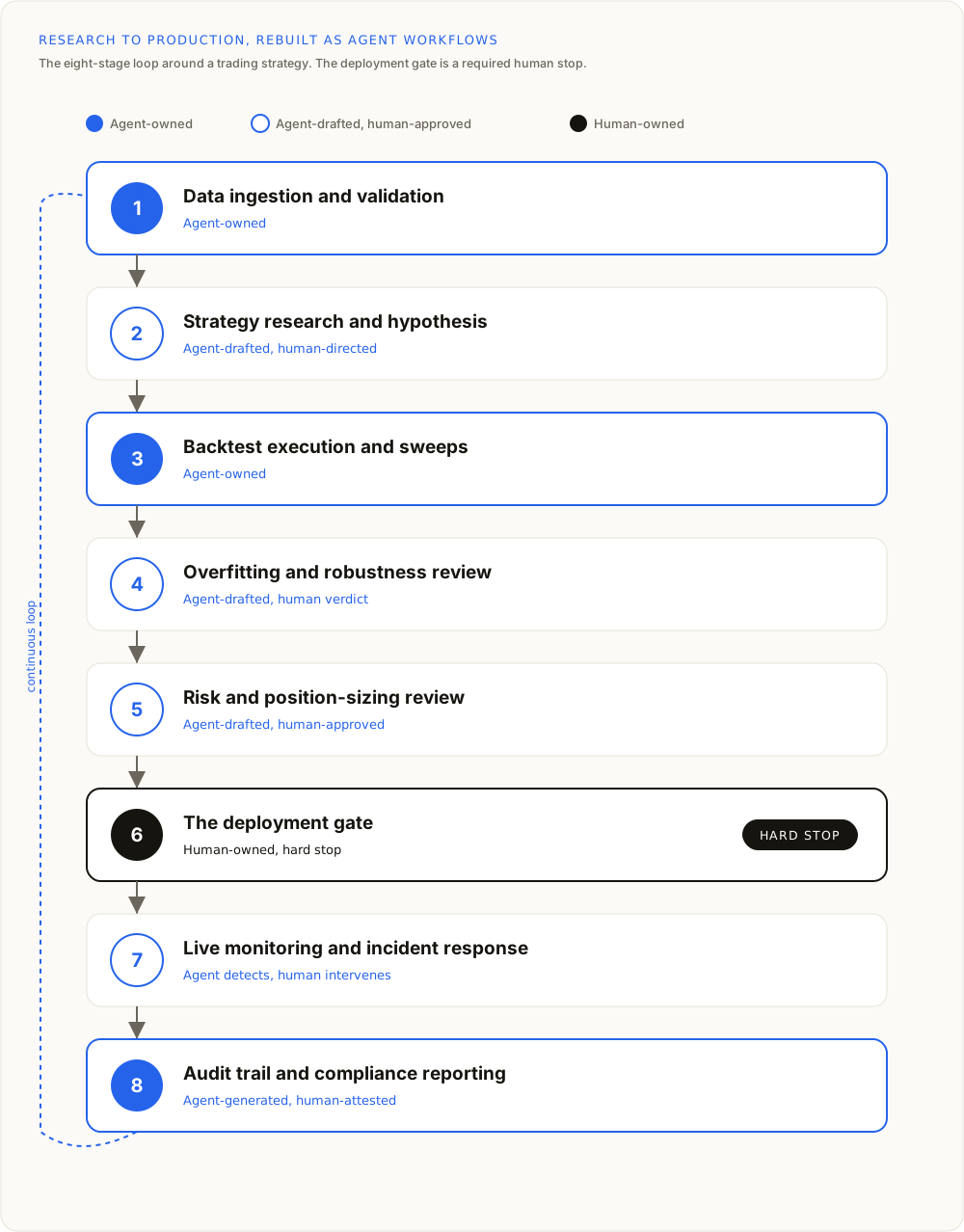
Here is the core idea this refresh is built on: the algorithm is not the interesting automation target, the loop around it is. Strategy research, data validation, backtest sweeps, overfitting checks, risk review, the deployment gate, live monitoring, and audit-trail generation are repetitive and judgment-adjacent, and they are currently done by expensive people. That is where supervised agents belong. And because trading is regulated, the human approval gate an agent must respect is required by law, which makes "agent drafts, human approves" the compliant design rather than a compromise.
Each stage below lists what the human does today, what an agent can own, what stays human-approved, the failure mode, and the audit artifact produced.
Stage 1: Data ingestion and validation
Human today: reconciling vendor feeds, spotting gaps, checking split and dividend adjustments, screening for survivorship bias. Agent-owned with alerting. Failure mode: a silent bad tick or an unadjusted split poisons every downstream backtest. Audit artifact: a data-quality report per feed, per day, with exceptions flagged. This is unglamorous, high value, and the safest place to start.
Stage 2: Strategy research and hypothesis generation
Human today: scanning literature and factors, engineering features, retrieving prior experiments. Agent-drafted, human-directed. The agent proposes and retrieves; a researcher decides. It assists a quant, it does not replace one. Failure mode: plausible but spurious factors that a researcher must reject. Audit artifact: a logged hypothesis with its rationale and the prior work it drew on.
Stage 3: Backtest execution and parameter sweeps
Human today: setting up environments, walk-forward splits, running and aggregating sweeps. Agent-owned. Failure mode: an environment mismatch or a leaked future value invalidates results. Audit artifact: reproducible run manifests (data version, code hash, parameters, seeds).
Stage 4: Overfitting and robustness review
Human today: checking in-sample versus out-of-sample divergence, deflated Sharpe, regime sensitivity, lookahead leakage. Agent-drafted findings, human-owned verdict. This is the most defensible new capability on the page: the agent runs the battery of checks and flags concerns, a human makes the call. Failure mode: shipping an overfit strategy because the checks were skipped under deadline. Audit artifact: a robustness report attached to the strategy.
Stage 5: Risk and position-sizing review
Human today: limit checks, drawdown ceilings, correlation with the existing book. Agent-drafted, human-approved. Failure mode: a strategy that looks fine alone but concentrates risk against positions you already hold. Audit artifact: a pre-deployment risk assessment.
Stage 6: The deployment gate
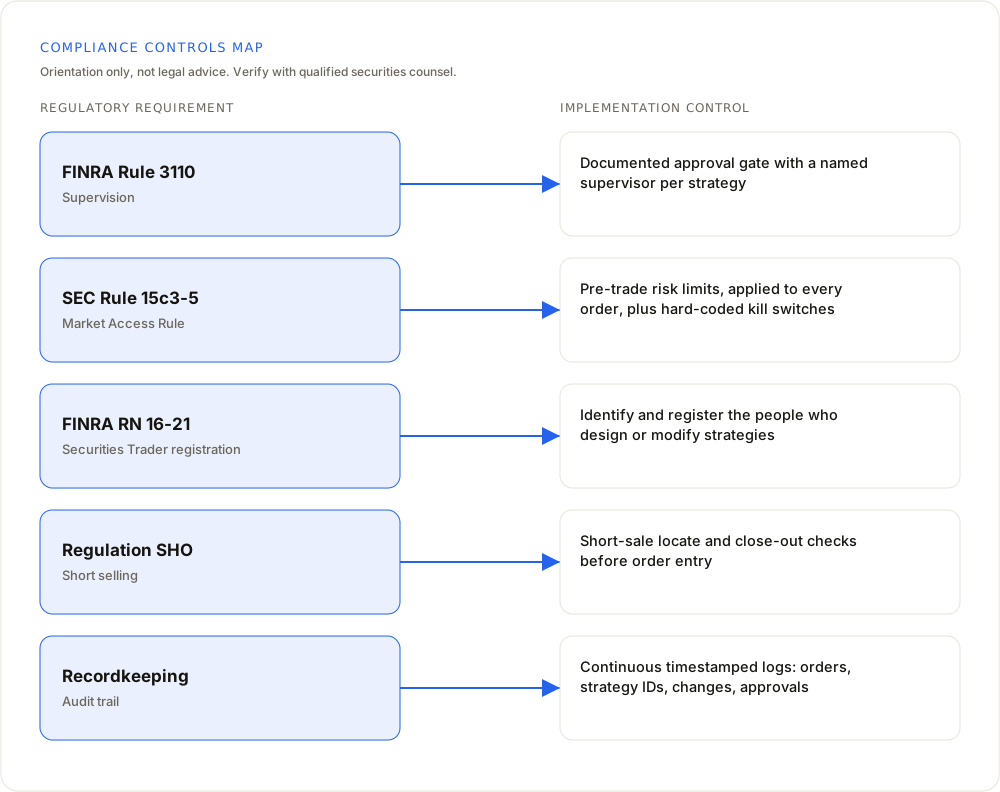
This is the hard stop. The agent assembles the approval package (strategy description, controls, test evidence, risk assessment); a named human approves. Nothing reaches production without it. This maps directly to the supervision and documented-governance expectations under FINRA Rule 3110 and the market-access controls under SEC Rule 15c3-5. Failure mode: an ungated deployment, which is both a trading risk and a supervisory violation. Audit artifact: the signed approval record.
Stage 7: Live monitoring and incident response
Human today: watching for drift, comparing live fills against backtest assumptions, triggering kill switches, escalating. Agent-owned detection, human-owned intervention. Kill switches are hard-coded and non-negotiable, never model-mediated. An LLM does not get to decide whether to halt trading. Failure mode: slippage or drift silently erodes the edge, or a runaway loop keeps trading. Audit artifact: a monitoring log with every alert and action.
Stage 8: Audit trail and compliance reporting
Human today: assembling order logs, strategy IDs, change history, and approval records for supervisors and examiners. Agent-owned generation, human-attested. Failure mode: an incomplete trail when a regulator asks. Audit artifact: the compliance record itself, generated continuously rather than reconstructed under pressure.
What should never be agent-owned in trading
Naming what you refuse to automate is what makes the rest of this credible to an operator and a compliance officer. These stay human, full stop:
- Autonomous capital allocation without a human gate. No strategy goes live, and no size changes materially, without a named human approving it.
- Self-modifying live strategies. A strategy that rewrites its own logic in production is unsupervisable and unauditable.
- LLM-mediated kill switches. Halts are deterministic and hard-coded. A language model never sits between a risk breach and the stop.
- Anything where a hallucinated value could reach an order router. Model output does not flow unvalidated into orders. Ever.
If a vendor cannot tell you where these lines are in their system, that is the answer.
What a governed pipeline actually costs
The right question is not "what does an engineer hour cost." It is "what does it cost to stand up a governed research-to-production pipeline, and what does each additional strategy cost once the pipeline exists."
The useful economics here have not changed: the first strategy is expensive because you are building the pipeline (data validation, backtesting infrastructure, risk controls, the deployment gate, monitoring, audit). Every strategy after that is far cheaper, because it rides the same governed rails. That is an infrastructure-and-agents cost curve, not a per-hour staffing one. You are buying a durable capability your team owns, not renting hours.
For how that maps to a build decision and payback, see the AI agent development cost and AI agent ROI breakdowns rather than a price you will not be able to hold us to.
Regulatory compliance for algorithmic trading
Compliance summarized for orientation only. It is not legal advice, and the specifics change. Verify with qualified securities counsel before deploying.
Supervision and registration
Firms running algorithmic strategies are subject to FINRA Rule 3110 (Supervision), which requires supervisory systems and procedures before and after a strategy is deployed. Separately, under the requirement introduced by FINRA Regulatory Notice 16-21 (SEC-approved in 2016), the people primarily responsible for the design, development, or significant modification of algorithmic trading strategies, or for supervising that work, must register as Securities Traders and pass the qualifying exam. If you build algos at a member firm, that requirement may apply to your engineers.
Market access and pre-trade controls
SEC Rule 15c3-5 (the Market Access Rule) requires broker-dealers with market access to maintain pre-trade risk controls, applied on a pre-trade basis, for every order, whether entered by a human or generated by an algorithm. In practice this is where hard limits and the effect of kill switches live. This rule, not the citation the earlier version of this article used, is the correct anchor for automated pre-trade controls.
Short selling and anti-fraud
Regulation SHO governs short selling, including locate and close-out requirements, and is distinct from algorithmic risk controls. SEC Rule 10b-5 is the general anti-fraud rule; for algorithmic trading it is the backdrop for manipulation concerns such as spoofing and layering. These are separate obligations from market-access controls, and the previous version of this page blurred them.
Practical checklist
- Pre-trade risk controls under the market-access rule, applied before any order reaches an exchange.
- Hard-coded kill switches and position limits, tested and documented.
- A documented approval process with a named supervisor for each strategy.
- A complete, timestamped audit trail: orders, strategy IDs, changes, approvals.
- Registration for the people who design or significantly modify strategies, where the rule applies.
Because getting this wrong on a page fintech buyers read is worse than omitting it, treat the above as a map, not the territory, and confirm it with counsel.
How Gaper shows up
Gaper is an AI-native implementation partner. For trading and quant operations, we build and deploy the supervised agent workflows described above, the data-validation, backtest-orchestration, robustness-review, monitoring, and audit-generation layers, into your own stack, on your data, with the human approval gates your obligations require. You own the system and can hand it to your regulator.
What that means for this buyer specifically:
- Ownership and auditability, not labor. We do not sell engineer hours or "vetted developers." We build a governed pipeline your team owns and can change, with the audit trail an examiner expects generated by default.
- Agents where they belong, humans where the rules require. Every workflow above respects a named-human approval gate and hard-coded kill switches. That alignment with supervision and market-access rules is the point, not a limitation.
- We do not touch what should stay human. No autonomous allocation, no self-modifying live strategies, no model-mediated halts.
This is the flagship engineering piece for our AI agents for fintech work. If you want to go deeper on the build decision, see build vs buy AI agents and how to become AI-native, and on the operational side, deploy AI agents and AI agent data privacy for enterprises.
Book a free AI assessment and we will map which part of your research-to-production loop is the highest-leverage place to automate, and scope the smallest governed workflow worth shipping. Free, 30 minutes, no obligation. Or talk to an AI architect about the technical and compliance shape of it.
Frequently asked questions
How do Zipline, Backtrader, and QuantConnect compare for Python backtesting?
What is the difference between backtesting and paper trading?
What is the most expensive mistake algorithmic traders make?
What is the realistic minimum capital to start algorithmic trading live?
What parts of a quant research workflow can safely be automated?
What does a regulator expect from an automated approval gate?
Build or buy trading infrastructure?
How do agent decisions in a trading pipeline get audited?

Ready to turn AI into execution?
Book a free assessment of one workflow. We map it, make an honest build versus buy call before any code, and if an off the shelf product covers the job we will tell you so.