
Why Clinics Struggle to Staff the Front Office, and What Successful Practices Are Building Instead
Front office hiring is a structural loop, not bad luck. See why leading practices own the supervised AI agents that run their front desk instead of hiring harder.
If you run a practice or manage an office, you already know the front office hiring loop by heart, because you have lived it more times than you would like. You post the role, you screen candidates for days, and you finally train someone up, only for them to leave a few months later or call in sick during a packed clinic, and just like that, patient access takes the hit all over again.
Here is the part most people do not want to say out loud: this is structural, not something you can fix by hiring harder. Every time you solve it with one more hire, you are really just resetting the same clock and waiting for it to run down again.
The pressure keeps building from every side at once, and it is worth naming what you are actually up against:
- Clinical demand keeps rising, so the front desk only gets busier.
- Administrative talent is scarce and expensive, so every good hire is hard to win.
- Recruiting stays slow and costly, so the gaps stay open longer than you would like.
- One resignation wipes out the training you just paid for, and the clock resets.
Put those forces together, and the loop is not bad luck; it is the predictable result of leaning on hiring to solve a problem hiring was never going to fix. That is why the smartest practices have stopped asking how to hire faster and started asking a better question: how do we depend on hiring less in the first place?
What a thin front office really costs you
Front office gaps never stay at the front office; they ripple straight into the things you actually care about:
- Calls that go unanswered, and patients who do not bother calling back.
- Scheduling that slows to a crawl and leaves slots empty.
- A patient experience that quietly erodes, visit by visit.
- Revenue and margins that take the hit last, but take it hardest.
The trouble is that each fix only buys you a little time, so you end up patching a long-term structural problem with short-term moves, a little more overtime here, a temp there, another job post after that, and none of it compounds in your favor.
A smarter alternative: a front office that runs itself
This is where Gaper works differently from the usual vendor pitch, and where we come in. Most AI vendors hand you a demo that never leaves the sandbox, or a tool you rent per seat forever and barely use. We do the opposite. We build and deploy supervised production AI agents directly into your front office workflows, get them live in days rather than quarters, and hand you a system your practice owns and operates.
What makes that worth the switch is what actually runs inside it. The repetitive front office work is carried by AI agents built into your existing systems, not a walled-off app you have to bend your practice around:
- Gaper AI Scheduler books, reschedules, and fills cancellations against your real availability.
- Gaper AI Front Office Assistant answers patient calls and messages around the clock, so nothing dies in voicemail.
- Gaper AI Scribe drafts the visit note into your system, and the clinician edits and signs.
- Gaper AI Triage sorts inbound messages and routes the urgent ones to a human fast.
Because all of it is built around your existing workflows, connects to your EHR, and ships HIPAA-ready with evals and guardrails, each agent behaves like a trained team member rather than a generic bot you have to babysit. And there is one line we hold firm on throughout: every decision that touches a patient still belongs to your staff, so the agents carry the repetitive work while your people keep the judgment.
Trade the hiring scramble for predictable operations
When the front office runs on agents you own, the math quietly changes in your favor:
- Fewer missed calls and faster scheduling, day in and day out.
- A lighter administrative load on the team you already have.
- Better patient access, without another job post going out.
- No churn, no per-seat creep, and no surprise renewal hikes.
The deeper shift is that you stop renting and start building something that lasts. Unlike a subscription or a pilot that stalls, a production agent you own is an asset. After three years of paying for tools you never controlled, you have spent a fortune and own nothing, but with agents built into your own stack, every month adds to something that is actually yours.
The takeaway
You cannot hire your way out of a structural staffing problem, but you can build your way out of it. The practices pulling ahead are not the ones posting the most listings; they are the ones who own the agents that run their front desk, get them live in days, and stop paying rent on tools they will never control.
See what Gaper would build for your practice, and where a supervised agent would pay back first, with a free AI assessment. Or look at how we approach production AI agents for healthcare you own for good.
Thirty minutes, no commitment. We map one workflow, make the build or buy call, and scope the smallest thing worth shipping.
Frequently asked questions
Why is front office staffing such a persistent struggle?
Can we just hire faster to solve it?
What does a thin front office really cost?
What does Gaper build instead of another tool to rent?
Is it HIPAA-ready, and who makes the final call on patient decisions?
Why own the agents instead of subscribing?
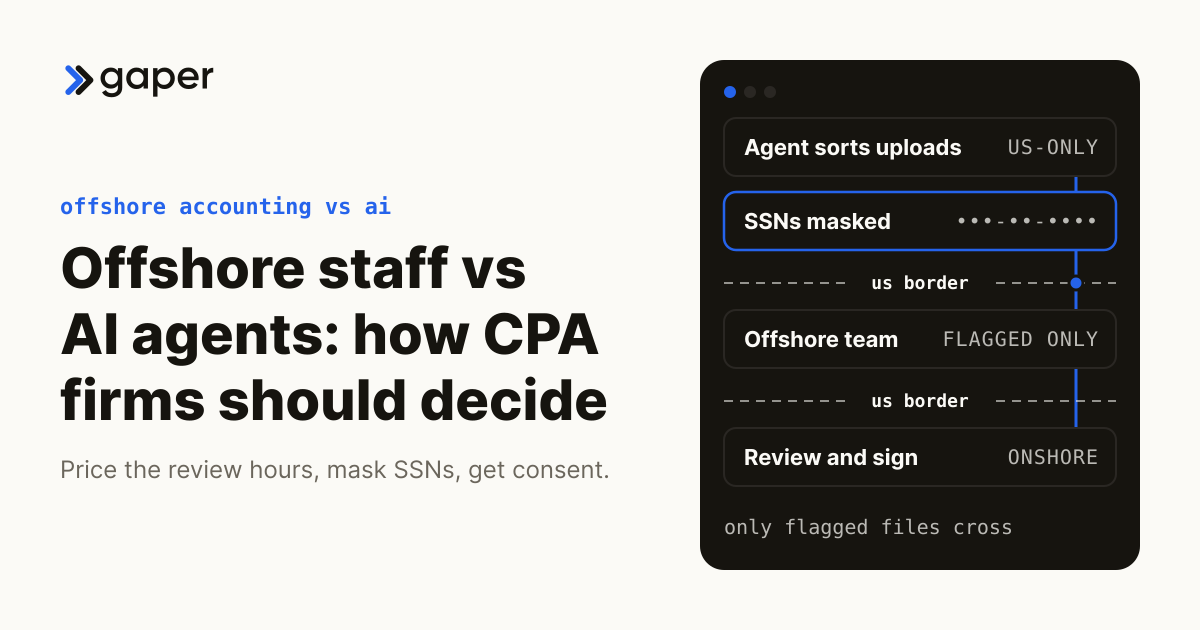
Offshore Accounting Staff vs AI Agents: How CPA Firms Should Decide
IndustryHow to Scale an Accounting Firm Without Hiring More Staff
A nine person firm reclaims about 857 hours in year one. That is either $99,000 of advisory capacity or a $72,000 avoided hire, never both. Scaled by firm size.
Aug 16, 2026
Building Smarter Apps: Integrating LLM APIs for Seamless Natural Language Understanding
Ready to turn AI into execution?
Book a free assessment of one workflow. We map it, make an honest build versus buy call before any code, and if an off the shelf product covers the job we will tell you so.