
Why Are Software Engineers Paid So Much? 2026 Salaries and the Hire vs Deploy Math
Why software engineers are paid so much in 2026, on BLS and Levels.fyi data: scarcity, AI skills, equity and location, plus when to hire or deploy a workflow.
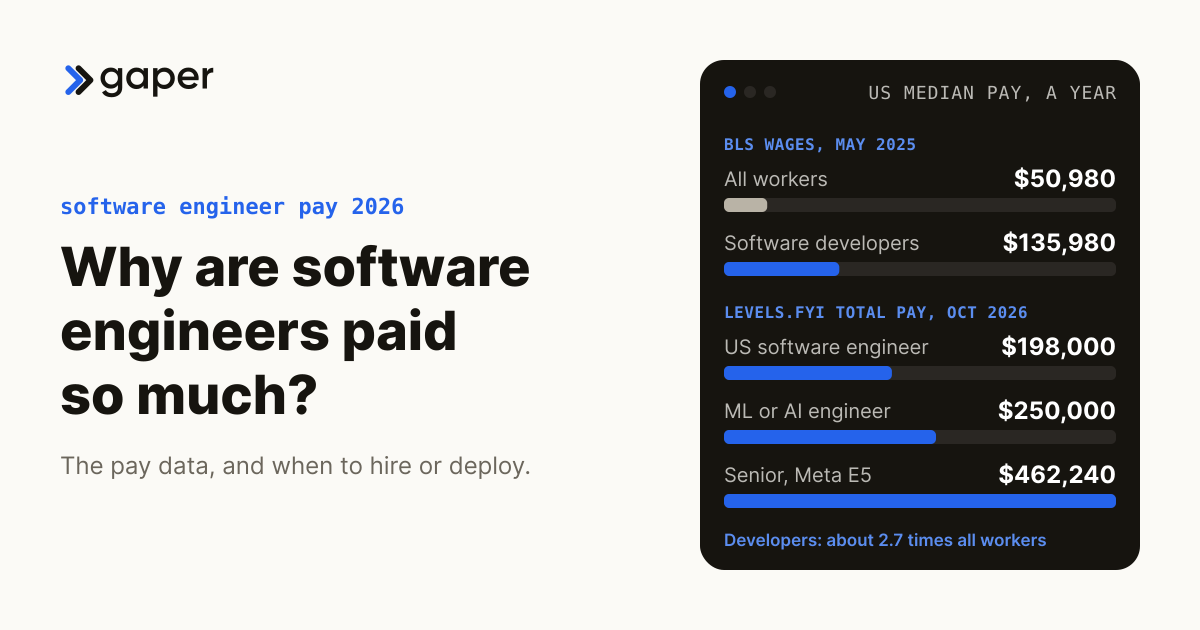
Software engineers are paid so much because experienced talent is scarce, demand keeps rising, and one engineer's work can move revenue or cost directly: the median US software developer earned $135,980 in May 2025, about 2.7 times the $50,980 median for all workers (BLS, 2025). Senior engineers at Amazon, Google and Meta report median packages of $388,176 to $462,240, much of it in stock (Levels.fyi, October 2026). For a buyer, the question is when a hire is worth it and when one deployed AI workflow does the job.
Why software engineers command premium salaries
Pay follows a few forces that show up in public wage and hiring data. In brief:
Key Takeaways
- Extreme scarcity: Only 1 in 100 developers qualify as top-tier talent.
- Explosive demand: Every company now needs software engineers, driving up market rates. BLS projects 10% employment growth from 2025 to 2035.
- Value creation: Engineers directly build products that generate revenue for businesses.
- Market benchmarking: FAANG salaries set the competitive floor for all hiring.
- Hire or deploy: when the work is one AI workflow, price a scoped build against a hire.
Table of Contents
- Why Are Software Engineers Paid So Much? 5 Core Reasons
- The Real Numbers: US Engineer Salaries in 2026
- Equity, AI skills and location
- What Does Hiring Actually Cost?
- Why Offshore Isn’t Always Cheaper
- When Should You Pay $250/hr?
- How Gaper Bridges the Cost vs Quality Gap: Hire or Deploy
- Buyer questions on engineer pay
Why Are Software Engineers Paid So Much? 5 Core Reasons
Software engineers are paid significantly more than most other professions because they operate in one of the most supply-constrained, high-demand markets in modern business. The fundamental answer is simple: scarcity meets demand meets value creation. Let me break down the five core reasons engineers command the salaries they do in 2026.
Reason 1: Extreme Scarcity
Only 1 in 100 software developers qualify as truly top-tier talent. The scarce thing is not people who can write code. It is experienced engineers who can design systems, review work and, in 2026, direct and check AI tools. Senior-level positions accounted for 69.3% of US software development job postings in Q1 2026 and entry-level positions for 4.5%, the bottom of the range across the occupation groups Indeed compared (Indeed Hiring Lab, 23 July 2026). Toptal says it accepts fewer than 3% of the 200,000+ people who apply each year (Toptal FAQ, company-stated, checked 23 October 2026).
Universities produce thousands of new computer science graduates annually, but many lack the hands-on experience, problem-solving depth, or architectural thinking that makes an engineer genuinely valuable. The pipeline from junior to senior is also narrowing. Stanford researchers found employment for 22 to 25 year olds in the most AI-exposed occupations about 19% below where it would be had it kept pace with peers in less-exposed jobs, as of June 2026, with no such gap for experienced workers (Stanford Digital Economy Lab, August 2026). This scarcity means the engineers worth hiring can name their price.
Reason 2: Explosive and Growing Demand
Every company now needs engineers. It’s not just tech startups or software companies anymore. Healthcare providers, law firms, retail chains, financial institutions, manufacturing plants, even nonprofits all need talented developers to build and maintain digital operations.
BLS projects employment of software developers, QA analysts and testers to grow 10% from 2025 to 2035, much faster than average, with about 106,100 openings a year (BLS, 2026). US software development postings on Indeed grew almost 15% from late February 2025 while overall postings fell 7%, and 71% of the increase from May 2025 to May 2026 came from senior roles (Indeed Hiring Lab, 8 July 2026). Postings are still about 27.5% below pre-pandemic levels, so the premium goes to experienced engineers. When demand outpaces supply this severely, salaries rise.
Reason 3: Engineers Directly Create Business Value
Unlike many professions, an engineer’s output directly translates to revenue and competitive advantage. A single great engineer can build a feature that generates millions of dollars in revenue. A bad hire can cost a company millions through delays, quality issues, or technical debt. Companies understand this leverage.
That is why senior engineers report median packages of $388,176 at Amazon (L6), $446,091 at Google (L5) and $462,240 at Meta (E5) on Levels.fyi (US, October 2026). A company pays that when the engineer's work is expected to be worth several times the package. When it is, that ROI justifies the investment.
Reason 4: High Replacement Cost
When a senior engineer leaves, the cost to replace them extends far beyond salary. Gem's 2026 Recruiting Benchmarks Report, built on 1.2 million hires, averages 35 to 36 interviews per engineering hire, against 22 to 24 for non-technical roles (Gem, 2026). During the vacancy and ramp period, your remaining team is slower. Knowledge transfer takes weeks.
Gallup estimates that replacing an employee can cost one-half to two times their annual salary (Gallup, 2019), roughly $68,000 to $272,000 on the $135,980 BLS median. Paying slightly more to retain a strong engineer is often cheaper than replacing them.
Reason 5: Market Benchmarking Sets the Floor
FAANG companies (Facebook, now Meta, plus Apple, Amazon, Netflix and Google) and other top-tier tech firms pay at the high end of the market. These industry leaders set the benchmark. When talent is fungible and can move between companies, salaries across the entire market rise to match or exceed the benchmark. A startup in rural Texas cannot pay a senior engineer 80k dollars per year when they can move to Seattle or San Francisco, where median packages are $253,000 and $280,000 (Levels.fyi, October 2026). Market forces are relentless.
The Real Numbers: US Engineer Salaries in 2026
Transparency matters when discussing compensation. Here’s what companies actually pay for engineers in 2026.
| Measure | Figure | Source |
|---|---|---|
| Median software developer wage | $135,980 | BLS, May 2025 |
| 75th and 90th percentile wage | $171,980 and $214,670 | BLS, May 2025 |
| Median US software engineer total pay | $198,000 | Levels.fyi, Oct 2026 |
| Median US ML or AI engineer total pay | $250,000 | Levels.fyi, Oct 2026 |
| Senior median: Amazon L6, Google L5, Meta E5 | $388,176, $446,091, $462,240 | Levels.fyi, Oct 2026 |
Sources: BLS May 2025 wage data; Levels.fyi software engineer, ML and AI, Amazon and Meta pages, US, checked 23 October 2026. BLS reports wages; Levels.fyi totals are self-reported and include stock and bonus.

A senior software engineer at a FAANG company typically earns:
- Base salary: company-wide medians of $180,000 at Amazon, $205,000 at Google and $230,506 at Meta
- Stock options and bonuses: $80,000 a year in stock at Amazon and Google; $180,000 in stock plus $47,000 bonus at Meta
- Total compensation: $388,176 to $462,240 at the senior levels above
For contract work, Toptal publishes no rates. Upwork's own guide puts software developers on its marketplace at $10 to $100 an hour, experts at $70 to $150 or more (Upwork, checked 23 October 2026), plus a 5% or 10% client fee. At 2,080 hours a year, $250 an hour is $520,000.
For junior to mid-level engineers, pay drops roughly 40 to 50 percent: Google's L3 median ($214,634) is 52% below L5, and the BLS 25th percentile ($105,210) is 39% below the 75th. For AI and machine learning roles, the top quarter of US packages starts at $370,000 and the 90th percentile is $512,000.
Gaper offers a different model entirely. We automate screening and placement using AI, which eliminates the expensive middle-man markups of Toptal, Turing, and traditional staffing firms. We do not promise to compete on hourly rate with low-quality offshore platforms. We source globally instead.
How much of a software engineer's pay is equity?
At big tech firms, a large share. Meta's company-wide median package on Levels.fyi is $457,506: $230,506 base, $180,000 a year in stock and $47,000 bonus, so stock is about 39%. At Google and Amazon, stock is $80,000 a year on medians of $285,000 and $260,000 (October 2026).
Equity is a big reason engineer pay looks so high next to other professions. Shares vest over years, so they work as a retention tool: unvested stock is money an engineer forfeits by quitting, which is why poaching a senior engineer costs a premium.
Why do AI engineers earn more than other software engineers?
Because AI skills are scarcer than the demand for them. US ML and AI engineers report a median $250,000 in total pay on Levels.fyi, against $198,000 for all US software engineers (October 2026), and PwC's 2026 AI Jobs Barometer puts the average wage premium for AI skills at 62%.
PwC's figure, from more than a billion job ads across 27 countries and territories, rose from 57% a year earlier, and PwC found jobs requiring specific AI skills growing roughly eight times as fast as the overall jobs market (PwC, 15 June 2026).
The premium buys judgment: testing models on your own data, building an evaluation set from real cases, designing for security. If you need it for one or two workflows, not a roadmap, deploying may fit better.
Does location still change what engineers are paid?
Yes, by a lot at the top. On Levels.fyi city pages the median software engineer package is $280,000 in the San Francisco Bay Area and $253,000 in Greater Seattle, against $198,000 for the US as a whole, while New York City ($200,000) and Greater Austin ($190,000) sit close to it (October 2026).
Outside the US the gap is wider: the Levels.fyi median for software engineers in India is about ₹3.05 million a year (Levels.fyi India, checked 23 October 2026).
What Does Hiring Actually Cost? A Realistic Breakdown
When evaluating total cost of ownership, most hiring managers focus only on hourly rate or salary. This is a mistake. The comparison table below shows that the cheapest option per hour often results in the highest total cost of ownership due to vetting risk, ramp time delays, and quality variance.
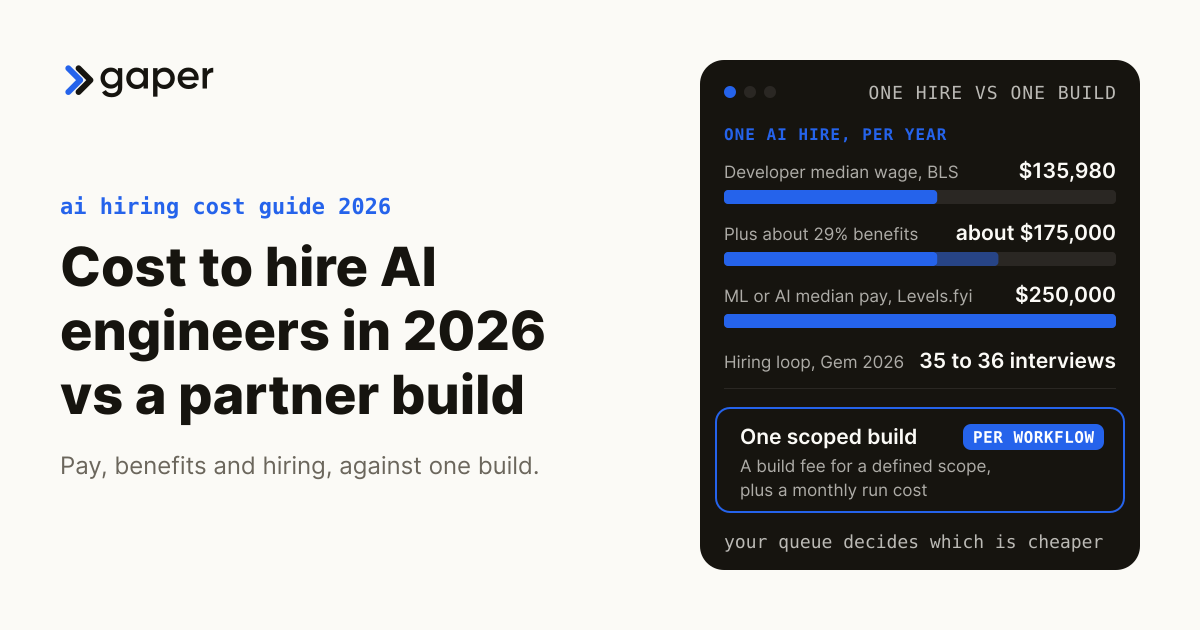
The full arithmetic is on our page on the cost to hire AI engineers. In short: the $135,980 BLS median becomes roughly $175,000 a year to employ once about 29% is added for benefits (derived from BLS employer cost data, June 2026), before recruiting.
What does hiring actually cost? Compare total cost of ownership across provider types.
| Provider Type | Hourly/Monthly Cost | Vetting Depth | Who Directs the Work | Hidden Costs |
|---|---|---|---|---|
| US Full-Time Senior Engineer | $171,980 to $214,670 salary (BLS 75th to 90th percentile); $388,176+ at senior big-tech levels | Very thorough, run by you: 35 to 36 interviews per hire (Gem) | You | Benefits of about 29%, recruiting, replacement |
| Toptal | No published rates; $79 a month once matching proceeds | Strong vetting (company-stated under 3% accepted) | You | The engineer's rate, your management time |
| Freelance/Upwork | $10 to $100 an hour, plus a 5% or 10% fee | Minimal: ID checks and reviews | You | Quality variance, IP risk |
| Implementation partner | Build fee for one defined workflow, plus a monthly run cost | Checked against an evaluation set from your cases | The partner, with people you name | Your reviewers' time |
The hidden costs in hiring are substantial:
- Vetting and screening: 35 to 36 interviews per engineering hire (Gem, 2026)
- Benefits: about 29% on top of salary (derived from BLS, June 2026)
- Onboarding, knowledge transfer and ramp time: weeks of productivity while a new engineer learns your codebase
- Turnover and replacement: one-half to two times annual salary (Gallup, 2019)
- IP and security risk from unvetted freelancers: varies, but can be catastrophic
Gaper’s no long-term contract model reduces much of this uncertainty. You are not locked into a 6-month or 1-year commitment.
Why Offshore Isn’t Always Cheaper (Even at $10/hr)
The math looks tempting on paper. A software engineer in Pakistan or India might be available at 10 to 15 dollars per hour, the low end of the $10 to $100 range Upwork quotes for developers on its marketplace, compared to $250 an hour for a premium specialist. Why not just hire offshore and pocket the savings?
The answer is hidden costs and risk.
When you hire a random engineer from an open marketplace like Upwork, where screening beyond identity checks and reviews is mostly up to you, you inherit significant risk:
First, vetting is much harder. You do not have a network you trust, so you must spend weeks interviewing and testing candidates. Even then, quality is unpredictable. Communication gaps (timezone differences, English proficiency, domain expertise) mean feedback loops take longer. A simple 1-hour meeting becomes a 24-hour async exchange, which compounds into weeks of delays.
Second, ramp time is brutal. Without deep context about your codebase, tech stack, and business domain, a new offshore hire can take weeks to become productive. During this period, you are paying for work that is not moving the needle. A US or top-tier offshore engineer (like those on Gaper) ramps far faster because they are experienced, quickly understand requirements, and can hit the ground running.
Third, retention is low. Turnover among low-cost engineers hired one at a time is high. As soon as they gain experience and become productive, they can move to a higher-paying role or a different client. You start the hiring and ramp cycle over again.
Fourth, IP risk is real. Engineers pulled in from unknown sources may have loose attitudes toward security, confidentiality, and intellectual property. If your code or product ideas leak, the damage is incalculable. Gaper screens engineers for security and IP alignment. Whoever you use, settle IP ownership in writing; our Upwork alternatives guide compares platform terms.
The trap is thinking cheap per-hour rate equals cheap total cost. It does not. When you factor in vetting risk, communication overhead, extended ramp time, and high turnover, offshore hiring at 10 to 15 dollars per hour often costs far more than the sticker rate suggests.
When Should You Pay $250/hr? And When Should You Hire Remote?
Pay a premium rate for rare expertise, zero-defect systems, long multi-year R&D, or a codebase only your own team understands. For an MVP, a team that has to scale up and down, or one defined AI workflow, a remote team or a scoped build usually fits better.
Not every project deserves a 250-dollar-per-hour Toptal engineer. And not every project fits Gaper either. The key is matching engineer caliber to project scope. A full year at $250 an hour is $520,000, just above the $512,000 90th percentile for US ML and AI engineers, so a premium rate pays off only where the skill is rare or a defect is expensive.
When You Should Pay $250/hr
- Rare expertise: cryptography, quantum computing, niche domains
- Zero-defect systems: financial trading, medical devices, aerospace
- Long-term R&D: 1+ year deep technical work with handoff
- Institutional knowledge: Only your team knows the codebase
When to Hire Gaper
- MVP and scaling: Need teams fast, cost-conscious budgets
- AI plus code hybrid: Only Gaper offers both AI agents and engineers
- Flexibility: Need to scale or reduce team size without long contracts
This framework is honest. It does not claim Gaper engineers are the same caliber as Toptal. It claims Gaper engineers are sufficient for the vast majority of product and business needs, at a price point that makes fast hiring and iteration possible.
How Gaper Bridges the Cost vs Quality Gap: Hire or Deploy
The traditional hiring market presents an unpleasant choice: either pay 250 to 400 thousand dollars per year for a proven engineer, or take a risk on unknown offshore talent at 10 to 20 dollars per hour and hope quality is acceptable.
Gaper solves this false choice.
We built AI-powered screening to identify strong engineers globally, not just from expensive Western tech hubs. We then pay them fairly so they stay committed and do good work. And we deliver assembled teams quickly, eliminating the weeks of recruiting and ramp time.
What makes Gaper different from other offshore platforms?
First, our AI agents. Gaper is not just an engineer marketplace. We offer pre-built AI agents (Kelly for healthcare scheduling, AccountsGPT for accounting, James for HR recruiting, Stefan for marketing operations) that automate routine work. This means when you hire an engineer through Gaper, you can pair them with AI to multiply their productivity. Other platforms offer only labor. We offer labor plus AI.
Second, our screening filter. We do not accept all comers. This means you are not sifting through hundreds of mediocre proposals. You get engineers who can actually ship.
We have placed engineers at companies like Google, Amazon, Stripe, Oracle, and Meta, and delivered products faster than companies thought possible. And we have done it at a price point that does not force you to choose between cost and quality.
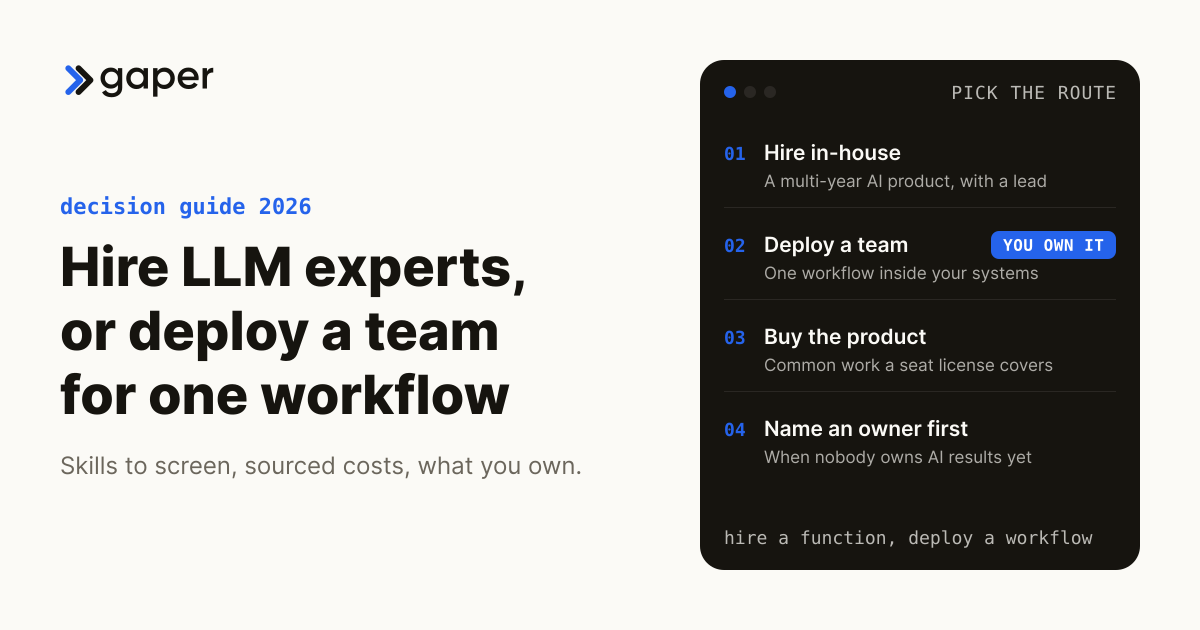
In 2026 the choice has a second axis: hire or deploy. Do you need a person, or one workflow running in production? Gaper is the AI-native implementation partner that deploys supervised AI agents you own.
When hiring an engineer makes sense
- AI is a standing function: a product or roadmap with years of work, not one or two workflows.
- Someone can direct it: a senior lead to review the work and own the decisions.
- You already have the people: if you employ AI engineers with spare capacity, build in-house.
If you want help alongside that team, our AI engineering page describes how a forward-deployed team builds alongside yours and hands over a system you control.
When deploying one scoped workflow makes sense
- The need is one workflow, not a seat: a hire buys a permanent cost for a temporary need.
- It touches systems of record, data or risk: the Rent-vs-Own test says rent a point tool for narrow, common work and own a supervised agent here.
- You want to own the result: at handover you hold the code, prompts, evaluation set, runbook and audit trail in accounts you control.
A partner prices the workflow, not the person: a build fee for a defined scope plus a monthly run cost named before you sign. Gaper works through the Gaper method, Assess, Scope, Build, Supervise, Hand over, described on our forward-deployed engineering page. If a product already covers the workflow end to end, buy it instead; see build vs buy for AI agents.
Run the numbers with the salary calculator
The AI engineer salary calculator prices the hire side: pick seniority, specialization and region for a market hourly range and an annual fully loaded cost, on 2,080 hours plus roughly 25 percent overhead. Its default, a senior US AI engineer, shows about $364,000 a year, above the salary-based BLS figures because it starts from market rates. Compare a year of that hire with a build price plus twelve months of run cost. A long, steady queue favors hiring; a short one favors a scoped build.
Curious how Gaper’s engineers and AI agents could accelerate your project? Get a free assessment to see your options. Free assessment. No commitment.
Why are software engineers paid so much compared to other professions?
They work in a supply-constrained, high-demand market, and their output moves revenue or cost directly. The median US software developer earned $135,980 in May 2025, about 2.7 times the $50,980 median for all workers (BLS, 2025), and big-tech pay pulls the rest of the market up.
Only 1 in 100 developers qualify as truly top-tier talent, yet every company now needs engineers. This scarcity, combined with the fact that engineers build revenue-generating products and systems, places them at the top of the compensation ladder. Additionally, FAANG companies set the competitive benchmark for salaries, driving market rates upward across all industries, and much of their pay comes in stock that most professions never receive.
What is the average software engineer salary in 2026?
The median US software developer wage was $135,980 in May 2025, the latest BLS figure. The median US software engineer package on Levels.fyi, including stock and bonus, is $198,000, and senior engineers at Amazon, Google and Meta report medians of $388,176 to $462,240 (October 2026).
BLS surveys employers across every industry, so it includes developers at banks, hospitals and government agencies. Levels.fyi collects self-reported packages, which skew toward tech employers. ML and AI engineers sit higher, at a $250,000 median.
Are software engineers worth their salary?
Yes, when the engineer drives business outcomes worth a multiple of the package. For commodity work, a team with high turnover, or a single workflow that a scoped build could cover, a premium salary may not match the impact.
A single great engineer can build a product that generates millions in revenue, making even a $460,000 senior package a fraction of the value created. The key is matching engineer caliber to project scope and business value.
Is offshore cheaper? Should I hire developers in India?
Yes, offshore rates are cheaper on the surface, but hidden costs often offset the savings. Vetting is harder without established networks, communication spans multiple time zones, ramp time runs longer, and quality variance is high.
Gaper bridges this gap by screening engineers globally, eliminating the risk that makes cheap hiring expensive. If client data is involved, where the work happens can also carry legal duties, so settle that before choosing a country.
Will engineer salaries fall in 2026?
Not for experienced engineers, on current data. BLS projects 10% employment growth for software developers, QA analysts and testers from 2025 to 2035, and 71% of the rise in US software postings from May 2025 to May 2026 came from senior roles (Indeed Hiring Lab). Entry-level hiring is weaker.
While AI tooling has improved productivity, it has also accelerated product development cycles, creating even more work for engineering teams. Salaries for experienced engineers are unlikely to fall until supply significantly exceeds demand, and the 2026 data does not point that way.
Thirty minutes, no commitment. We map one workflow, make the build or buy call, and scope the smallest thing worth shipping.
Frequently asked questions
How much of a software engineer's pay is equity?
Why do AI engineers earn more than other software engineers?
Does location still change what engineers are paid?
When Should You Pay $250/hr? And When Should You Hire Remote?
Why are software engineers paid so much compared to other professions?
What is the average software engineer salary in 2026?
Are software engineers worth their salary?
Is offshore cheaper? Should I hire developers in India?
Will engineer salaries fall in 2026?

Ready to turn AI into execution?
Book a free assessment of one workflow. We map it, make an honest build versus buy call before any code, and if an off the shelf product covers the job we will tell you so.