
How to Choose an AI Implementation Partner: Questions to Ask Before You Sign
How to choose an AI implementation partner: ten questions to ask, what good answers sound like, red flags, contract terms, and 7216 and ABA 512 checks.
Choose the partner that can show you an agent running in production, will write your ownership of the code, prompts, evaluation set and runbook into the contract, and can answer your profession's data rules without hand-waving. Pick one workflow before the first call, ask every firm on your shortlist the same questions, and score the answers on criteria you would apply to anyone, including the firm that wrote this guide. Sometimes the right answer is to buy a product and hire no partner at all.
Start with what you should hold at the end
Before comparing firms, decide what you expect to hold when the engagement closes: a supervised agent working in production inside your systems, plus the code, prompts, evaluation set, runbook and audit trail to keep it working without its builder. For the definition itself, see what an AI-native implementation partner is.
If a firm's last deliverable is advice, you are buying consulting. If it is software your team runs, you are buying implementation, often delivered forward-deployed, with an engineer shipping code inside your own systems.
Before you shortlist: write one page about one workflow
Set the agenda before the first call with a single page that names:
- The workflow, start to finish, as it runs today. "Client document intake to a prepared workpaper" is a workflow. "AI for the tax department" is not.
- The systems it reads and writes, and whether each one has an API or only a screen.
- The data it touches, by legal category: tax return information, customer information under the FTC Safeguards Rule, client confidences.
- The person who will own the agent and review its exceptions once it is live.
- One number to move, and its value today. Without a baseline, nobody can prove the agent worked.
- What the agent must never do alone, such as sign, file, post to the ledger or advise a client.
- A budget range and who approves the spend, so every proposal is scoped to the same envelope.
Send it to every firm. A partner who asks about your exceptions has read it. If you run an accounting firm and have not picked the workflow yet, the accounting workflow automation matrix classifies common workflows by how much an agent can own and the review gate each needs.
For names, our roundup of AI agent development companies is one starting point, and it includes us, so treat it as one input.
How can you tell production proof from a demo?
Ask to see something a person depends on today: the exception queue, the audit log and the evaluation set behind a live agent, with client details redacted. A demo on sample data shows the best case; production evidence shows the cases nobody planned for.
Ask for four things:
- A walkthrough of one live agent: what it reads, what it writes, and who approves what.
- The low-confidence or failure queue, not the happy path.
- The evaluation set, how it was built from real cases, and when it was last re-run.
- A reference call with the operator who reviews the agent's exceptions, not only the executive who signed.
Confidentiality justifies redaction, not an empty answer. Hold every firm to that bar, us included.
Questions to ask an AI implementation partner
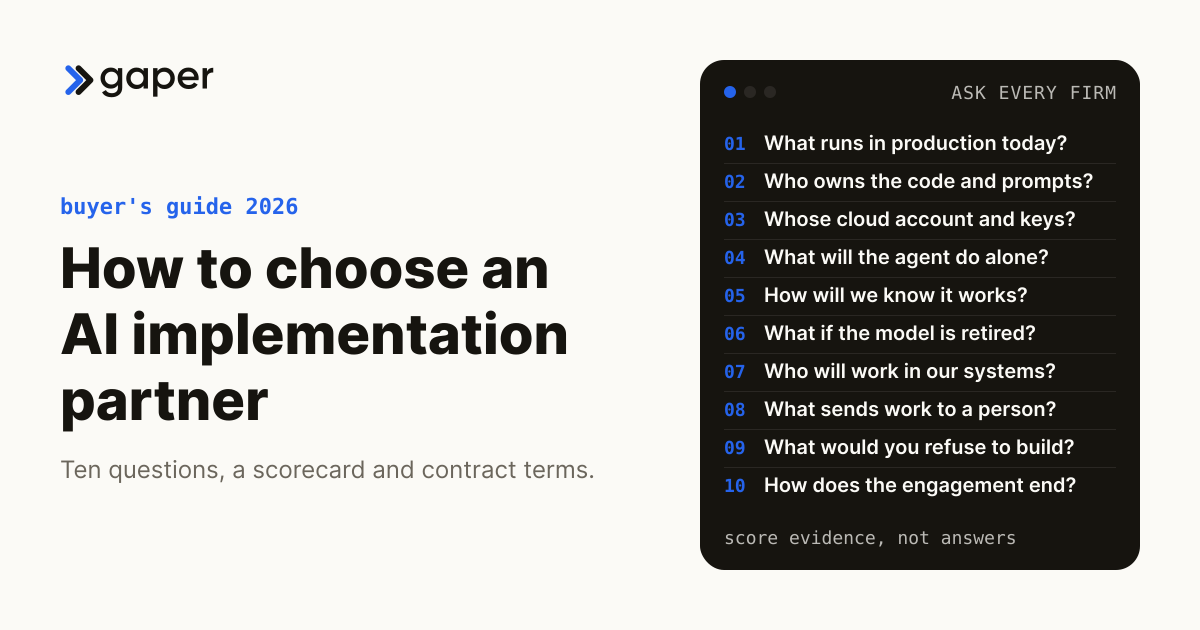
Ask every firm the same ten questions, in writing, and compare the answers side by side.
1. What is running in production today, and who would notice if it stopped?
A good answer names a workflow, its systems and the person who reviews its exceptions, then offers to show you the logs. A pilot is not production.
2. Who owns the code, prompts, evaluation set and runbook, and where is that written?
A good answer points to an assignment clause in the draft contract, plus a license to the partner's pre-existing libraries that survives the relationship. "You'll own it" on a sales call is not an answer.
3. Whose cloud account, repository and model API keys will this run on?
Yours, from the first build. If the agent can only run in the vendor's account, you are renting it, and the price should say so.
4. Which steps will the agent do alone, which will it draft for approval, and which will it never touch?
A good answer is a step map with a named approver for every approval. We use the Gaper Ownership Map: every step is Automated, Agent-drafted, human-approved or Human-owned, and the agent never runs a human-owned step alone.
5. How will we know it works, before launch and after?
An evaluation set built from your own past cases, a pass threshold in the acceptance terms, and a baseline measured before the build. An accuracy figure with no test set behind it is a claim, not evidence.
6. What happens when the model underneath is retired?
A good answer names who re-runs the evaluation set on the replacement and who pays. This is routine: on 30 September 2026 Anthropic told developers that Claude Sonnet 4.5 retires from its API on 30 November 2026, and its deprecation policy promises at least 60 days' notice for publicly released models.
7. Who exactly will work in our systems, where are they located, and how will we see progress?
Names and roles, the country each person works from, any subcontractors, and regular demonstrations on your own data. For accounting firms, location has legal weight, covered below.
8. What sends work to a person, and who covers that queue when the reviewer is out?
A good answer gives the rule that routes an item to review, the person who owns that queue and where items go when that person is away. Then ask what happens to an item nobody picks up.
9. What would you refuse to build for us, and when would you tell us to buy a product instead?
A good answer names, unprompted, work they send to a product, such as booking meetings, call transcription or receipt capture your ledger already offers, and a workflow they would not automate yet, such as one crossing a system with no usable API. "We can build anything" is the worrying answer.
10. How does the engagement end?
A handover list (code, prompts, evaluation set, runbook, audit trail), knowledge transfer to your named owner, revoked credentials and a written record of data deletion.
Where Gaper's own answer is no
Gaper is the AI-native implementation partner that deploys supervised AI agents you own. Here is where that means a plain no in our own answers:
- Q2, ownership: owning the agent does not take you outside Section 7216. It moves control of the region, logs and credentials to you, and leaves the consent rule in place.
- Q3, whose accounts: not ours. Repository, cloud account and model keys are yours from the first build, and after handover your team runs the agent, or we run it there under contract.
- Q4, the step map: nothing material is signed, filed, posted or advised without a person approving it.
- Q5, proof: no ROI multiple or headcount cut promised up front. We agree one metric and measure it against your baseline.
- Q7, who works on it: we are not a staffing firm and do not sell engineering time. Our proposals price a workflow, not hours.
- Q9, what we refuse: a go-live date guaranteed before we have seen your systems, and a custom build for work a product already does well.
How do you keep the comparison fair?
Score every firm against the same criteria, including ones your favorite might fail, and score evidence rather than answers: a contract clause, a log, a reference call. A criterion that only one vendor could ever meet is a sales pitch, not a test.
| Criterion | Evidence to ask for | Walk away if |
|---|---|---|
| Production work | A live agent walkthrough and an operator reference | Nothing runs anywhere today |
| Ownership | An assignment clause and handover list in the draft contract | Prompts or evaluation sets stay with the vendor |
| Runtime | Your repository, cloud and API keys from the first build | It only runs in the vendor's tenant |
| Supervision | A step map with a named approver for each approval | "Fully autonomous" for anything material |
| People and location | Names, roles, work locations, subcontractors | They cannot say who will see your data |
| Security evidence | A SOC 2 Type II report or equivalent, and insurance certificates | There is nothing you can put on file |
| Run cost | A monthly run line and a change process | The run line is blank or left for later |
| Honest scoping | A case where they told a client to buy instead | Every problem gets a custom build |
Score each row 0 (no evidence), 1 (a verbal answer) or 2 (a document, log or clause in hand), and treat a 0 on Ownership, Runtime or Supervision as disqualifying whatever the total. Apply the table to us exactly as you would to anyone else.

What extra questions should an accounting firm ask?
Four sets: who sees tax return information during the build and whether they got written notice of Sections 6713 and 7216, which recipients your client consents must name, which sections of your WISP the build changes, and whether the partner will sign a Safeguards Rule contract. Owning the agent removes none of these.
Section 7216. Ask three questions. If the agent is software used in return preparation, has everyone who will see return data received the written notice of Sections 6713 and 7216 that 26 CFR 301.7216-2(d)(2) requires? Which model provider and sub-processors must your consents name, given that 301.7216-3(a)(3)(i)(B) generally requires the specific recipient? Where does everyone in the data path sit? Under 301.7216-2(c)(2) and (d)(1) and 301.7216-3(a)(3)(i)(D), any disclosure to a preparer outside the United States, even your own employee, generally needs the client's signed consent first, and 301.7216-3(b)(4) generally bars consent to send a Form 1040 client's social security number to one, subject to a narrow safeguard exception.
The WISP. In IR-2026-92 (18 August 2026), the IRS reminded tax professionals that federal law requires them to keep a written information security plan, and that they count as financial institutions under the Gramm-Leach-Bliley Act. 16 CFR 314.4(g) also requires you to adjust the program for material changes to your operations or business arrangements. Ask which sections of your plan the build changes.
IRS OPR. The Office of Professional Responsibility's Issue Number 2026-19 (24 June 2026) says practitioners must handle client data only with secure, enterprise-approved AI, must thoroughly review AI-created documents before delivery, and that "outsourced or third-party AI tools should be vetted." Ask what evidence the partner will give you for that vetting file, and where a credentialed reviewer sees every output before it leaves the firm.
Safeguards Rule vendor oversight. 16 CFR 314.4(f) requires you to select service providers capable of appropriate safeguards, require those safeguards by contract, and reassess providers periodically. Ask whether the partner will sign that clause. Our AI security guide for accounting firms covers consent format, offshore consent language and the full vendor diligence script.
What extra questions should a law firm ask?
Three sets: whether any tool in the build learns from your inputs and who else can reach them, how the partner's people will be supervised and bound to confidentiality, and where matter data goes and under whose contract. ABA Formal Opinion 512 frames the first two, and a recent privilege ruling frames the third.
ABA Formal Opinion 512 (29 July 2024) says a client's informed consent is required before information relating to the representation goes into a self-learning generative AI tool, and that boilerplate in an engagement letter is not enough. It also tells lawyers to read and understand each tool's terms of use and privacy policy to learn who can access their inputs. Ask whether any component is self-learning on your inputs, and ask for the terms of every model provider in the chain.
Model Rule 5.3. Rule 5.3(b) requires a lawyer with direct supervisory authority over a nonlawyer to make reasonable efforts to ensure that person's conduct conforms with the lawyer's obligations, and Opinion 512 says those duties extend to outside parties using generative AI on a matter. It lists what earlier opinions expect when outsourcing, from reference checks, vendor credentials and security policies to confidentiality agreements, a conflicts check and a forum for relief if the agreement is breached. Ask for each in writing, and ask how the agent will respect your ethical walls, with permissions checked per user on every query.
Privilege. In United States v. Heppner (S.D.N.Y.), Judge Rakoff ruled from the bench on 10 February 2026, with a memorandum filed on 17 February 2026, that a defendant's written exchanges with a generative AI platform were protected by neither attorney-client privilege nor the work product doctrine. It binds no other court, but it shows how one court treated a third-party AI platform. Ask where matter data goes, under whose contract, and whether that contract bars the provider from training on or disclosing it. Our reading of the Heppner ruling covers the detail.
The Model Rules bind only where a state has adopted them, and bar opinions are advisory, so check your own jurisdiction. This is information, not legal advice.
What are the red flags in an AI implementation proposal?
Nothing in production, only demos on the vendor's data; a price built on hours or headcount; an agent that only runs in the vendor's account; no evaluation set in the acceptance terms; and confident promises about go-live dates, ROI multiples or removing people. Any one of them is a reason to ask harder questions.
Four more:
- The proposal describes a team, not a workflow. Engineers for a number of months, billed by the hour, is staffing under another name.
- "Fully autonomous" sits next to a tax position, a filing, a ledger posting or client advice.
- "You own it, so 7216 doesn't apply," or "the model doesn't train on your data, so privilege is safe." Neither follows.
- The forward-deployed label comes with nobody working in your systems.
What must the contract settle before work starts?
Seven things: who owns the code, prompts, evaluation set and runbook; whose accounts the agent runs on; the data terms; the acceptance test; governance and scope changes; who handles model changes and at what cost; and how the engagement ends. Each gets harder to negotiate once the agent is live.
On 29 September 2026, Gartner predicted that by 2028, 70% of enterprises will abandon agentic AI built by vendor forward-deployed engineering, "trapped by soaring costs and unable to evolve it on their own." It is a forecast, not a measured result, and it targets engagements delivered the way ours are, so read it before signing with anyone. Gartner's Mukul Saha says the best-scoped of these engagements settle governance, business value delivery, IP ownership, project co-ownership, knowledge transfer and an exit strategy from day one, and the release warns of "FDE washing", consulting marketed as forward-deployed engineering.
Turn that into clauses:
- Ownership. Assignment of the code, prompts, evaluation set, runbook and configuration, plus a surviving license to pre-existing libraries.
- Runtime. Repository, cloud account and model API keys in your name from the first build.
- Data. No training on your inputs or outputs, named sub-processors and regions, a breach-notice deadline, deletion at exit. Accounting firms add the 314.4(f) safeguards clause and the 7216 contractor notices; law firms add the confidentiality agreements and breach notification Opinion 512 describes.
- Acceptance. The metric, baseline, evaluation set and pass threshold that define done.
- Governance. A named owner on each side, the step map attached as a schedule, and a written process for changing scope.
- Model changes. Who migrates the agent when a model is retired, and who pays.
- Knowledge transfer and exit. Runbook walkthroughs, your owner shadowing real changes, termination assistance and credential handover.

Bring this list to a free AI assessment and ask us all ten questions about one of your own workflows, including the ones where our answer is no.
How should an AI implementation proposal be priced?
Ask for a scoped build for one workflow, priced separately from a monthly run or support line, and for what moves each number: integrations, data cleanup, approval controls and hosting. If a firm bills time and materials instead, ask for a cap and what triggers a change order.
Be wary of a firm price quoted before anyone has seen your systems. For accounting firms, our AI implementation cost guide sets out illustrative bands and the run-cost questions to put to any vendor, including us.
What if no partner on your shortlist passes?
Do not sign the least bad proposal. Buy a product when every firm failed on ownership or runtime, since you would be renting anyway, or when a product covers the workflow at your volume. Build it yourself when you have AI engineers and a named owner, and pay outside experts only to review the design.
| What your scoring showed | Next step |
|---|---|
| Every firm scored 0 on Ownership or Runtime | Compare products on where the data goes and the price at your volume |
| A product already handles the workflow | Buy it, since a custom build adds run cost, not control |
| Nobody passed, but your engineers can take it on | Build in-house, with this page's questions as your acceptance criteria |
| Nobody inside will own the result | Pause until someone has the time and authority to review exceptions |
That is the Rent-vs-Own test: rent a point tool for narrow, common work, and own a supervised agent when it touches systems of record, data or risk. Our build vs buy guide runs the test in depth. Whether your own team or an outside firm should write the code is a separate decision, set out in in-house vs outsourced AI development. If buying wins, a good partner will say so.
Thirty minutes, no commitment. We map one workflow, make the build or buy call, and scope the smallest thing worth shipping.
Frequently asked questions
How can you tell production proof from a demo?
How do you keep the comparison fair?
What extra questions should an accounting firm ask?
What extra questions should a law firm ask?
What are the red flags in an AI implementation proposal?
What must the contract settle before work starts?
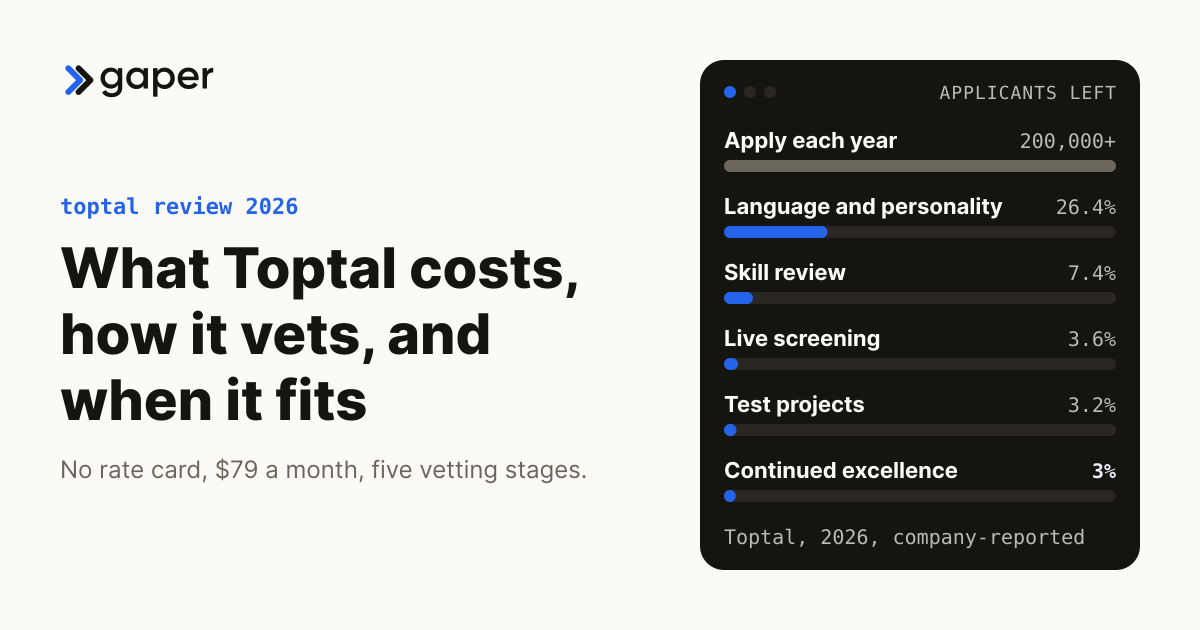
Toptal Review (2026): Pricing, Vetting, and When an AI Implementation Partner Fits Better
IndustryWhat a peer reviewer will ask about the AI your firm uses
The AICPA peer review standards never mention artificial intelligence. Here is what your reviewer will actually test when an agent touched the workpapers.
Oct 1, 2026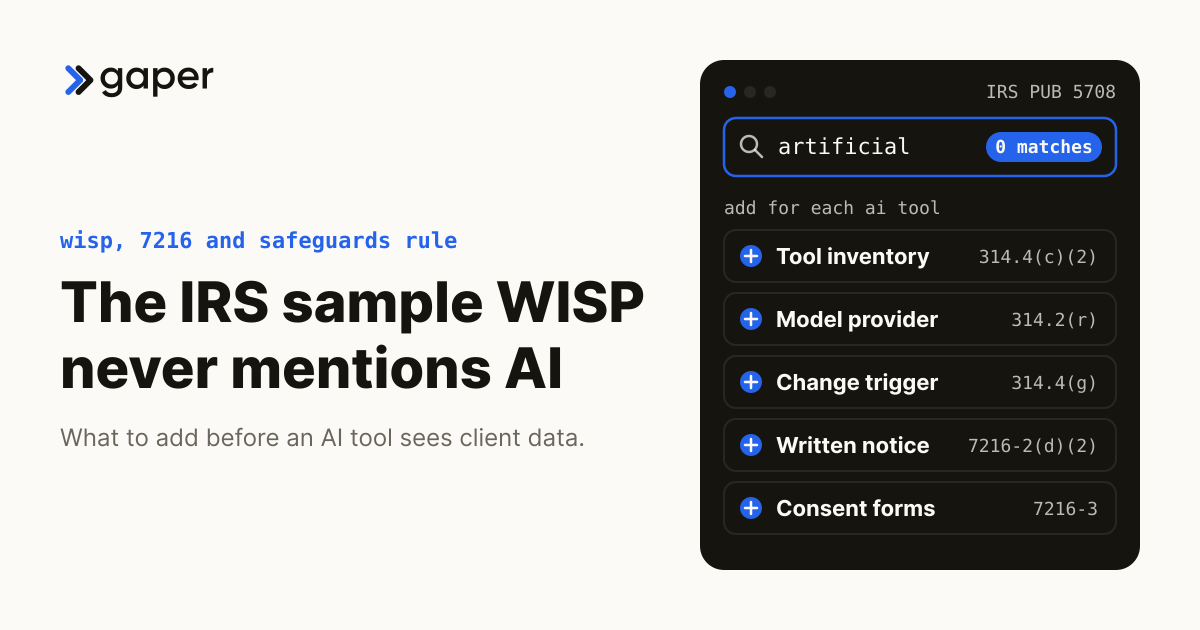
Your WISP was written before AI, and the IRS sample never mentioned it
Ready to turn AI into execution?
Book a free assessment of one workflow. We map it, make an honest build versus buy call before any code, and if an off the shelf product covers the job we will tell you so.