
Manual vs Automated Accounting (2026): A Firm Partner's Guide
Manual vs automated accounting for firm partners: which work to automate, hand to a supervised agent or keep human, with cost, risk, review and 7216 rules.
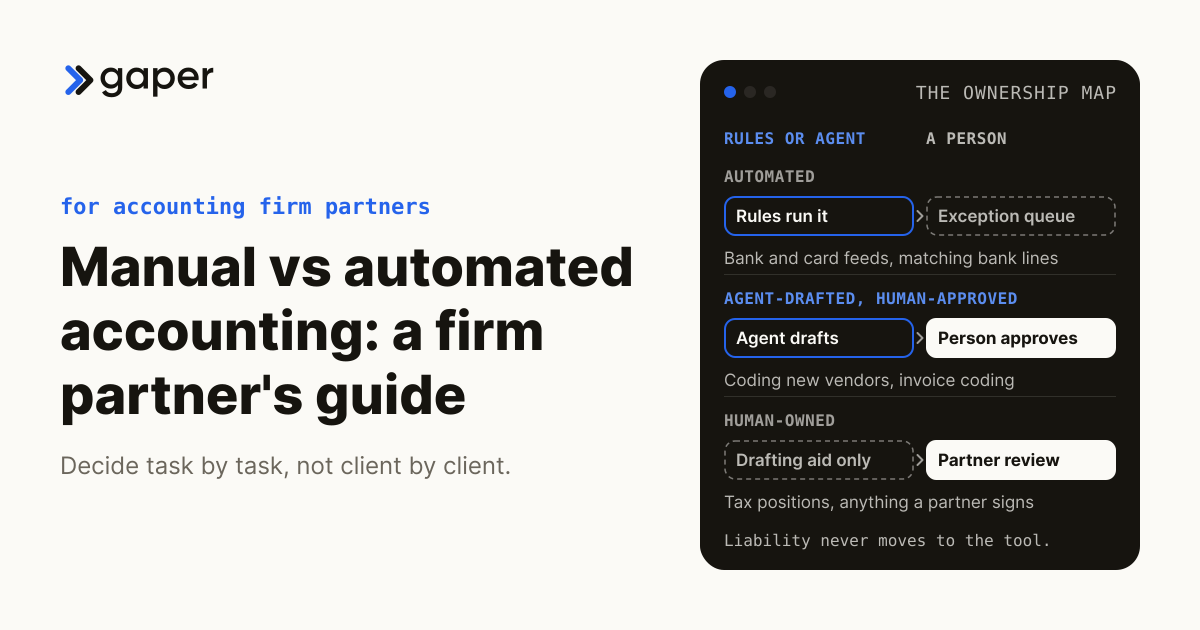
Decide task by task, not client by client. Automate rule-shaped, high-volume work such as bank feeds and matching, hand coding, accruals and reconciliation drafts to a supervised agent whose output a named person approves before it posts, and keep judgment, tax positions and sign-offs human. Cost, risk, review burden and the client-data rules decide which lane each task belongs in.
Updated October 2026: every external figure checked at its source on 27 October 2026.
Manual vs Automated Accounting in 2026: The Firm Partner Decision Guide
The Gaper Ownership Map puts every workflow step in one of three lanes: Automated, Agent-drafted, human-approved, or Human-owned (the agent never runs it alone).
| Lane | Work that belongs here | Cost | Risk if wrong | Review burden | Client-data rule |
|---|---|---|---|---|---|
| Automated (rules) | Bank and card feeds, matching bank lines, duplicate flags, fixed vendor rules | Mostly inside the ledger plan already paid for | A stale rule repeats one error every month | Exception queue daily, rules reviewed quarterly | Data stays in the client's ledger; oversee the feed provider |
| Agent-drafted, human-approved | Coding new vendors, invoice coding, accrual and reconciliation drafts, variance notes | Agent licence or build, plus reviewer hours | A plausible wrong code a tired reviewer approves | A named person approves every item before it posts | 7216 consent if tax return information reaches a vendor; AICPA 1.700.040 contract |
| Human-owned | Revenue recognition judgment, tax positions, intercompany eliminations, anything a partner signs | Manager and partner hours, the scarcest cost | Liability and penalties attach to the preparer | Partner review, as today | AI only as a drafting aid under written firm policy |
Price the cost column with your own hours: the 2025 National MAP Survey put the median manager billing rate at $198 an hour. Partners already lean to the middle lane. In Intuit's 2026 survey of 725 US accounting professionals, 6 percent wanted AI to run deliverables autonomously and 34 percent wanted it to draft for sign-off (Intuit, June 2026; Intuit commissioned it).
Key Takeaways
- APQC's 2018 close benchmark: median 6.4 calendar days, top quartile 4.8 or less, bottom quartile 10 or more.
- Liability never moves to the tool: IRS OPR Issue Number 2026-19 (June 2026) applies existing Circular 230 duties to AI-assisted work.
- Section 7216, AICPA confidentiality and the FTC Safeguards Rule apply whoever owns the tool.
- Stack layers that matter: the client general ledger (QuickBooks Online, Xero, Sage Intacct, NetSuite), AP and spend (BILL, Ramp), and an agent layer on top. AccountsGPT is Gaper's agent layer, deployed in your firm's cloud and owned by your firm.
Table of Contents
- Definitions and scope
- Month end close speed and error rate
- Who is liable when AI codes an entry wrong?
- Cost per transaction and scaling pain
- 202 6 tools landscape
- Where AI agents like AccountsGPT fit
- Confidentiality before client records go near AI
- Decision matrix by client file shape
- Pricing once the work takes a third of the time
- Migration playbook in 90 days
Manual vs Automated Accounting: Definitions and Scope
Manual accounting means people key entries, reconcile in spreadsheets and chase invoices by email. Automated accounting means feeds, rules and an agent do the keying and matching, while people review exceptions and sign.
On an automated file, an agent codes receipts against the chart of accounts and routes only what it cannot match to a preparer, and every state change is timestamped to a user. Automation is a chain: feeds, coding, reconciliation, accruals and reporting. Skip a link and that manual step constrains everything downstream. Our guide to AI for accounting firms covers where agents sit across the wider practice.
Where Hybrid Models Sit
Most client files sit here: QuickBooks Online with bank feeds, and your team still processing accruals in Excel. Hybrid is not stable. Either the manual side grows until it absorbs another staff accountant, or automation extends into accruals, AR and consolidation, which is the path that adds clients without adding headcount.
What Do We Do With the Clients Who Will Not Go Digital?
Segment the book by data quality, then automate only the clean-feed lane. A deliberate manual lane is normal and stable, as long as it is priced at what it really costs to staff, so the client can see the choice.
Clean-feed clients are where automation pays. Convert mixed clients, with feeds on some accounts and paper on the rest, one account at a time. Paper-only clients stay manual.
Two facts help in the conversation. The IRS says every requirement for paper books and records also applies to electronic ones (IRS, reviewed August 2026), so a scanned receipt is a valid record. And do not invent a deadline: Intuit stopped selling QuickBooks Desktop Pro Plus, Premier Plus, Mac Plus and Enhanced Payroll to new US subscribers after 30 September 2024, but existing subscribers keep renewals, updates and support (Intuit).
Month End Close Speed and Error Rate
Close speed is the clearest proxy for process maturity, and the realistic gain is moving a file from the slow quartile toward the median. Error rates have no reliable public benchmark, so count your own adjusting entries instead.
APQC, measuring calendar days from trial balance to consolidated statements across about 2,300 organisations, put the top quartile at 4.8 days or less, the median at 6.4 and the bottom quartile at 10 or more (CFO.com, March 2018). The spread is about double, so a file moved from 10 days to 6 has captured most of the gain. Rework hides inside hours already charged: count the adjusting entries on one client last year and multiply by your average preparation time.
Why Audit Trail Compounds
Manual close hides errors in archived email approvals, and when the client raises money, sells or is audited, your firm reconstructs the trail. An automated close logs every state change, user and override as it happens, so the PBC list and the hours spent assembling support both shrink.
Speed Translates Into Decisions
A bottom quartile close shows the client April results well into May; a top quartile close shows them inside the first week, while they can still act. That is advisory value, and the argument for pricing the close as an outcome instead of as hours. It is also where AccountsGPT, deployed into your firm's cloud and owned by your firm, pays back fastest, because the agent handles the coding and matching while your people keep the judgement calls.
If an AI Codes an Entry Wrong, Who Is Professionally Liable?
The firm is. Nothing about the tool changes whose name goes on the work, and the IRS Office of Professional Responsibility confirmed in June 2026 that existing Circular 230 duties apply to AI-assisted work.
Issue Number 2026-19, dated 24 June 2026 (IRS OPR; Journal of Accountancy), walks through six numbered provisions, and four matter most for coding work. Under 10.22, review AI-created work before it reaches a client or the IRS, checking facts, citations and calculations. Under 10.35, understand the tool's mechanics, limits and risks. Under 10.36, keep documented firm procedures on training, data security, accuracy monitoring and vetting AI providers. And 10.51(a)(15) bars willful unauthorized disclosure or use of tax return information, which uploading data to unsecured AI systems risks.
So the review evidence is the deliverable: for each coding batch, keep what the tool proposed, who reviewed it, what was overridden and why, and the date. Write the AI policy before the first client file goes through, because 10.36 asks whether procedures existed, not whether the output happened to be right. A vendor accuracy percentage is not a control. A signed review is a defense.
Cost Per Transaction and Scaling Pain
No honest published benchmark exists, so build your own: divide the fully loaded cost of the hours booked to one client's bookkeeping last year by its transaction count, then rerun it a year after automating. That delta is the figure you can defend.
Staff time is the largest component by a wide margin, so watch the ratio of client files to preparers. Software is the smallest: QuickBooks Online lists $38 to $340 a month per company, users included, and BILL $49 to $89 per user a month. The hidden component is rework inside hours you already billed.
The Scaling Cliff
Transaction volume grows faster than the fee, so the file that was profitable at onboarding is break even three years later, and another preparer is getting harder to fund. Accounting degrees awarded fell 6.6 percent to 55,152 in the 2023-24 academic year, and master's degrees in accounting or taxation fell about 15 percent to 14,335 (AICPA, October 2025).
Why Outsourced Bookkeeping Is Not the Answer
Outsourcing runs the same manual workflow on cheaper labour and concentrates risk in one vendor. Bench, which had reported more than 12,000 small business customers, shut down abruptly on 27 December 2024, and Employer.com announced its purchase three days later (PYMNTS, 2024); it now runs again at $199 to $649 a month (Bench). Owning the automation is a different position from renting the labour. For task-level evidence, see how AI assists bookkeepers.
If We Automate Work We Bill Hourly, Are We Cannibalizing Our Own Revenue?
On an hourly engagement, yes: cutting the hours cuts the fee. The economics only work if pricing changes before the workflow does, so treat this as a pricing decision, not a technology decision.
Thomson Reuters Institute reports margins above 30 percent at tax and accounting firms through 2025, from more than 600 tax professionals, but revenue and margin growth not moving together at most tax firms (Thomson Reuters Institute, June 2026). So convert the engagement to a fixed fee first, at today's hours, then automate and keep the difference as margin. Our analysis of automation fee erosion runs the numbers.
2026 Tools Landscape: QuickBooks to NetSuite to Ramp
The stack has four layers: general ledger, AP and spend, AR and collections, and the agent layer. Choose by fit first and price second, because staff hours spent on a poor fit dwarf the licence.
US list prices from each vendor's own page, checked October 2026:
| Tool | Layer | Published list price | Agent layer fit | What to check |
|---|---|---|---|---|
| QuickBooks Online | General ledger | $38 to $340 a month, plus a Free plan | Documented API | Automation differs by tier |
| Xero | General ledger | $27 to $97 a month after this year's rise | Documented API | US payroll and sales tax differ from QuickBooks |
| NetSuite | ERP plus GL | Quote only | Deep, build required | Implementation scope, not licence |
| Sage Intacct | Cloud financials | Quote only | API led | Modules inside the bundle |
| Ramp | AP, cards, spend | $0; Plus $15 per user a month plus a platform fee | Built in coding rules | Approval rules need tuning |
| BILL | AP and AR | $49 to $89 per user a month, plus a flat $49 a month AP and AR Partner plan for accountants | OCR led | Per user pricing scales with access |
| AccountsGPT (Gaper) | Agent layer. Best for: Firms automating client compliance work | Quote, scoped to your client book | This is the agent layer | Needs a clean chart of accounts on each file before it earns its keep |
Which automated accounting tool is best for mid market companies? For a firm's larger client files, a common stack is Sage Intacct or NetSuite as the general ledger, BILL or Ramp for AP and spend, and an agent layer such as AccountsGPT on top. Name a manager inside your firm to own the exceptions queue. Model payback from your own staff cost on one file.
How To Evaluate A Stack Before You Standardise Your Book On It
Test on one file, not on unnamed case studies: record a quarter of hours on your messiest mid sized client, automate only feeds and coding, and compare the same quarter a year later. Someone must own the chart, the rules and the exceptions queue, usually a manager who knows the client. Gaper builds and deploys the agent; your manager keeps the judgement and the client relationship, and the firm owns what gets deployed.
How Do We Judge Whether a Vendor Will Still Exist in Three Years?
You cannot, so contract as if it might not. Before signing, confirm what the export contains, the notice and access periods on termination, and who owns the trained rules. Then keep your own quarterly export.
Botkeeper, an AI bookkeeping platform built for accounting firms, announced its closure in February 2026 after 11 years, citing a perfect storm of macroeconomic shifts and late 2025 consolidation that hit its largest clients (Accounting Today, February 2026). Bench's shutdown, above, was abrupt.
Exports are thin: QuickBooks Online exports reports and lists to Excel, while estimates, purchase orders and attachments need separate steps (Intuit, updated August 2026). Ask whether your trained rules and correction history come out, or only the transactions. The Safeguards Rule already requires this diligence: section 314.4(f) says to choose capable providers, bind them by contract and reassess them periodically (16 CFR 314.4).
Should We Buy Off the Shelf, or Does a Firm Like Ours Build Anything?
For most small and mid size US firms the answer is buy, and a page selling custom AI work should say so plainly. QuickBooks, Xero, Dext, Ramp and BILL already cover the standard workflows, and custom work earns its keep only on a repeatable, high-volume workflow no vendor serves.
Gaper is the AI-native implementation partner that deploys supervised AI agents you own. Our Rent-vs-Own test: rent a point tool for narrow, common work; own a supervised agent when the work touches systems of record, data or risk.
A custom agent doing commodity work makes every bank connection change and model deprecation your problem. In MIT NANDA's preliminary 2025 data, purchased tools and partnerships succeeded about 67 percent of the time, internal builds far less often (Fortune, August 2025); read it as directional. The test is volume times specificity; if you run it twice a year, a checklist beats an agent.
If a firm does build, the sensible arrangement is that the agent runs in the firm's own cloud and the firm owns it outright, which removes the vendor continuity risk described above. That is the model Gaper works in, and it is genuinely the wrong answer for most of the firms reading this page.
Where AI Agents Like AccountsGPT Fit in Manual vs Automated Accounting
The agent layer sits on top of the ledger and spend tools and takes the repetitive coding and matching that lands on a staff accountant. Scope it with the Ownership Map, lane by lane, before any client file goes near it.
A practical way to scope the split on a client file is to draw three bands, the Ownership Map's lanes: work an agent can own outright (Automated), work an agent prepares and a person signs (Agent-drafted, human-approved), and work that stays fully human (Human-owned). The middle band is where most of the argument happens: matching and proposing codes sit in the first band, posting entries and accruals in the second, judgment and signatures in the third. No credible published percentage exists for that split; it depends on the client's transaction mix.

Gaper's AccountsGPT operates in the first two bands. It runs in your firm's cloud, against your firm's client data, and your firm owns the deployment, so nothing leaves an environment you control. Your own managers keep the sign offs in the second band. AccountsGPT also does tax preparation and payroll, and a human approves anything that posts. For how AccountsGPT compares with other AI bookkeeping tools, see the top AI apps for finance professionals. You can book a free assessment. Free assessment. No commitment.
Can AI agents fully replace human accountants in 2026? No. An agent like AccountsGPT can own the repetitive layer: bank reconciliation, invoice coding, expense categorisation, and recurring entries. Revenue recognition judgement, tax positions, intercompany eliminations, and anything a partner signs stay with your people. Even in that layer, a human approves anything that posts. The right model is an agent your firm owns plus your own managers, not an agent alone.
Why An Owned Agent Beats Renting Software Or Labour
A pure agent hits walls at edge cases. A person working alone cannot scale across a book of clients. The combination compresses cost while keeping the work defensible in an audit. The distinction that matters commercially is ownership: a rented service can be repriced or withdrawn, as Bench's customers found. An agent deployed in your own cloud stays yours.
What Do We Owe on Confidentiality Before Client Records Go Near an AI Tool?
Three duties apply, and meeting one does not meet the others: Section 7216 limits disclosing or using tax return information, the AICPA Code requires a confidentiality contract or client consent, and the FTC Safeguards Rule requires vendor oversight.
This is information, not legal advice.
Section 7216. Knowing or reckless disclosure or use of tax return information carries a fine of up to $1,000 ($100,000 where 6713(b) applies), up to a year in prison, or both, and IRC 6713 adds $250 per disclosure, up to $10,000 a year. Under 26 CFR 301.7216-3(a), the general consent rule, a preparer needs written consent unless 301.7216-2 permits the disclosure; for 1040 clients Rev. Proc. 2013-14 sets the format and wording, including a separate document and no consent made a condition of service. The consent-free preparer-to-preparer route in 301.7216-2(d)(1) excludes substantive determinations and covers only preparers in the United States, and a developer of software used to prepare returns is itself a preparer under 301.7216-1(b)(2)(i)(B). For a 1040 client, 301.7216-3(b)(4) bars consent to send the SSN to a preparer abroad, apart from the narrow safeguard exception in (b)(4)(ii). Owning the agent changes control of region, logs and masking, not the consent duty. Our Section 7216 consent guide for AI tools has the wording.
The FTC Safeguards Rule. Tax and accounting professionals are financial institutions under the Gramm-Leach-Bliley Act, so the FTC Safeguards Rule, 16 CFR 314, applies, as the IRS repeated in IR-2026-92 on 18 August 2026. It requires a written information security program with nine elements, service provider oversight among them (FTC), and the exemption for firms under 5,000 consumers does not cover that duty (16 CFR 314.6). IRS Publication 5708 is the written plan template.
AICPA confidentiality. Rule 1.700.001 bars disclosing confidential client information without specific consent, and Interpretation 1.700.040 requires a confidentiality contract with a third-party provider or the client's specific consent (Journal of Accountancy, 2015).
Circular 230. Issue Number 2026-19 tells practitioners to use only secure, enterprise-approved AI for client data, and warns that one client's data can resurface in another's answer.
Get two answers in writing before the pilot: does the vendor train models on your client data, and is any processing or human review done outside the United States.
Decision Matrix by Client File Shape
Transaction volume decides the lane more than client revenue, because volume drives hours. Four common shapes:
| Client file shape | Starting stack | Lane for most of the work | Watch for |
|---|---|---|---|
| Paper-only, low volume | Scanned receipts into QuickBooks Online or Xero | Human-owned, priced as such | Setup cost that never comes back |
| Clean feeds, simple books | QuickBooks Online or Xero with bank rules | Automated, reviewed monthly | Rules nobody revisits |
| Growing, AP heavy | Ledger plus BILL or Ramp, agent on coding and accruals | Agent-drafted, human-approved | Hours creeping past the fee |
| Multi-entity or larger | Sage Intacct or NetSuite, BILL or Ramp, agent layer | Agent-drafted, with judgment human-owned | Intercompany and revenue recognition |
The higher volume buckets are where an owned agent is most useful to a firm. Those client files generate enough transactions to consume real staff time, but not enough fee to justify putting another preparer on them. AccountsGPT deployed against those files, with one of your own managers owning the exceptions queue, is the fit.
When To Stay Manual
Staying manual is defensible on a very low volume or genuinely bespoke file, where setup cost will not come back. The test: if the hours booked to a file are flat and comfortably inside the fee, leave it alone. If they are creeping, that file is already paying a hidden tax, and so are you.
How Do We Price and Package This Once the Work Takes a Third of the Time?
There are three honest options: hold the fee on fixed-fee work, pass part of the saving through for volume, or repackage compliance as a subscription. Choose deliberately, because drift ends in hourly invoices for hours nobody worked.
Hold the fee and keep the margin. Legitimate on a fixed-fee engagement where the client bought an outcome. Not safe on an hourly one: Issue Number 2026-19 says billing for manual work or time not actually spent may violate Circular 230 section 10.27, depending on the facts, and that AI savings should be passed on openly, with the AI work disclosed.
Pass part of the saving through and take volume. This works only if the freed capacity is redeployed; otherwise you have cut price for nothing.
Repackage compliance into a subscription. The AICPA PCPS and CPA.com 2024 CAS Benchmark Survey of 206 practices (2023 data) found median CAS growth of 17 percent, only 10 percent billing mainly by the hour, and median net client fees per professional of $156,250, up 29 percent (CPA.com, December 2024); the 2026 edition is due in December. Thomson Reuters Institute adds that firms using value-based or fixed-fee pricing for advisory report margins above 31 percent (Thomson Reuters Institute, June 2026).
A defensible bundle names a delivery date rather than an hour count, states review responsibility and lists what is out of scope. Change it at renewal, and announce the workflow change: clients resent automation they discover on an invoice.
Migration Playbook: From Spreadsheets to Closed Books in 90 Days
The 90 day sequence below is how we order the work. It is a plan, not a guarantee, and the most common cause of a stalled rollout is starting at the tool instead of at the chart of accounts.
Days 1 to 14: Chart of Accounts Cleanup
Consolidate duplicate accounts, standardise naming and tag every account to a statement line. Every automation rule inherits the chart, so get it wrong and you have automated the mess.
Days 15 to 30: Bank and Vendor Feeds
Connect bank, card and processor feeds such as Stripe and PayPal, and move invoices into Ramp or BILL, so every dollar arrives without keying. Expect many exceptions early; they are the rules you teach the system.
Days 31 to 60: Rules and AI Agent Setup
Train AccountsGPT on the cleaned chart of accounts and the first 30 days of categorised entries. Set rules for vendors, recurring entries and accruals, and assign each a lane. Exceptions fall steeply, then flatten. No public benchmark exists for exception rates, so accept no target rate in a contract, and name an owner for the exceptions queue.
Days 61 to 90: First Automated Close
The first close takes longer than the old one, because you are debugging rules in production; the gain shows on the second and third cycles. Aim for APQC's 2018 top quartile, 4.8 days or less, over several cycles, and document every rule for the next audit.
How Gaper Helps During Migration
Gaper builds and deploys the agent layer, then hands it over. It runs in your firm's cloud environment against your client data, and your firm owns the deployment, the rules, and the chart of accounts work underneath it. We are not placing a person in your office, and we are not selling you a seat in someone else's product. If the engagement ends, the agent keeps running, because it is yours.
In practice that means the chart of accounts rationalisation and the rule build happen alongside your manager rather than instead of them, so the knowledge stays inside the firm. Book a free assessment and we will scope it against one real client file.
How much does Gaper charge to automate client compliance work? Pricing is quoted per engagement, because this is a build and deployment rather than a subscription, and the scope depends on how many client files you want covered and how clean their charts of accounts are. The shape is consistent: a one off build and deployment cost, then a smaller ongoing cost for maintaining rules and models. The agent runs in your firm's cloud and your firm owns it, so there is no per seat licence that grows as you hire. We scope it against one real client file on the assessment call. Gaper publishes its AI implementation price bands for accounting workflows.
Who Owns This Internally, and What Happens If We Hit Busy Season Mid Rollout?
One named manager, with authority to change how work is done and the hours taken out of their chargeable target. Do not start inside busy season: anything unfinished by mid January stops until after 15 April.
Ownership. A senior can configure rules but cannot retire another manager's spreadsheet, and an unfunded owner defaults to client work. MIT NANDA's preliminary study blamed failed AI pilots on a learning gap in tools and organisations, not model quality (Fortune, August 2025).
Timing. The IRS opened the 2026 filing season on 26 January, with a 15 April deadline and about 164 million individual returns expected (IRS, January 2026). May to October is the workable window.
Adoption. Staff quietly keep the old spreadsheet running, so set a dated cutover per workflow and log exceptions in the tool.
Staffing reality. New CPA exam candidates fell from 42,626 in 2023 to 28,082 in 2024 (Journal of Accountancy, October 2025); NASBA counted 36,590 in 2025, up from its own 2024 count of 27,994 (NASBA, August 2026). The pipeline is turning slowly, as our 2026 accounting industry trends set out, so scope the rollout to what your one owner can carry.
What is the real difference between manual and automated accounting in 2026?
Who does the keying and matching. In manual accounting people key entries, reconcile in spreadsheets and route invoices by email; in automated accounting feeds and an agent do that work, and people review the exceptions and sign.
The close moves toward APQC's top quartile, and for a firm the difference shows up as hours booked to the file, not a headline savings number.
How long does migration from manual to automated accounting take?
A clean migration runs about 90 days: chart of accounts cleanup in days 1 to 14, feeds in days 15 to 30, agent and rules setup in days 31 to 60, and the first automated close in days 61 to 90.
Steady state takes several more close cycles, depending mainly on how clean the chart of accounts is on day one.
Thirty minutes, no commitment. We map one workflow, make the build or buy call, and scope the smallest thing worth shipping.
Frequently asked questions
What Do We Do With the Clients Who Will Not Go Digital?
If an AI Codes an Entry Wrong, Who Is Professionally Liable?
If We Automate Work We Bill Hourly, Are We Cannibalizing Our Own Revenue?
How Do We Judge Whether a Vendor Will Still Exist in Three Years?
Should We Buy Off the Shelf, or Does a Firm Like Ours Build Anything?
What Do We Owe on Confidentiality Before Client Records Go Near an AI Tool?
How Do We Price and Package This Once the Work Takes a Third of the Time?
Who Owns This Internally, and What Happens If We Hit Busy Season Mid Rollout?
What is the real difference between manual and automated accounting in 2026?
How long does migration from manual to automated accounting take?
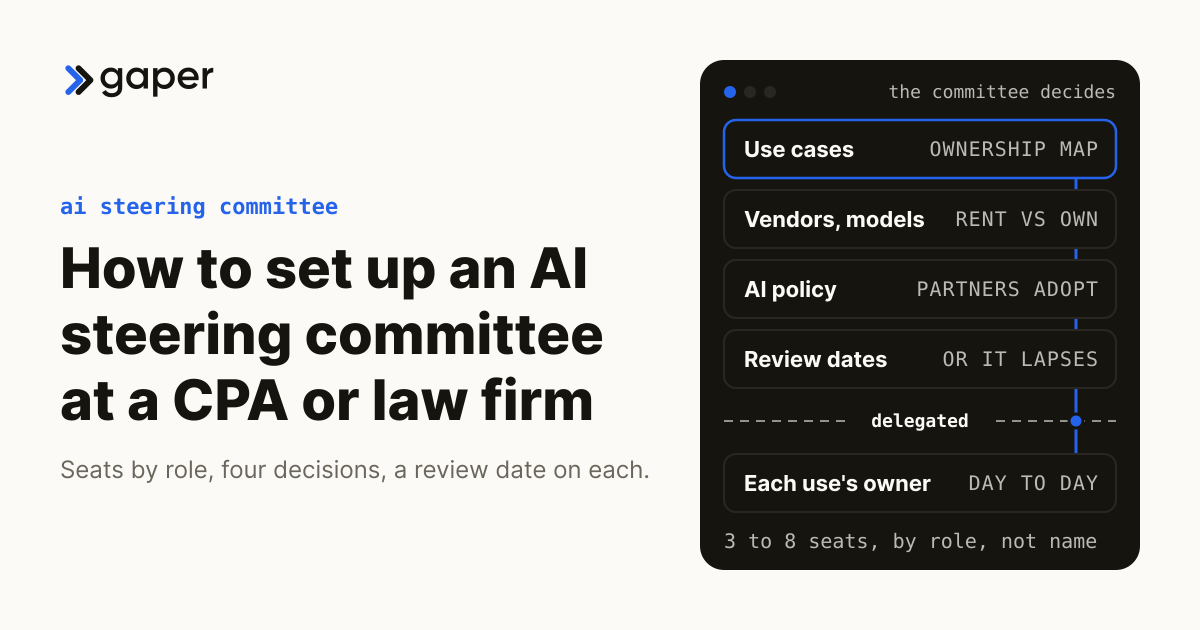
How to Set Up an AI Steering Committee at an Accounting or Law Firm
IndustryHow to Scale an Accounting Firm Without Hiring More Staff
A nine person firm reclaims about 857 hours in year one. That is either $99,000 of advisory capacity or a $72,000 avoided hire, never both. Scaled by firm size.
Aug 16, 2026
How LLMs Can Streamline Operations and Free Up Resources Through Automated Financial Document Processing
Ready to turn AI into execution?
Book a free assessment of one workflow. We map it, make an honest build versus buy call before any code, and if an off the shelf product covers the job we will tell you so.