
7 Reasons AI Agent Projects Fail (and How to Avoid Them)
Most AI agent projects die between the demo and production. Here are the seven failure modes that kill them, and the operating decisions that get agents shipped.
Most AI agent projects do not fail in the demo. They fail in the eleven weeks after the demo, when the thing that looked magical on a slide has to run unattended against real data, real users, and a real on-call rotation. Gartner has floated numbers like 40% of agentic AI projects being scrapped by 2027. You do not need the exact figure. If you have shipped anything, you already know the shape of it: the prototype works, everyone is excited, and then the project quietly stalls.
The pattern is consistent enough to name. Below are the seven reasons agent projects die, and what the teams that get to production do differently.
1. The pilot was never built to become production
A weekend prototype and a production agent are different artifacts. The prototype optimizes for a convincing single run. Production optimizes for the thousandth run at 2 a.m. when an upstream API returns a malformed payload.
When the demo uses a hand-picked input, a generous prompt, and a human watching the screen, none of the hard parts exist yet. Then someone says "great, let's roll it out," and the team discovers the prototype has no error handling, no retries, no logging, no auth model, and no way to recover from a half-completed task.
What works: build the pilot on the rails it will need in production from day one. Real data, real failure injection, real observability. A pilot that cannot survive a bad input was never a pilot. It was a screenshot.
2. No owner for the agent in production
Agents are not deploy-and-forget software. Model behavior drifts, prompts rot as the underlying product changes, and a vendor model update can silently shift outputs overnight. Someone has to own that.
Most failed projects have a builder but no operator. The data scientist who built it moves on, and six months later nobody can answer "why did the agent do that?" because nobody owns the runtime.
The fix is organizational, not technical. Before launch, name the person or team accountable for the agent's behavior in production, with a budget for monitoring and iteration. If no one will own it after launch, do not launch it.
3. Evaluation is vibes, not a harness
This is the quiet killer. Teams ship agents they cannot measure, so they cannot tell whether a prompt change helped or hurt. Every iteration becomes an argument about anecdotes.
Production-grade agents need an evaluation harness before they need more features:
- A golden set of real tasks with known-good outcomes
- Automated scoring on each run, not manual spot checks
- Regression tests so a prompt tweak that fixes one case does not break ten others
- Tracking of cost and latency per task, not just accuracy
- A way to replay production failures against new versions
Without this, you are flying blind. With it, iteration becomes an engineering loop instead of a debate. The teams that ship treat evals as the product, not an afterthought.
4. The agent never touches the real stack
Demos run in a sandbox. Production runs inside your CRM, your ticketing system, your database, your auth, your rate limits, and your compliance boundaries. The gap between those two worlds is where most projects stall.
An agent that can draft an email is a toy. An agent that can read the customer's account, check entitlement, draft the email in your voice, log the action to the system of record, and escalate when it is unsure is a product. The second one requires real integration work that nobody scoped because the demo skipped it.
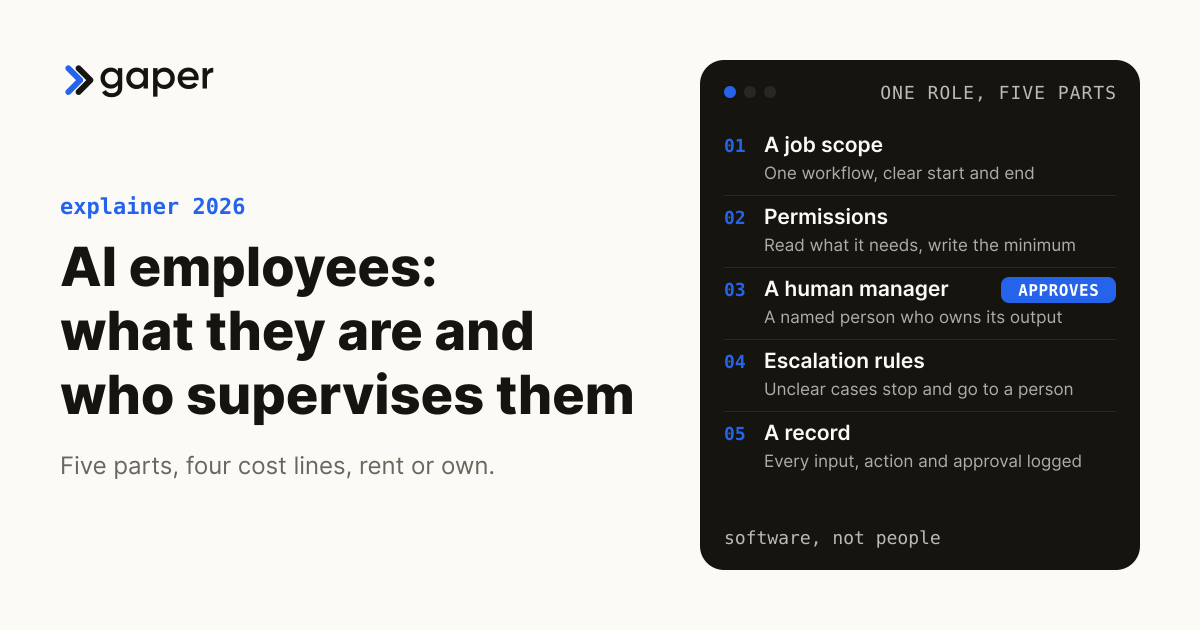
This is precisely the work that takes agents from idea to running inside real workflows, and it is why we built Gaper to deploy production AI agents inside the client's actual stack rather than handing over a clever prototype. The integration is not the boring part after the AI. The integration is the project.
5. Scope is a personality, not a job
"Build an agent that handles support" is not a scope. It is an ambition. Projects that try to automate an entire role in one shot accumulate edge cases faster than they can close them, and the agent ends up trusted for nothing because it is wrong about something.
The agents that survive contact with production start narrow and earn their territory. Pick one workflow with a clear definition of done. For example: triage inbound tickets and route them, with a confidence threshold below which a human takes over. Ship that. Measure it. Expand.
Narrow scope also makes the human-handoff design tractable. You know exactly where the agent's authority ends, which means you know exactly what to monitor and what to escalate. "Handle support" gives you none of that.
6. No human-in-the-loop design, so trust collapses on the first bad call
An agent that acts autonomously with no graceful handoff is one wrong action away from being switched off forever. The first time it refunds the wrong customer or sends a confidently incorrect answer, the organization's tolerance evaporates, regardless of how good the other 95% of runs were.
Trust is built by designing for the agent being wrong, not by pretending it will not be:
- Confidence thresholds that route uncertain cases to a person
- Reversible actions where possible, and approval gates where not
- Clear audit trails so a human can reconstruct what happened
- Staged autonomy: suggest, then act-with-approval, then act-and-notify
The teams that win do not ask the organization to trust the agent. They make the agent's mistakes cheap, visible, and recoverable, and trust accrues from there.
7. The business case was a feature, not a P&L line
A lot of agent projects are funded on novelty. "We should have an AI agent for this." That budget is the first thing cut when priorities tighten, because no one tied the agent to a number anyone cares about.
Agents that survive are attached to a metric the business already tracks: cost per ticket, time-to-resolution, sales cycle length, hours of manual data entry eliminated. When the agent moves that number, it stops being a science project and becomes infrastructure.
Define the metric before you build. Instrument it from day one. If you cannot name the line on the P&L the agent is supposed to move, you do not have a project. You have a curiosity, and curiosities do not survive a budget review.
The throughline
Notice what most of these failures are not. They are not about the model being too dumb. The frontier models are already good enough for an enormous range of production work. The failures are about everything around the model: scope, integration, evaluation, ownership, human design, and a business case that holds up.
That is the gap between a demo and a deployed agent, and it is mostly engineering and operating discipline, not AI research. If you are evaluating an agent initiative, audit it against these seven points before you green-light it. The projects that clear all seven are the ones still running a year later. The ones that clear two or three are the ones that become the cautionary tale in the next budget cycle.
The good news: every one of these is fixable, and most are fixable before you write the first line of agent code. Decide who owns it. Pick one narrow workflow tied to a real metric. Build the eval harness first. Plan the human handoff. Then build the pilot on production rails from the start. Do that, and the demo-to-production cliff stops being a cliff.
Thirty minutes, no commitment. We map one workflow, make the build or buy call, and scope the smallest thing worth shipping.
Frequently asked questions
Why do most AI agent projects fail?
What is the difference between an AI agent pilot and a production agent?
How do you measure whether an AI agent is working?
How do you build trust in an autonomous AI agent?
Should you automate an entire role with one AI agent?
What does Gaper do for AI agent projects?
Ready to turn AI into execution?
Book a free assessment of one workflow. We map it, make an honest build versus buy call before any code, and if an off the shelf product covers the job we will tell you so.