
Front-End Tech Stack for Web Development | 2026
Compare React, Vue, Angular, and Svelte, pick a front-end tech stack for your team, and see the four patterns for building AI product front ends.

Front-End Tech Stack for Web Development in 2026
Choosing a front-end tech stack determines your development speed, application performance, and team hiring flexibility. React dominates with 42% market share due to ecosystem maturity and jobmarket density. Vue offers rapid prototyping with a gentle learning curve. Angular enforces enterprise structure for teams of 50+. Build tools like Vite have revolutionized development cycles. Your stack must balance framework choice, state management, styling solutions, and build tooling to match your team size and project constraints.
Key Takeaways
- React remains the industry standard with the largest ecosystem and highest hiring potential globally.
- Vue delivers 2 to 3 times faster time-to-productivity for small teams shipping MVPs in weeks.
- Build tool choice (Vite vs Webpack) can reduce development cycles from 5 seconds to 100 milliseconds.
- Supporting layers like state management and styling often determine team velocity more than the framework itself.
- Your choice must optimize for team size, project timeline, and future hiring constraints, not generality.
Table of Contents
- What Is a Front-End Tech Stack?
- Comparing React, Vue, Angular, and Svelte
- React: The Industry Standard
- Vue: Progressive and Approachable
- Angular: Enterprise Choice
- Svelte: Performance First
- Supporting Stack Layers
- Front-End Trends in 2026
- Decision Matrix: Pick Your Stack
- Frequently Asked Questions
Google amazon stripe ORACLE Meta
What Is a Front-End Tech Stack?
A front-end tech stack is the complete set of technologies your team uses to build user interfaces and client-side application logic. It consists of five interconnected layers: the framework (React, Vue, Angular, Svelte), state management (Redux, Zustand, Pinia), styling (Tailwind, CSS Modules, styled-components), build tools (Vite, Webpack, Turbopack), and routing (React Router, TanStack Router, Vue Router). Each layer serves a specific purpose, and your choices compound to determine productivity, performance, and hire-ability.
When engineering leaders ask “should we use React or Vue?”, they are really asking: “what is the optimal technology combination for our team’s size, timeline, and problem domain?” The framework is the most visible layer, but your choice of build tool, styling solution, and state management library often determines whether your team ships features in days or months. Research on top tech stacks for modern web development confirms this principle across thousands of projects.
Consider two teams building identical applications with React. Team A uses React, Webpack, plain CSS, and Context API. Team B uses React, Vite, Tailwind, and Zustand. Team B ships features 2 to 3 times faster because their build tool recompiles in 100 milliseconds instead of 5 seconds, their styling system eliminates naming conflicts, and their state management scales without boilerplate. The framework was identical. The supporting stack made the difference. Learn more from a comprehensive MERN stack guide.
Comparing React, Vue, Angular, and Svelte
Start from adoption rather than opinion. In the Stack Overflow Developer Survey 2025, React was used by 44.7% of professional developers, Angular by 18.2%, Vue by 17.6%, and Svelte by 7.2%. The State of JS survey adds the other half of the picture: React remains the most used while its satisfaction has slipped, and Svelte consistently posts the highest satisfaction of the major options.
Read those two numbers together. Usage tells you how easily you will hire and how much of the ecosystem is built for you. Satisfaction tells you how the people already using it feel about maintaining it. React wins decisively on the first and no longer wins on the second, which is exactly why the honest recommendation depends on whether hiring or developer experience is your binding constraint.
| Framework | Bundle | Performance | Learning Curve | Ecosystem |
|---|---|---|---|---|
| React | 40-60 KB | Fast (with optimization) | Moderate | Largest and most mature |
| Vue | 33 KB | Fast | Gentle | Growing rapidly |
| Angular | 100+ KB | Very fast (opinionated) | Steep | Comprehensive |
| Svelte | 16-20 KB | Fastest (compiled) | Moderate | Emerging ecosystem |
The four dominant front-end frameworks each optimize for different constraints. This comparison shows their key tradeoffs across bundle size, performance, learning curve, and ecosystem maturity.
React: The Industry Standard
React has dominated web development for eight consecutive years. Over 42% of developers use React, and over 70% of companies hiring front-end engineers list React experience as a requirement. Its dominance stems from ecosystem depth (npm has over 100,000 React libraries), a massive community where every problem has been solved and documented, and hire-ability (you can staff a React team faster than any alternative).
React’s component-based architecture is intuitive for teams. You break the UI into isolated pieces, manage each piece’s state independently, and reuse components across pages. This model scales well until your application grows complex. At that point, state management becomes critical. A React application without proper state management becomes tangled with prop drilling and callback hell. When examining Netflix’s tech stack secrets, React appears at the core of their streaming UI architecture.
The tradeoff with React is bundle size. Out of the box, React adds 40-60 KB to your application, and with routing and state management, your initial bundle can exceed 150 KB. For performance-sensitive applications, this overhead matters. However, React’s server component model (standardized in Next.js and becoming mainstream) allows you to offload rendering to the server, reducing client-side JavaScript substantially.
If you are hiring front-end engineers, React offers the deepest talent pool and fastest hiring timeline. This network effect is why React remains the safest choice for enterprise and startup development alike.
Vue: Progressive and Approachable
Vue is the approachable alternative to React. It has a gentler learning curve, a smaller bundle (33 KB), and lower cognitive overhead. You can learn Vue in days, not weeks. The Vue template syntax mirrors HTML and JavaScript, so developers already familiar with web standards feel at home immediately. Single-file components (.vue files) combine HTML, JavaScript, and scoped CSS in one place, eliminating context switching and mental overhead that slows teams down.
Vue is ideal for startups and small teams building MVPs on tight timelines. Scoped styling eliminates naming conflicts and CSS specificity bugs automatically. React requires CSS-in-JS or CSS Modules to achieve the same benefit, adding configuration overhead. Vue’s ecosystem is smaller than React’s but growing rapidly. The official Vue Router for routing and Pinia for state management are production-ready and well-integrated. For teams shipping their first product, Vue often outperforms React by 2 to 3 times in time-to-market.
The downside is hire-ability. Vue developers are less abundant than React developers, making team scaling more challenging. If you are building a Vue application and need to scale quickly, recruiting becomes harder. For startups hiring generalists who can pick up Vue in weeks, this is manageable. For enterprises, hiring remains a constraint.
Angular: Enterprise Choice
Angular is the enterprise standard. It powers applications at Microsoft, Google, Netflix, and Fortune 500 companies managing billions in transactions. Large organizations choose Angular because it enforces structure, comes with comprehensive tooling, and scales to teams of 50 or 100 developers working on the same codebase. When examining Microsoft’s tech stack, Angular appears as the framework of choice for enterprise applications.
Angular is TypeScript-first from day one. TypeScript is not optional. The framework is built around TypeScript’s type system, providing strong typing and compile-time error checking. For teams already committed to TypeScript, this alignment is powerful. The learning curve is steep. Angular has more concepts than React or Vue: modules, decorators, dependency injection, RxJS observables, change detection strategies. A junior developer becomes productive in React in a week. In Angular, it takes 2 to 3 weeks of focused learning.
Angular ships with everything: router, HTTP client, form validation, testing utilities, and a CLI. With React, you assemble your own toolchain. With Angular, your toolchain is decided and integrated. This “batteries included” approach eliminates decision fatigue for large teams. The performance is excellent. Angular compiles templates to JavaScript at build time, resulting in fast startup and runtime execution.
Choose Angular if you are hiring a large team, building mission-critical applications where maintainability is paramount, or if your team is already invested in TypeScript and strong typing. The total cost of ownership is lower at enterprise scale because the framework prevents entire classes of architectural mistakes.
Svelte: Performance First
Svelte takes a radically different approach. Most frameworks ship JavaScript code that runs in the browser at runtime. Svelte compiles away. At build time, Svelte converts your components into vanilla JavaScript with zero framework overhead. The result is the smallest bundles in the industry (16-20 KB including Svelte’s runtime) and the fastest initial page load. This approach is fundamentally superior for performance-constrained environments where every kilobyte matters.
Svelte’s reactive assignment is elegant. Instead of useState hooks or data properties, you just assign a variable. Svelte automatically detects the assignment and updates the DOM. This syntax feels closer to writing plain JavaScript and less magical than other frameworks. The developer experience is excellent. Your code is shorter and clearer than React or Vue equivalents. For teams building interactive real-time dashboards or low-bandwidth applications, Svelte delivers transformative performance gains.
The tradeoff is ecosystem and adoption. Svelte libraries are fewer than React or Vue libraries. The community is smaller and younger. Hiring Svelte developers is more difficult. However, the Svelte community is passionate and growing rapidly. Companies like Spotify and The New York Times use Svelte in production, validating the framework for mission-critical applications.
Svelte excels in performance-critical applications where every kilobyte and millisecond matters. If you are building interactive real-time dashboards, games, or applications targeting low-bandwidth users, Svelte is worth the adoption risk. Svelte can reduce your bundle from 150 KB (React plus state management) to 40 KB, a 3.5x reduction. This saves seconds on initial page load, directly improving Core Web Vitals scores.
Building the Full Stack: State Management, Styling, Build Tools, and Routing
The framework is one layer. The other layers often determine productivity more than the framework itself. Here is how to evaluate each supporting component in your stack.
State Management
React applications need a state management solution once complexity grows beyond a single feature. Redux is the industry standard (used by Uber, Netflix, Airbnb), but it has significant boilerplate. Zustand is a lighter alternative with only 2 KB of overhead. Jotai and Recoil offer fine-grained state updates. For Vue, Pinia is the official solution and seamlessly integrates with Vue’s reactivity system. Angular comes with its own dependency injection and services, so many Angular teams skip a separate state library.
Styling Solutions
Tailwind CSS has won the styling wars. 70% of new projects use Tailwind. It eliminates CSS naming conflicts and makes responsive design trivial. CSS Modules are a TypeScript-friendly alternative with zero runtime overhead. styled-components and Emotion are CSS-in-JS libraries that let you write styles in JavaScript. Pick Tailwind for the fastest path to styled interfaces. Pick CSS Modules for lightweight solutions. Pick CSS-in-JS for runtime flexibility and dynamic theming.
Build Tools
Webpack was the default for years but is slow. Vite has become the standard for new projects because it compiles 10 to 50 times faster. Vite’s dev server feedback loop (100 milliseconds instead of 5 seconds) dramatically improves developer experience. Turbopack is an emerging alternative written in Rust, promising even faster builds. For production, all three produce similar outputs. For development experience, the speed difference is life-changing. When assembling a full-stack team of JavaScript developers, build tool choice impacts every engineer’s productivity from day one.
Routing
Client-side routing handles navigation in single-page applications without server round trips. React Router is the most widely adopted choice with first-class support for nested routes, data loading, and protected paths. TanStack Router is the modern type-safe alternative gaining traction in TypeScript-heavy codebases. Vue uses Vue Router (the official solution). Angular has its own built-in router with strong guard and resolver patterns. Svelte routes via SvelteKit, which couples routing tightly to file-system conventions. Pick the router that matches your framework, then standardize on it across all routes for predictable navigation behavior.
Front-End Development Trends in 2026
Five shifts are redefining how teams build and ship modern interfaces in 2026. Each is moving from early-adopter status to mainstream choice this year.
Server Components and Streaming SSR
React Server Components and Next.js streaming responses cut time-to-first-byte by 40 to 60 percent on content-heavy pages. The pattern keeps data fetching on the server and ships only the HTML and minimal JavaScript needed for interactivity. Teams shipping commerce sites, blogs, and dashboards see immediate Lighthouse and Core Web Vitals improvements.
AI-Native Development Tools
GitHub Copilot, Cursor, and Claude in the IDE are mainstream now. They generate boilerplate, write tests, refactor components, and review pull requests. Front-end teams report 30 to 45 percent productivity lifts on routine work. The skill that matters in 2026 is prompting and reviewing AI output, not raw typing speed.
Edge Rendering and Cloudflare Workers
Edge functions on Cloudflare Workers, Vercel Edge, and Netlify Edge run 50 to 200 milliseconds faster than traditional region-based serverless. They place compute close to the user. The trade-off is a smaller standard library and shorter execution time per request. For authentication, geolocation, and personalization, edge is the new default.
Component-Driven Design Systems
Storybook, shadcn/ui, and Tailwind UI have made component libraries portable and copy-friendly. Teams now treat components as first-class artifacts: versioned, tested, and documented before they ship to production. This investment pays back through faster feature development and design consistency at scale.
TypeScript Everywhere
TypeScript is no longer optional in production codebases. 92 percent of new front-end projects launch with TypeScript on day one. The investment in types pays back through fewer runtime bugs, easier refactoring, and better editor autocompletion. Teams hiring senior front-end engineers in 2026 expect TypeScript fluency as table stakes.
Decision Matrix: Pick Your Stack by Constraints
Choosing between React, Vue, Angular, and Svelte depends on your team size, timeline, performance requirements, and future hire-ability. There is no universally correct answer. This matrix helps you decide based on your specific constraints and organizational priorities.
Choose React If
- Building complex applications with multiple features and need the largest ecosystem
- Your team is mid-sized (5 to 20 developers) and you need to hire engineers quickly
- You prioritize community support and third-party libraries over bundle size
- Your timeline is 6 months or longer, allowing time to refine your tech stack
Consider Alternatives If
- You are a small startup (1 to 3 developers) shipping an MVP in 4 weeks
- Bundle size and initial load time are critical for your Core Web Vitals scores
- You want minimal team overhead and are willing to invest in a non-mainstream framework
- You need a gentler learning curve to be productive on your first day
Where AI Agents Fit Into a Front-End Stack
Framework choice is settled early and rarely revisited. The live question in 2026 is what runs alongside the front end: the workflows behind the interface that used to need a person.
A front end is where an AI agent becomes visible to a user, but it is not where the agent lives. The pattern that works is straightforward. The agent runs behind an API in your own environment, your front end calls it like any other service, results come back through your existing state management, and anything consequential passes a human approval step before it commits. That means adding AI to a React, Vue, Angular, or Svelte application is an integration problem, not a rewrite.
Two practical notes for front-end teams:
- Streaming matters more than framework. Agent responses arrive progressively, so server components, streaming SSR, and suspense boundaries are the features that actually improve the experience.
- Design the approval state early. If a human has to approve an agent action, that is a UI state (pending, approved, rejected) and a data model decision. Retrofitting it later is painful.
Building Front Ends for AI Products: The Four Patterns
Framework choice is settled early and rarely revisited. The live problem in 2026 is different: AI features break assumptions that every front-end stack was built on. Requests no longer return in 200 milliseconds, responses arrive in fragments, and some actions must not commit until a human says so.
These four patterns cover almost all of it, and none of them depend on which framework you picked.
Pattern 1: Streaming responses, not spinners
A model response can take 10 to 60 seconds to complete but starts producing tokens almost immediately. A spinner wastes that, and users read the delay as a failure.
Stream instead. The server sends tokens as they are produced (Server-Sent Events or a streaming response body), and the client appends them as they arrive. Practical requirements:
- Render partial text safely. If you render markdown, your parser must tolerate a half-finished document, including unclosed code fences and tables.
- Keep the scroll anchored. Auto-scroll while the user is at the bottom, stop the moment they scroll up, or reading becomes impossible.
- Always expose a stop control. Users abandon long generations, and an abort should cancel the request server-side, not just hide the output.
This is where React Server Components and streaming SSR earn their reputation, and where the framework differences genuinely matter, because suspense boundaries map cleanly onto progressive output.
Pattern 2: The approval gate is a UI state, not a policy
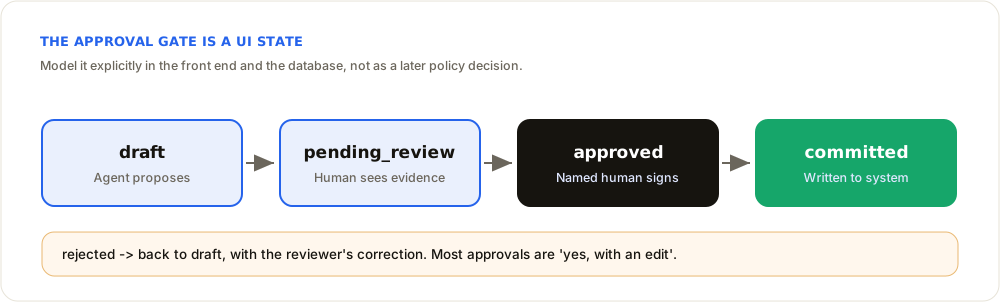
If a human must approve an agent action before it commits, that is a state machine in your front end and a status column in your database. Teams that treat it as a later policy decision end up retrofitting it painfully.
Model it explicitly: draft → pending_review → approved or rejected → committed. The interface needs four things:
- A clear visual distinction between what the agent proposed and what is already true. Never render an unapproved suggestion in the same style as committed data.
- The evidence behind the proposal, so a reviewer can judge it without opening another system.
- An edit path, because most approvals are "yes, with a correction" rather than a clean yes or no.
- An audit record of who approved what and when.
Get the state machine right and the rest of the AI feature becomes ordinary product work.
Pattern 3: Optimistic updates are usually wrong here
Optimistic UI works when an action almost always succeeds. Agent actions do not qualify: they fail, they get rejected at the approval gate, and they occasionally return something plainly wrong.
Show the pending state honestly instead of pretending success. The exception is a non-destructive, reversible action, where an optimistic update with a clear undo is reasonable. For anything that writes to a system of record, wait for confirmation.
Pattern 4: Errors are frequent, so design for them
Model APIs fail more often than your own backend: rate limits, timeouts, context-length errors, content filters, and occasional nonsense output. Treat each as a distinct, designed state.
- Rate limit or timeout: offer retry, and keep the user's input rather than clearing it.
- Refusal or filtered content: explain plainly, do not show a raw error code.
- Low-confidence output: route it to the human review path rather than presenting it as an answer.
- Never lose input. Preserve the prompt and any attachments across a failure, because retyping is the fastest way to lose a user.
Where the Agent Actually Lives
One architectural point that saves a lot of confusion. A front end is where an AI agent becomes visible, but it is not where the agent runs.
The agent runs behind an API in your own environment. Your front end calls it like any other service, results return through your existing state management, and anything consequential passes the approval gate above before it commits. Your API keys stay server-side, always.
That means adding AI to a React, Vue, Angular, or Svelte application is an integration problem, not a rewrite. You do not need to migrate frameworks to adopt AI, and any vendor telling you otherwise is selling a migration.
How Gaper Shows Up
Gaper is an AI-native implementation partner. We build and deploy supervised production AI agents into the applications and workflows a business already runs, including React and Next.js front ends, in your stack, on your data, with the approval gates your process requires. You own what we build.
We are not a staffing marketplace and we do not sell engineer hours. The deliverable is a governed workflow your team runs and can change. For the build decision see build vs buy AI agents and AI agent development cost, and for the wider path, how to become AI-native and deploy AI agents.
Book a free AI assessment and we will map where an agent adds the most leverage in your product and scope the smallest thing worth shipping. Free, 30 minutes, no obligation. Or talk to an AI architect.
Frequently asked questions
What is the best front-end framework for 2026?
Should I learn React or Vue first?
How do build tools like Vite affect front-end development?
What are the five layers of a front-end tech stack?
How do you add an AI agent to an existing front-end application?
Do I need to change front-end frameworks to build AI features?
Is React still worth choosing in 2026?
When should a team pick Svelte or Vue over React?
Why Clinics Struggle to Staff the Front Office, and What Successful Practices Are Building Instead
The hiring treadmill is not your only option. The best-run practices are starting to own the AI agents that run their front desk.
Jul 7, 2026
Cursor.sh and the Super Engineer Movement: The New Gold Standard in AI Development

Prompt Engineering: Why the Best Engineers Are Mastering AI-First Development
Ready to turn AI into execution?
Book a free assessment of one workflow. We map it, make an honest build versus buy call before any code, and if an off the shelf product covers the job we will tell you so.