
Toptal Review 2026: Pricing, Vetting, and When to Build Instead
Toptal review: rates run $60 to $150+ an hour, with a $500 refundable deposit and a $79 monthly fee, plus when automating the work beats renting hours.

Toptal Review 2026: Pricing, Vetting, and When to Build Instead
This Toptal review covers what the platform actually costs in 2026, how its vetting and hiring process works, who it genuinely suits, and the option most buyers never consider: automating the workflow instead of renting hours to run it. Toptal is a strong product for a specific job. The mistake is using it for work that is repeatable, because then you pay for the same output every month, indefinitely.
Key takeaways
- Toptal clients typically pay $60 to $150+ per hour, with specialised talent above $200, and that rate is a blended figure including an undisclosed platform markup (2026 pricing analyses).
- Getting started requires a $500 refundable deposit plus a $79 per month subscription that continues until you cancel.
- Full-time engagements commonly run $12,000 to $20,000 per month per engineer before the subscription.
- Toptal does not publish a rate card. Pricing depends on skill set, seniority, and project complexity, which makes budgeting harder than with a fixed-price vendor.
- The vetting is real and the trial period is genuine. What you are buying is screening and matching, not a cheaper hour.
Rates and fees change. Figures here reflect publicly reported 2026 analyses; confirm current terms with Toptal directly before you budget against them.
What Is Toptal and How Does It Work?
Toptal is a vetted freelance marketplace connecting companies with software engineers, designers, finance experts, and product managers. Its positioning has been consistent since launch: screen hard, admit a small share of applicants, and charge a premium for that filtering.
The process is straightforward. You describe the role, a matcher proposes candidates from the vetted pool, you interview a shortlist, and you start with a trial period before committing to a longer engagement. The value is that you skip sourcing and first-round screening, which is genuinely the slowest part of hiring a contractor.
The "top 3%" claim is widely quoted and widely misread. It means Toptal accepts a small fraction of people who apply, not that it has assessed the world's engineers and holds the best of them. Plenty of strong engineers never apply to marketplaces at all.
Toptal Pricing: What You Actually Pay
Toptal uses a blended hourly rate that bundles the freelancer's pay, payroll taxes, and the platform fee. You do not see the split, which is the most common complaint in buyer reviews.
| Cost component | What to expect in 2026 |
|---|---|
| Hourly rate, general engineering | Roughly $60 to $150+ per hour |
| Hourly rate, specialised (including AI) | $200+ per hour is common |
| Full-time monthly engagement | Roughly $12,000 to $20,000 per engineer |
| Upfront deposit | $500, refundable, applied against your first invoice |
| Subscription | $79 per month until cancelled |
| Trial period | A genuine trial before longer commitment |
Two budgeting notes. First, the absence of a published rate card means your quote depends on the role and the matcher, so get it in writing before planning a quarter around it. Second, the monthly subscription is easy to forget once an engagement ends.
Is Toptal expensive?
Compared to posting on a general freelance site, yes, considerably. Compared to a recruiter fee plus the internal hours you would spend screening candidates, it is often defensible. The honest framing: Toptal sells reduced hiring risk and time saved. Whether that is worth the premium depends on how costly a bad hire or a slow start is for you.
Who Should Use Toptal?
Use Toptal if
- You need a specialist for a defined scope and lack the internal network to find one quickly.
- The work is genuinely bespoke: novel product development, architecture, or a problem nobody on your team has solved.
- You want screening handled and will pay a premium to skip sourcing and first-round interviews.
- You need capacity fast for a project with a clear end date.
Look elsewhere if
- Your budget is tight and the role is a standard, well-supplied skill where the premium buys little.
- You need several people at once, where a blended rate compounds quickly.
- The work is repetitive and rules-driven, which the next section covers.
- You want transparent published pricing you can plan against without a sales conversation.
For a wider field of platforms in this category, see our Toptal alternatives comparison.
The Third Option Most Buyers Miss: Build Instead of Rent
Toptal, Turing, and Upwork all answer the same question: how do I rent a person by the hour. For bespoke engineering that is the right question. For repetitive work it is the wrong one.
A large share of what companies hire freelancers for is repeatable process work: document intake and data entry, first-draft content and reporting, reconciliation, support triage, lead research. Those are workflows, not projects. Renting hours to run a workflow means paying again every month for the same output.
The alternative is to build a supervised AI agent that runs the workflow inside your own systems, with a human approving anything consequential. The cost shape is different: higher once, then far lower per run, and you own the result instead of re-hiring it. The trade is real work upfront to define the workflow, wire the integrations, and set the approval gates.
An honest boundary, because this is where vendors overclaim. Agents do not replace an engineer for novel product work, architecture, or any problem requiring judgment about unfamiliar territory. For those, a marketplace hire is a sound choice.
| Your situation | Better fit |
|---|---|
| One-off build, novel product work, specialist skill for a fixed scope | A marketplace hire such as Toptal |
| Repetitive, rules-heavy workflow run daily or monthly | A supervised agent you own |
| You need capacity now and the work is genuinely bespoke | A marketplace hire |
| You are paying for the same task again every month | A supervised agent you own |
| Regulated work needing an audit trail and a named approver | A supervised agent with an approval gate |
A useful test: if you could write the steps down as a procedure and hand them to a new starter, it is probably a workflow worth automating. If you could not, hire a person.
How Toptal's Vetting Actually Works
The vetting is the product, so it is worth understanding what it does and does not screen for. Toptal's published process runs in stages: a language and communication screen, a timed technical assessment covering algorithms and problem solving, a live technical interview, a test project, and then ongoing quality review once someone is placed.
What that reliably filters for is baseline technical competence and communication. What no marketplace screen can tell you is whether someone fits your codebase, your domain, and your team's working style. That last part is still your job, which is why the trial period matters more than the badge.
The widely quoted "top 3%" figure describes the acceptance rate among applicants, not a measurement of the global engineering population. It is a real filter and a meaningful one. It is not evidence that the best available engineer for your problem is inside the pool.
Engagement Models and Contract Terms
Three shapes, with different economics:
| Model | Typical use | What to watch |
|---|---|---|
| Hourly | Variable or advisory work | Rate is blended and unpublished; agree the cap and reporting cadence upfront |
| Part-time | Ongoing support, a few days a week | Continuity risk if the engineer takes a full-time engagement elsewhere |
| Full-time | Sustained team capacity | Commonly $12,000 to $20,000 per engineer per month; the largest commitment |
Terms worth reading before signing, because they are where surprises live:
- IP assignment. Confirm in writing that work product assigns to you, and that it survives the engagement ending.
- NDA and subprocessors. If the engineer will touch customer data, your obligations flow through to them.
- Notice and termination. How much notice ends an engagement, and what happens to work in progress.
- Conversion. If you later want to hire the person directly, know the fee before you get attached.
- The subscription. The $79 per month continues until cancelled, including after an engagement ends.
The 12-Month Cost Model: Hire Versus Build
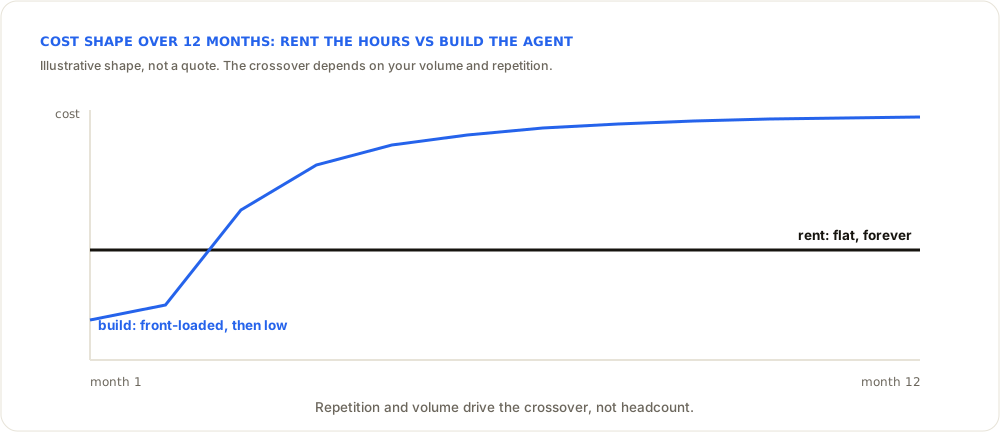
This is the comparison that actually decides the question, and it is almost never laid out. Take one repeatable workflow, say invoice intake and coding, and cost it two ways over a year.
Renting the hours. A contractor running that workflow is a recurring cost that scales with volume and continues as long as the work does. Month 12 costs the same as month 1, and if volume doubles, so does the bill. You own nothing at the end.
Building the agent. Cost is front-loaded: defining the workflow, wiring integrations, building the evaluation harness, setting the approval gates. After that, running cost is compute plus a much smaller amount of human review time. Month 12 costs a fraction of month 1, and volume growth is close to free.
| Rent the hours | Build the agent | |
|---|---|---|
| Cost shape | Flat and recurring | Front-loaded, then low |
| Effect of volume doubling | Roughly doubles | Marginal |
| What you own at month 12 | Nothing | A governed workflow, plus its audit trail |
| Fails badly when | The work is repetitive and never ends | The work is bespoke or one-off |
| Time to first value | Days | Weeks |
The crossover is driven by repetition and volume, not by headcount. A workflow run a few times a month rarely justifies building. One run daily, across a team, usually does. Deliberately no percentages here: the honest answer depends on your volume, and any vendor quoting a universal saving is guessing. See AI agent development cost and AI agent ROI for how we model it properly.
Getting a Good Result From Any Marketplace
If a marketplace hire is the right call, these change the outcome more than the platform you pick:
- Write a brief with acceptance criteria, not a skills list. "Ship X, measured by Y" beats "senior React developer" every time.
- Use the trial period deliberately. Give real work with a real deadline, not a warm-up task.
- Own the architecture decisions yourself. A contractor optimises for the scope you set, not for what you will need in two years.
- Document as you go. The engagement ends; the code stays. Insist on documentation as a deliverable rather than a favour.
- Decide the exit at the start. Who maintains this afterwards is a question best answered before the work begins, not after.
Toptal vs the Alternatives
The marketplace field splits by how much screening you are paying for, and how much of the hiring work is left with you.
| Platform | Model | Screening | Typical rate | Best for |
|---|---|---|---|---|
| Toptal | Curated marketplace, matcher-led | Heavy, multi-stage | $60 to $150+, specialists $200+ | Specialist skills where a bad hire is expensive |
| Turing | AI-matched global talent | Moderate, automated plus review | Generally below Toptal | Cost-sensitive remote roles at volume |
| Upwork | Open marketplace | None by default, you screen | Wide, $20 to $150+ | Small, well-defined tasks and short engagements |
| Andela | Managed teams, engagement-led | Moderate, team-oriented | Mid to upper range | Longer engagements needing a managed pod |
| Gun.io / Arc | Curated, smaller pools | Moderate to heavy | Mid to upper range | Senior individual contributors, lighter process |
The useful way to read this table is not price. It is who does the screening work. Upwork hands you the entire filtering job at the lowest headline rate. Toptal does the most filtering and charges accordingly. Everything else sits between. If your team has the bandwidth and the technical judgment to screen well, the premium buys less than it appears to.
What the Hiring Process Actually Looks Like
A realistic sequence, so you can plan around it rather than be surprised by it.
- Intake call. You describe the role, stack, and timeline. The quality of this conversation determines the quality of your matches more than anything else you do.
- Matching. A matcher proposes candidates from the vetted pool, usually within days rather than weeks.
- Your interviews. You still interview. The marketplace filtered for baseline competence, not for fit with your codebase or domain.
- Trial period. The engagement starts with a trial window. This is your real evaluation, so give real work with a real deadline.
- Ongoing engagement. Billing runs through the platform, and the monthly subscription continues until you cancel it.
The two steps teams under-invest in are the first and the fourth. A vague brief produces plausible but wrong matches, and a warm-up task during the trial tells you nothing you needed to know.
Common Complaints, and Which Ones Are Fair
Drawn from published buyer reviews. Worth knowing before you sign, and worth weighing fairly.
"The markup is opaque." Fair. The blended rate bundles the engineer's pay, taxes, and platform fee with no published split, so you cannot tell what share reaches the person doing the work. If transparent pricing matters to your procurement process, this is a genuine problem.
"It is expensive." Fair but incomplete. It is expensive against a general freelance site, and often defensible against a recruiter fee plus your own screening hours. The question is what a bad hire or a slow start costs you.
"The top 3% claim is marketing." Partly fair. The figure describes acceptance rate among applicants, not an assessment of the global talent pool. It is a real filter; it is not proof the best available person for your problem is inside it.
"Quality varies." Fair, and true of every marketplace. Screening establishes a floor, not a ceiling, and fit with your domain is something no general screen can test.
"The subscription is easy to forget." Fair and avoidable. The monthly fee continues after an engagement ends until you cancel it. Diarise it.
Questions to Ask Before You Sign
Cheap to ask, expensive to skip:
- What exactly does the trial period cover, and what happens to work in progress if we end it?
- Does IP assign to us on payment, and does that survive termination?
- What is the replacement process, and how long does a replacement take?
- Is this person working on other engagements concurrently, and at what allocation?
- What are the notice terms on both sides?
- If we later hire them directly, what is the conversion fee?
- When does the subscription stop billing, and what cancels it?
Get the answers in writing. Every one of these is a normal question, and reluctance to answer any of them in writing is itself information.
How Gaper Shows Up
Gaper is an AI-native implementation partner. We are not a freelancer marketplace and we do not sell engineer hours. We build and deploy supervised production AI agents into the workflows a business already runs, in your stack, on your data, with the approval gates your process requires, and your team owns what we build.
So Gaper is an alternative to a marketplace only when the work is a repeatable workflow. When you need a contractor for a bespoke build, a marketplace is the right tool and we will tell you so.
Where we have a product it maps directly: AccountsGPT for finance and bookkeeping workflows, plus industry work in AI agents for accounting, AI agents for customer support, and AI agents for fintech. For the economics, see build vs buy AI agents, AI agent development cost, and AI agent ROI. For the wider path, how to become AI-native and deploy AI agents.
Book a free AI assessment and we will tell you honestly whether your work is a hire or a workflow, and scope the smallest agent worth shipping if it is the latter. Free, 30 minutes, no obligation. Or talk to an AI architect.
Frequently asked questions
How much does Toptal actually cost beyond the headline hourly rate?
How long does it take to hire through Toptal?
When does it make sense to use Toptal rather than a cheaper alternative?
Does Toptal offer a replacement guarantee if an engineer is not a fit?
What are the best alternatives to Toptal in 2026?
Should I hire a freelancer or automate the workflow with an AI agent?
Is it cheaper to build an AI agent than to hire a contractor?
What work should never be handed to an AI agent?
Why Clinics Struggle to Staff the Front Office, and What Successful Practices Are Building Instead
The hiring treadmill is not your only option. The best-run practices are starting to own the AI agents that run their front desk.
Jul 7, 2026
The Essential Skills To Look For When Hiring Prompt Engineers

12 Projects to Build With Generative AI
Ready to turn AI into execution?
Book a free assessment of one workflow. We map it, make an honest build versus buy call before any code, and if an off the shelf product covers the job we will tell you so.