
Why Staffing Agencies Are Leaving Traditional HR Software for AI Agents
Why HR software built for in-house teams fails staffing agencies, which workflows AI agents can run, rent vs own, and the LL144 and EEO rules that apply.
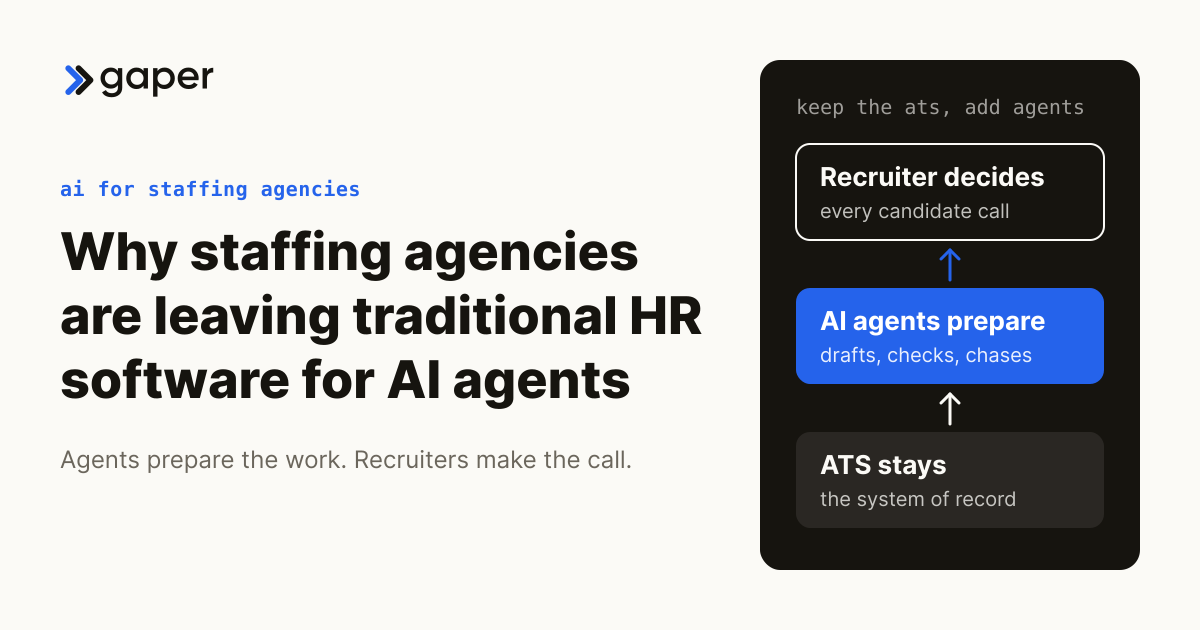
Leaving traditional HR software does not mean ripping out the applicant tracking system. It means dropping HR software built for in-house teams, and the idea that a system of record will do the work, in favor of AI for staffing agencies: agents that run on top of a staffing ATS such as Bullhorn or Avionte and handle the multi-client tasks recruiters still do by hand. An agency doing this well keeps a recruiter on every decision that affects a candidate, because the legal responsibility stays with the agency even when a vendor's tool makes the recommendation.
Why does traditional HR software fit a staffing agency so badly?
HR software was designed for one employer managing its own employees, so its core record is a person on that employer's payroll. A staffing agency runs a two-sided business: many client accounts, each with its own job orders, bill rates, submittal format and compliance rules, served by workers who rotate between them.
The unit of work is the job order, the submittal and the placement, and an HRIS has no natural home for any of them. The American Staffing Association reports that US staffing companies hired 12.7 million temporary and contract employees during 2023, while nearly 2.2 million worked for them in an average week of 2024 (ASA staffing statistics). That churn is the opposite of the stable workforce an HR suite assumes.
| Software built for in-house HR | What a staffing agency runs | |
|---|---|---|
| Customer | One employer | Many clients, each with its own rules |
| Core record | Employee | Job order, submittal, placement |
| Workforce | Stable headcount | Workers rotating between assignments |
| Success measure | Retention, time to hire | Fill rate, time to submit, spread per placement |
| Compliance | One employer's policies | Per client, per vertical, per jurisdiction |
Staffing agency software fixed the record problem, not the labor problem. A recruiter still reads the job order, writes the submittal, chases the missing license and notices the assignment ending next week. Bullhorn's 2026 GRID Industry Trends Report, a global survey of nearly 2,300 recruitment professionals, found only 10 percent of firms had implemented agentic AI across their full workflow (Bullhorn, 2026). It is a vendor's number.
In-house HR teams face a different problem, covered in AI agents for HR teams.
What does an AI-native staffing agency run differently?
An AI-native staffing agency keeps its ATS as the system of record and adds agents that do the reading, drafting and checking between records, while recruiters approve the output and own the client and candidate relationships. What changes is the labor model, not the software logo.

Recruiters stop being the integration layer between the ATS, the inbox, the spreadsheet and the client's vendor management system. You cannot buy that as a platform, which is the argument in why buying an AI platform won't make you AI-native, and the wider path is in becoming AI-native. Three things change in practice:
- Work becomes continuous. Agents watch for events, such as a new job order, a license nearing expiry or an assignment ending, instead of waiting for someone to remember.
- Vertical rules get written down. A healthcare desk and a light industrial desk need different checks, and an agent can only follow rules someone has made explicit.
- Every action leaves a record, which an agency needs for the compliance reasons below.
Which staffing workflows can AI agents run?
Six workflows carry much of an agency's repetitive load, and agents can run the mechanical part of each: job intake, sourcing from your own database, submittals, credentialing, redeployment and timesheet exceptions. In every one, the agent prepares the work and a recruiter or coordinator makes the call.
| Workflow | What the agent does | What a person still does |
|---|---|---|
| Job intake | Turns a client email or call notes into a structured job order, flags missing fields | Confirms the order with the client, sets the bill rate |
| Sourcing from your database | Searches past candidates and placements, drafts a long list with reasons | Decides who is worth contacting |
| Submittals | Drafts the write-up in each client's preferred format, checks the file is complete | Approves and sends every submittal |
| Credentialing | Tracks license, certification and document expiry, checks public sources on a schedule | Resolves anything flagged, signs off the file |
| Redeployment | Watches assignment end dates, proposes open orders that fit the worker's skills and history | Calls the worker, makes the offer |
| Timesheets | Chases missing timesheets, flags hours that break the client's rules | Approves exceptions before payroll and billing |
For credentialing, NCSBN's Nursys e-Notify sends institutions free automated nurse license status updates, and the HHS Office of Inspector General publishes its exclusions database as a downloadable file replaced every month. An agent can check both on a schedule.
The Gaper Ownership Map for a staffing agency
The Gaper Ownership Map sorts every task into three tiers: automated, agent-drafted and human-approved, and human-owned. For a staffing agency, anything that changes a candidate's chance of being submitted, placed or rejected sits in the second tier at least, and the decision itself stays with a person.
| Tier | Staffing examples |
|---|---|
| Automated | Parsing resumes into the ATS, merging duplicate records, timesheet reminders, expiry alerts, logging every agent action |
| Agent-drafted, human-approved | Job orders from intake notes, long lists, submittal write-ups, candidate outreach, redeployment proposals |
| Human-owned | Who gets submitted, rejecting a candidate, bill and pay rates, accommodation requests, client relationships |
An agent that ranks applicants for a job order is doing exactly what the rules below regulate, so the approval step is a control, not by itself an exemption.
Should you rent ATS AI add-ons or own your agents?
Rent when your ATS vendor's AI already covers the workflow and that workflow is not how you win. Own when the work is your matching logic, your client-specific process or a task that crosses systems the add-on cannot see. That is the Gaper Rent-vs-Own test, and many agencies will do some of each.
Bullhorn launched Amplify in May 2025 (Bullhorn, 2025) and in May 2026 added digital worker skills including Verify, alongside existing Screen and Match (Bullhorn, 2026). If a feature like that does the job at a price you can absorb, buy it. Owning earns its cost when the work spans your ATS, a client's VMS, payroll and a credentialing source. Bullhorn's REST API exposes candidates, job orders, submissions and placements, and Avionte's developer portal documents its API.
| Question | Rent the ATS add-on | Own the agent |
|---|---|---|
| Who can change the logic? | The vendor, on its roadmap | You |
| Where does the audit trail live? | In the vendor's product | In your own systems |
| What happens if you change ATS? | The capability stays behind | The agent moves with a new connector |
| Who carries the NYC bias audit duty? | You | You |
The last row matters most. New York City's official guidance on Local Law 144 says the vendor that created a tool "is not responsible for a bias audit of the tool" (DCWP guidance). Renting changes who maintains the software, not who answers for it. More in AI agents vs SaaS and build vs buy for AI agents.
What compliance rules does a recruiting agent have to respect?
A staffing agency is an employment agency under federal anti-discrimination law, so any agent that screens, ranks or refers candidates works inside rules that name agencies. The main ones are Title VII, adverse impact analysis, New York City's Local Law 144, state rules and candidate consent.
This is information, not legal advice; take specific questions to employment counsel.

Federal enforcement of the four-fifths guideline has moved since 2025, but Title VII 2000e-2(k) is unchanged. Each rule is covered below.
Title VII names employment agencies directly
42 U.S.C. 2000e-2(b) makes it unlawful for an employment agency to "fail or refuse to refer for employment" anyone because of race, color, religion, sex or national origin. The definition in 2000e(c) covers anyone regularly undertaking to procure employees for an employer.
That definition mattered in Mobley v. Workday. In July 2024 the Northern District of California dismissed the theory that Workday was an employment agency, because the complaint did not allege it found candidates for employers, but let claims proceed on the theory that employers had delegated screening to Workday as their agent. In May 2025 it preliminarily certified a nationwide age discrimination collective (order, May 2025). No liability has been found. For an agency, finding candidates for employers is the business itself, so no novel theory is needed to put its screening in scope.
Adverse impact still needs measuring
The federal Uniform Guidelines say a selection rate for any race, sex or ethnic group below four-fifths of the highest group's rate will generally be regarded by federal enforcement agencies as evidence of adverse impact (29 CFR 1607.4(D)). They list referral among covered employment decisions (1607.2(B)) and include employment agencies in the definition of a user (1607.16).
Federal enforcement has moved. Executive Order 14281, signed 23 April 2025, made it federal policy "to eliminate the use of disparate-impact liability in all contexts to the maximum degree possible" (Federal Register), and on 9 June 2026 the Justice Department announced an Office of Legal Counsel opinion concluding the EEOC's disparate impact guidelines are unconstitutional (DOJ, 2026). Title VII's disparate impact provision, 42 U.S.C. 2000e-2(k), is unchanged, and private plaintiffs can still sue. On 17 September 2026 the attorneys general of fourteen states issued joint guidance reaffirming disparate impact protections (California Attorney General, 2026). Keep measuring selection rates by group.
New York City's Local Law 144 covers agencies by name
Local Law 144 bars employers and employment agencies from using an automated employment decision tool in the city unless it has had a bias audit within the past year, a summary of results is published, and candidates who live in the city get notice (DCWP). The city's guidance requires an independent auditor and notice 10 business days before use. It covers agencies located in NYC, and agencies elsewhere when the job is tied to an NYC office. It excludes scanning a resume bank or outreach to people who have not applied for a specific position, so sourcing is lighter territory than scoring applicants against a job order.
Enforcement has been weak. A December 2025 New York State Comptroller audit found DCWP reviewed 32 companies and identified one issue of non-compliance, while the auditors found at least 17 potential instances at the same companies (Comptroller report 2024-N-6). The report puts civil penalties at $500 to $1,500 per day.
The state layer is growing
Since 1 January 2026, Illinois has made it a civil rights violation for an employer to use AI that has the effect of discriminating on a protected basis, or to use zip codes as a proxy for one, and requires notice when AI is used in employment decisions (775 ILCS 5/2-102). California's Civil Rights Council regulations on automated-decision systems took effect on 1 October 2025, define who counts as an agent, and require employment records, including automated-decision data, to be kept for at least four years (California Civil Rights Department, 2025). For an agent that ranks candidates, the log is a retention obligation, not a debugging aid.
Candidate consent is part of the workflow
The FCC ruled in February 2024 that AI-generated voices count as artificial voices under the Telephone Consumer Protection Act, so an AI agent that phones candidates with a generated voice needs their prior express consent, absent an exemption (FCC 24-17). Since 2020, for positions based in Illinois, an employer that uses AI to analyze recorded video interviews must notify the applicant, explain how the AI works and get consent, all before the interview (820 ILCS 42/5). Capture consent in the workflow, timestamped on the candidate record.
Is Gaper a staffing agency?
No. Gaper is the AI-native implementation partner that deploys supervised AI agents you own, and for staffing agencies that means building agents that work inside your ATS and your processes. We do not recruit, place candidates or compete with your desks for clients.
Where should a staffing agency start with AI agents?
Start with a workflow that has volume, a clear owner and a small compliance surface, such as job intake, credential expiry tracking or timesheet exceptions, rather than candidate screening. None of those scores a candidate, so they pay back in recruiter hours while you build the logging and approval habits that screening will need later. Screening comes once that trail is proven and the bias audit question has an answer.
Pick by counting: job orders arriving by email each week, credential files expiring each month, late timesheets each pay period. The count tells you whether to build or switch on an ATS feature, and the free AI assessment runs it against one of your workflows.
How does Gaper deploy recruiting agents for a staffing agency?
Gaper works in five steps: Assess, Scope, Build, Supervise, Hand over. We map one workflow against your ATS and client rules, then hand over everything so the agency owns what was built.
- Assess. Pick the workflow and place each task on the Ownership Map.
- Scope. The smallest useful version, exception path written first (how to scope an AI agent project).
- Build. ATS connectors, a review screen recruiters will open, logging from day one (how AI agents integrate with your stack).
- Supervise. Measure how often drafts are accepted, edited or discarded, and selection rates by group where an agent ranks candidates (monitoring, not the independent bias audit NYC requires).
- Hand over. Code, prompts, evaluation set and runbook in your accounts.
Reference build: illustrative, not a client engagement. An agency on Bullhorn wants fewer gaps between assignments. A redeployment agent reads placements ending in the next two weeks, compares each worker with open job orders using skills, shifts and history already in the ATS, and drafts a proposal for the worker's recruiter. The recruiter approves, edits or discards it, and the agent records which. Nothing reaches a worker without a person, and the agent never rejects anyone.
Thirty minutes, no commitment. We map one workflow, make the build or buy call, and scope the smallest thing worth shipping.
Frequently asked questions
Why does traditional HR software fit a staffing agency so badly?
What does an AI-native staffing agency run differently?
Which staffing workflows can AI agents run?
Should you rent ATS AI add-ons or own your agents?
What compliance rules does a recruiting agent have to respect?
Is Gaper a staffing agency?
Offshore Accounting Staff vs AI Agents: How CPA Firms Should Decide
IndustryAI Agents for Finance: FP&A, Close, and Reporting in Production
How finance teams put AI agents into production for FP&A, the monthly close, and reporting, what works, where pilots stall, and how to deploy safely.
May 29, 2026IndustryAI Agents for HR: Screening, Onboarding, and Support That Run in Production
A practical guide to AI agents for HR, where screening, onboarding, and employee support agents earn their keep, and what it takes to get them running in production.
May 23, 2026Ready to turn AI into execution?
Book a free assessment of one workflow. We map it, make an honest build versus buy call before any code, and if an off the shelf product covers the job we will tell you so.