
In Conversation with Becky Shields: Digital Transformation Inside a Top Accounting Firm
Becky Shields, Partner at Moore Kingston Smith, on how a mid-tier accounting firm adopts AI at scale: governance, ROI, Excel, the Big Four and new talent.
Becky Shields is a Partner at Moore Kingston Smith (MKS), one of the UK's leading mid-tier accounting firms, and sits on the ICAEW Tech Faculty Board. She has led digital transformation at MKS since she made partner in 2014. On the Founders Grit podcast, she talked with Usama Abid, VP of Engineering and AI at Gaper, about how MKS is rolling AI out across the firm, how it measures the return, and what the next generation of accountants needs from the profession.
From Manager to Partner: 20 Years Inside One Firm
Becky trained as an accountant at MacIntyre Hudson, in a much smaller office. She loved the work but knew she would need to be in London to progress and make a difference in the profession, so she joined Moore Kingston Smith as a qualified senior. Twenty years later she is still there.
Over time her job moved from doing the work to changing how the work gets done. When she made partner in 2014 and took on digital transformation, it felt "less like a change of career and a bit more like a job title catching up with the role I'd been playing for a while."
She thinks staying at one firm is underrated when you are trying to change it:
"You can't transform a place you don't understand."
After two decades she knows which spreadsheets everybody secretly relies on, and who to lean on to get something done.
Technology as an Edge, Then a Leveller
Becky traces her interest in technology to her competitive streak. She played football for more than 30 years, and sport taught her to look for an edge: tactics, analysis, anything worth a few percent over the other side. Early in her career, technology was that edge. Now she sees it as a leveller:
"A mid-tier firm can't outspend the Big Four, but with the right tools, we can outthink and even outpace them."
The same thinking took her to the ICAEW Tech Faculty Board. A team is only as good as the players it can attract, and if the profession can't attract the best people, every firm starts weaker. She wanted the ICAEW to keep a strong voice on technology.
How MKS Approached AI Adoption at Scale
MKS was among the first firms to take enterprise licences for Microsoft Copilot. The rollout brought quick wins and showed the tool's limits at the time, such as the size of its context window and the features then available. The firm's approach rested on four principles.
- Governance before tools. MKS put AI oversight at the top of the firm by setting up an AI steering committee with members from different teams, the quality board, the IT board and Becky's own team. The aim was a clear strategy, so people stopped arguing over whether they were allowed to use the tools and used them with confidence.
- No single-vendor bet. AI built into each service line's software gives marginal gains, but it can feel disjointed for clients who are passed between teams and asked to upload data to several platforms. MKS decided it was big enough to build rather than buy.
- One AI-enabled tech stack. Instead of one-off tools, MKS built shared components: client data handling, report writing and common analysis. Projects were picked partly on how many reusable components they would produce, so each one made the next faster.
- Discovery before delivery. The team ran more than 30 discovery workshops across service lines and operations teams. Each one explained what AI could do and asked people to describe their ideal workflow. Needs that came up in many teams went to the top of the list, because a component more teams needed would return more value.
The workshops also showed everyone that AI was a firm-wide programme, not experiments run by the teams furthest ahead.
What Separates Real ROI from Pilot Purgatory
Becky's starting point for ROI is being deliberate: know what a tool should do, set an ROI framework, and know who has to be convinced and what will get in the way.
Phase one of the firm's audit automation platform was straightforward to roll out in the end, because three things were in place first:
- The audit technical team was on board from the start.
- MKS joined the FRC regulatory sandbox, which gave it a set framework for discussing its approach with the regulator early.
- Many of the ideas came from the discovery workshops, so end users felt they were building something they had asked for.
MKS also tested its time-saving claims before rollout. It studied each workflow across a wide sample of teams and clients to catch as many edge cases as possible, which made it hard for anyone to argue the technology didn't fit their part of the business.
Her warning for any firm planning a large project:
"The first project, if it doesn't do what it should do, will undermine your future initiatives."
Is Accounting Still Running on Excel?
Asked whether the profession mostly runs on Excel with a better interface, Becky said: "100% it is." She doesn't blame Excel. It is a brilliant tool, and most accountants use a fraction of it.
"The problem is not that we use Excel. It's that we organise our work around documents rather than data."
Too often the file is where the work happens, rather than something the work produces. Becky wants data captured once, in a structured form, with schedules and reports generated from it. Excel can still be the output people work with, as long as it isn't doing the heavy lifting.
Getting there means changing where data is gathered and stored, and codifying the simple steps people repeat over and over so they can come out of spreadsheets.
Mid-Tier Firms vs. the Big Four
Are mid-size firms falling behind while the Big Four spend heavily on AI? Becky questioned how much of that spend is proprietary AI, and how much is tens of thousands of Copilot subscriptions adding up to millions of pounds.
Big budgets buy scale and polish, but AI narrows the gap.
"The real risk for mid-tier firms isn't a lack of money. It's waiting."
A well-chosen project like the audit automation platform can pay for itself almost immediately in time saved, but only if the firm is willing to rethink its business model, including who does the work, how and when.
Mid-tier firms also have advantages. They are closer to their clients, decide faster and can standardise processes quickly. Becky, who sits on the MKS leadership team, points out that when leadership decides how something will be done, it can be mandated overnight. That matters when the technology depends on standard processes.
Where AI Creates Real Leverage Today
Becky says the biggest gains are in "the unglamorous middle" of the work. Firms lose a surprising amount of time sending bits of paper around their own organisations. Her examples:
- Pulling data out of documents clients send
- Pre-filling research packs before a task begins
- Checking that numbers tie through and the story is consistent
None of these sound transformative to a client. On some projects, though, the savings run to tens of thousands of hours. The next step is to put that time back into the client experience. That's when the value-added success stories start to appear.
What the Next Generation of Accountants Needs
Becky's answer: "Trust and harder problems to solve earlier."
The profession assumes people need years of routine work before they can be trusted with judgement, and history doesn't support that. Newton did foundational work on calculus in his early twenties. Blaise Pascal was 19 when he began building one of the first mechanical calculators, to help his father, a tax official.
"That was a teenager automating accountants nearly 400 years ago."
She wants firms to give new recruits three things:
- The skills to review and challenge AI outputs
- A real understanding of data
- An understanding of why the work is done, not just how
If AI takes over the routine work, the "why" is what remains. Firms, she says, need to stop underestimating their people.
Is "Careful" the Right Speed?
The ICAEW moves carefully by design, while AI models change month to month. Becky thinks careful is right for principles: accountability, independence and evidence don't need to change. The practical guidance on how they apply does.
Accountants are custodians of data, so they have to lean into their ethical foundations. The danger is "when careful gets read as 'let's wait'." Careful and quick aren't opposites if you design for both, and the profession can publish its guidance faster so people feel confident moving at the pace of the technology.
The One Thing to Get Right in the Next Two Years
"Treat AI as a change to the way we work, not a software purchase."
If AI is led only by IT or the CTO rather than as a whole-firm initiative, it becomes "a pilot that will die quietly." Firms need to redesign how the work is done, how people are trained to do it and who they recruit. Get those right, Becky says, and everything else should follow.
What's Next for Becky and Moore Kingston Smith
MKS has results to show and more projects in the pipeline. It has moved past individual tasks, prompts and agents, and Becky doesn't measure success by how many agents are running. The focus now is whole workflows: how a piece of work comes together, and how client needs are changing, often worked out with the clients themselves.
On the people side, MKS is rebuilding its training around one question: where should AI sit in everything we do? The aim is to teach people the skills for the work ahead.
Her longer-term goal is to leave the firm able to adapt to whatever comes next. MKS went from COVID almost straight into AI, and she expects the firm will need to change faster each time. She also wants to keep talking openly about what worked and what didn't, and to show young talent the role accountants can play as custodians of data in the future of AI.
Key Lessons for Accounting Leaders
- Start with governance. A steering committee and a clear policy give people the confidence to use AI tools.
- Build shared components, not one-off tools. One stack gives clients a consistent experience and speeds up every project after the first.
- Let users shape the roadmap. Discovery workshops surface real problems and win buy-in before anything is built.
- Prove ROI before you scale. Test time-saving claims across teams and clients, and make sure the first big project delivers.
- Move data out of documents. Excel can be the output, but it shouldn't be the system.
- Don't confuse careful with waiting. For mid-tier firms, delay is a bigger risk than budget.
- Trust juniors sooner. Teach them to challenge AI outputs, understand data and know why the work is done.
Book a free AI assessment
Thirty minutes, no commitment. We map one workflow, make the build or buy call, and scope the smallest thing worth shipping.
Watch the full episode
More from Becky on her Founders Grit speaker page, or browse every episode of Founders Grit by Gaper.
Frequently asked questions
How did Moore Kingston Smith approach AI adoption at scale?
What separates accounting firms seeing AI ROI from those stuck in pilots?
Is Excel the problem in accounting?
Are mid-tier accounting firms at risk of falling behind the Big Four on AI?
What does the next generation of accountants need?
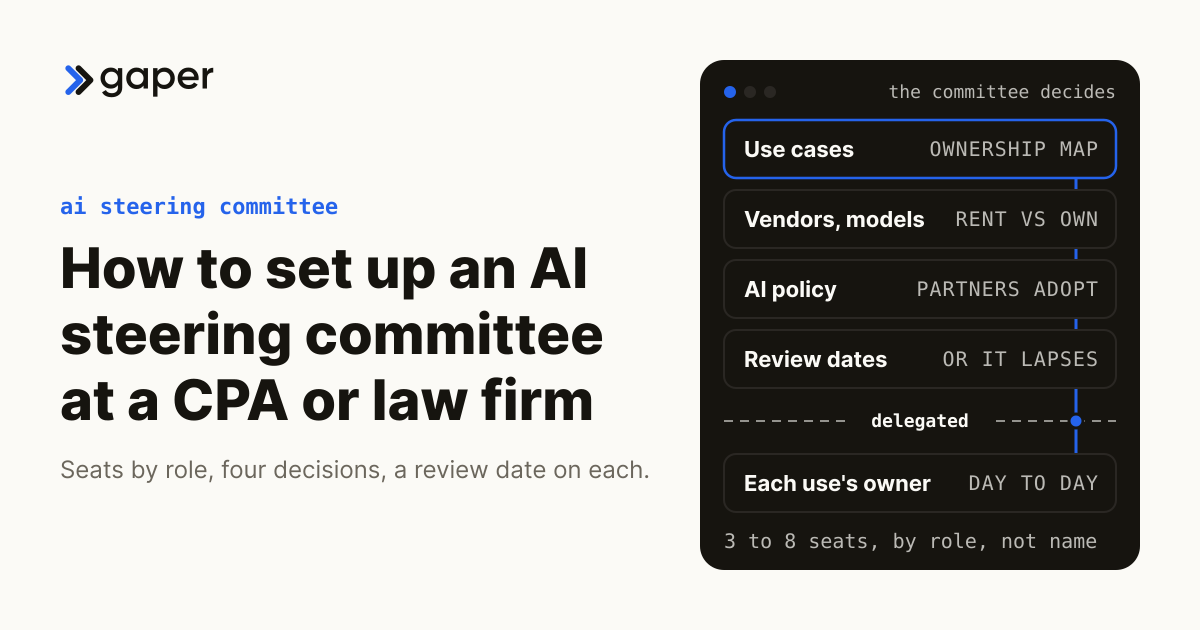
How to Set Up an AI Steering Committee at an Accounting or Law Firm
IndustryHow to Scale an Accounting Firm Without Hiring More Staff
A nine person firm reclaims about 857 hours in year one. That is either $99,000 of advisory capacity or a $72,000 avoided hire, never both. Scaled by firm size.
Aug 16, 2026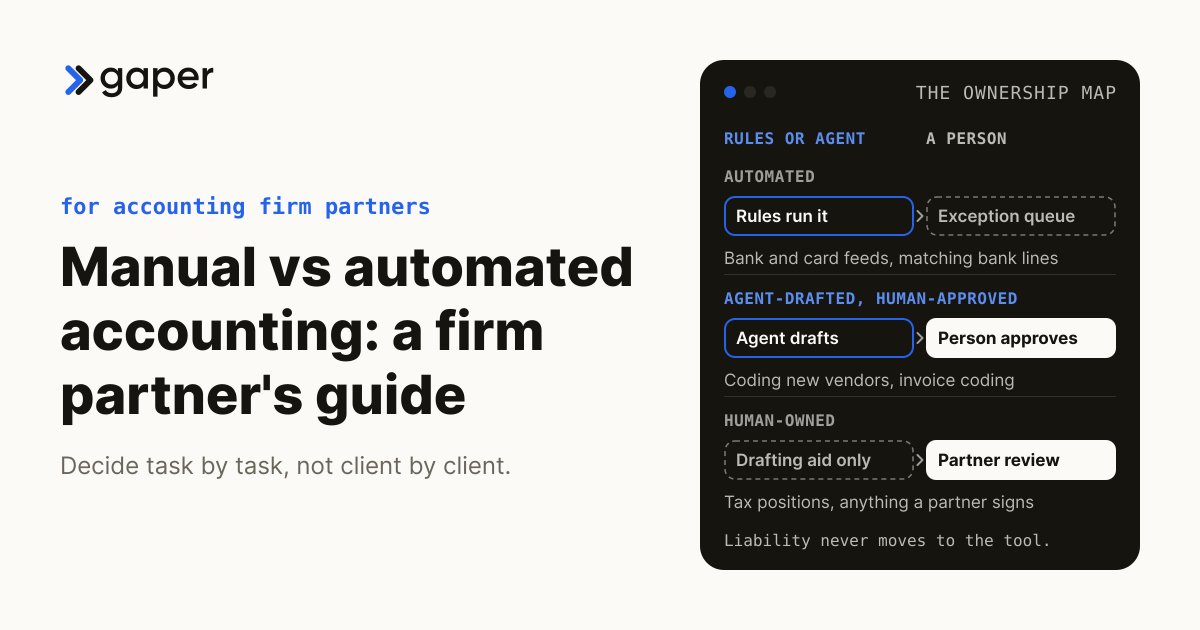
Manual vs Automated Accounting (2026): A Firm Partner's Guide
Ready to turn AI into execution?
Book a free assessment of one workflow. We map it, make an honest build versus buy call before any code, and if an off the shelf product covers the job we will tell you so.