
Hire LLM Engineers, or Deploy a Forward-Deployed LLM Team (2026)
When to hire LLM experts in-house and when to deploy a team for one workflow, with current salary data, a cost comparison and what you end up owning.
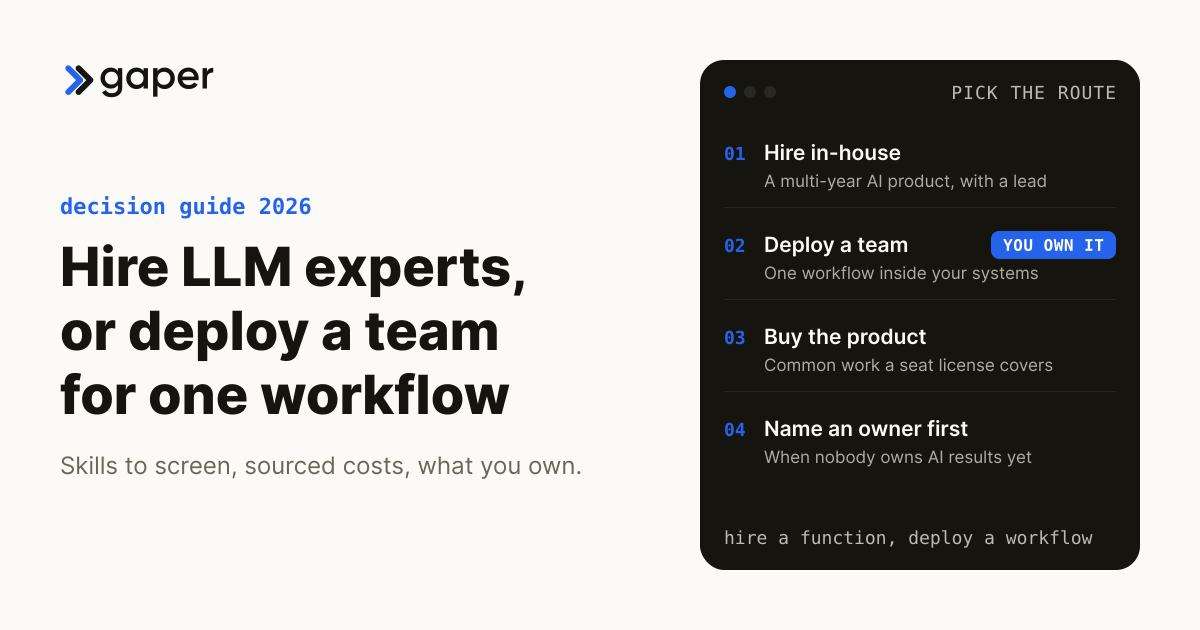
Hire LLM experts in-house when you are building an AI product for years and need people who own model choice, fine-tuning and evaluation as a standing function. Deploy a team when the goal is one workflow running in production inside your systems, built with evals and human approval, then handed back to you. This page covers both routes, what each costs on sourced salary data, and how to tell which one your project needs.
Hire LLM experts in 2026: RAG, fine-tuning, evals, and agent specialists
"LLM expert" now covers several jobs. Some engineers specialize in retrieval, some in fine-tuning and serving open-weight models, some in evaluation, and some in agent orchestration and tool use. Decide which your roadmap needs over the next two years before writing a job description; one hire rarely covers all four at depth.
If your project is mostly grounding answers in your own documents, that is a retrieval problem; our page on building RAG systems covers it. If it is mostly agents that call tools and hand work between steps, see AI agent development; for the full AI engineering service, from workflow map to a supervised agent in production, see our AI engineering page. This page stays on the model side: choosing a model, deciding whether to fine-tune, evaluating it, and keeping it working after launch.
Should you hire an LLM engineer or deploy a team?
Hire when LLM work is a standing function: a product roadmap, a senior lead to direct it, and years of features ahead. Deploy a team when you need one workflow in production inside your systems, with evals and human approval, and want to own the result without adding headcount first.
| Your situation | Better route | Why |
|---|---|---|
| An AI product with a multi-year roadmap, a senior lead to direct the work, and a goal of building the skill in-house | Hire | The capability compounds, and the lead can direct it |
| One workflow, such as triage, extraction or drafting, that touches your systems of record | Deploy a team | The work is scoped, integrated, evaluated and handed over |
| A job a product already covers, like meeting notes or general drafting | Buy the product | Neither a hire nor a build beats a seat license for common work |
| Nobody yet owns AI results at your company | Name an owner first | A hire or a build without an accountable owner tends to stall |
Row three is the Rent-vs-Own test in brief: rent a point tool for narrow, common work, and own a supervised agent when it touches systems of record, data or risk. You can do both: deploy a team for the first workflow, and hire once later workflows show a standing need.
What “Great LLM Experts” Means in 2026
Judge a great LLM engineer by the decisions they can defend, not the frameworks they list, because frameworks change every few months. Screen for these skills, each with a question that separates production experience from a demo.
| Skill | What good looks like | Ask in the interview |
|---|---|---|
| Model selection | Compares candidate models on your task and your data, not on public leaderboards | How did you choose the model on your last project, and what did you test? |
| Evaluation | Builds a held-out evaluation set from real cases and runs it on every change | Show me an eval you wrote and a regression it caught |
| Fine-tuning judgment | Knows LoRA, full fine-tuning and preference tuning, and when prompting or retrieval is enough | When did you decide not to fine-tune, and why? |
| Serving and cost | Can run an open-weight model on owned infrastructure and reason about quantization, batching and latency | What did one request cost, and how did you bring it down? |
| Security | Treats prompt injection, data leakage and personal data as design inputs | How would an attacker get this system to do something it should not? |
| Operations | Plans for provider model retirements, drift and on-call | What happens to your system when its model is retired? |
Two answers should worry you. A candidate who cannot describe a failed experiment has probably not run many, and one whose fix for every quality problem is a bigger model has not had to pay the bill.
What should an in-house LLM hire own in the first year?
One feature in production with a measured baseline, plus what makes later features safer: an evaluation set wired into every release, a register of which model each feature uses and when it retires, cost per request, and a runbook. Judge the year on what runs and is measured.
Write these into the role:
- An evaluation set before a model choice. Real cases from your data, scored on every prompt, model or tool change.
- A model register. Each feature's model and version, any announced retirement date, and a fallback that has passed the evaluation set.
- Cost per request, per feature. So a model or prompt change shows its price before the invoice does.
- Security tests. Prompt injection and data leakage checks on anything reading outside input.
- A named business owner. The engineer owns the system; someone in the business owns its results.
A deployed team should leave the same kind of footing behind, an evaluation set, a runbook and a named owner, so make it part of the job.

What does a deployed LLM team deliver?
A working agent in your systems, plus the means to keep it working: the evaluation set that gates every release, a runbook for failures and model changes, and the code and prompts in your repository. After handover you run it yourselves, or Gaper operates it under an SLA.
Gaper engineers work forward-deployed: a Gaper engineer embeds with your team and takes a single workflow from the process you already run. The agent is built in your repo, gated by evals and guardrails, with a person approving any risky action, and runs as supervised production in your cloud with an audit trail and a named owner.
The deliverables:
- The agent. Built on whichever model passes your evaluation set: a hosted model from OpenAI, Anthropic or Google, or an open-weight model, which Gaper also fine-tunes and self-hosts when the data, privacy or cost case supports it.
- The evals. Real cases scored on every change, before it reaches a user.
- The runbook. For drift, model retirements, failed integrations and patterns a reviewer flags.
- The handover. Code, prompts, evaluation set, runbook and audit trail, in accounts you control, with training for the people who will run it.
Engagements follow the Gaper method: Assess, Scope, Build, Supervise, Hand over. During scoping, the Gaper Ownership Map tags each step as Automated; Agent-drafted, human-approved; or Human-owned, meaning the agent never runs it alone.
Have a workflow in mind? Scope it with an AI architect in a free 30-minute assessment: we map the steps, decide whether to build, buy or hire, and say so when a product already does the job.
How much does an LLM engineer cost compared with a scoped build?
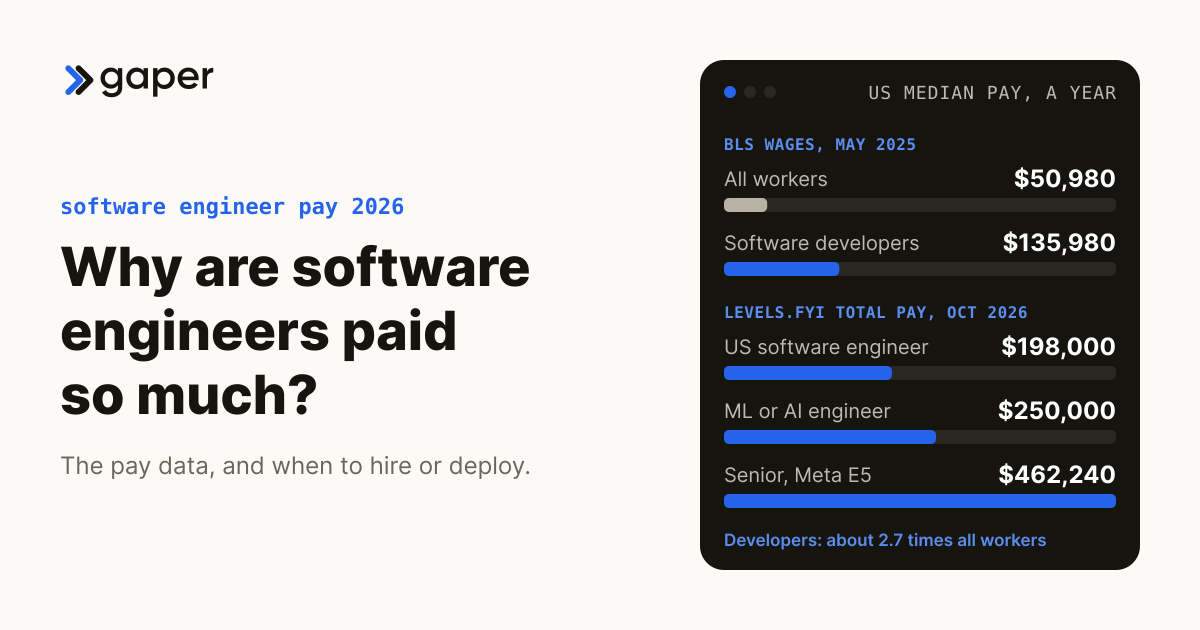
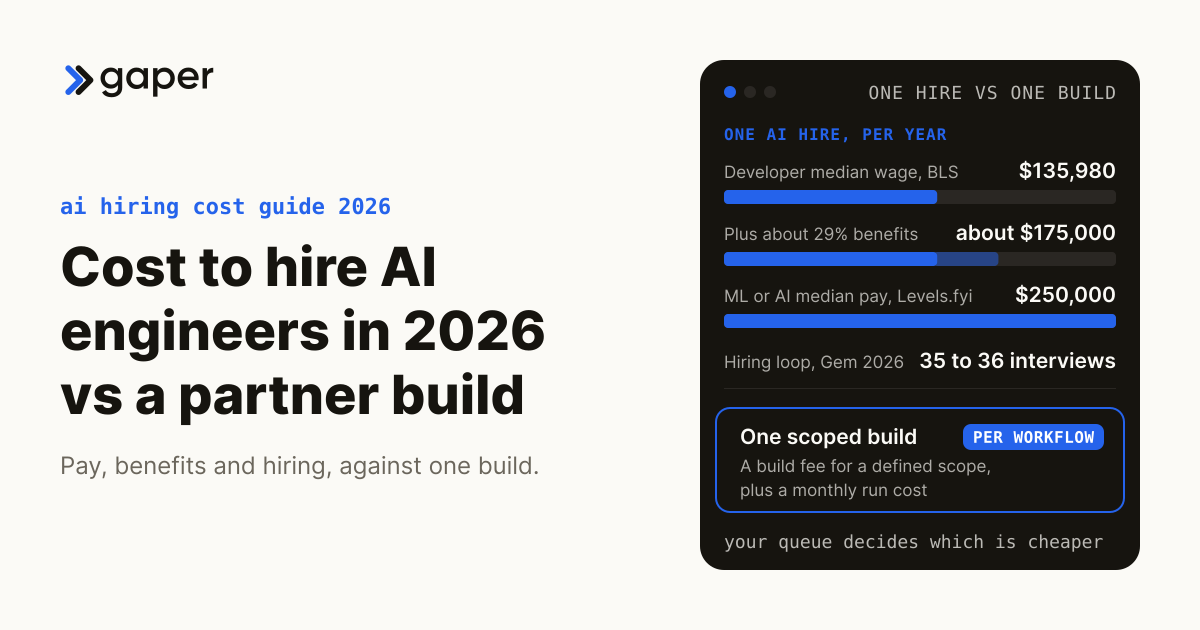
On Levels.fyi, the median US ML or AI engineer earns $250,000 a year in total pay (October 2026), before benefits and recruiting. A scoped build is priced per workflow, plus a monthly run cost named up front. Which costs less depends on how many workflows you have queued.
- The US Bureau of Labor Statistics put the median annual wage for software developers at $135,980 in May 2025, before any AI premium (BLS, 2025).
- In private industry, benefits were 30.0% of employer compensation costs in June 2026 (BLS Employer Costs for Employee Compensation, June 2026, released 9 September 2026, USDL-26-1494). Paid leave, 7.5% of those costs, is already inside an annual salary, so the other benefits add roughly 29% on top: a $135,980 salary works out to about $175,000 a year to employ.
- Gem's 2026 Recruiting Benchmarks Report, built on 1.2 million hires from June 2021 to May 2025, puts the average at 35 to 36 interviews per engineering hire, against 22 to 24 for non-technical roles (Gem, 2026).
| Cost line | Hire an LLM engineer | Scoped build with a deployed team |
|---|---|---|
| Pay | $135,980 median developer wage (BLS, May 2025); $250,000 median ML or AI total pay, middle half $170,000 to $370,000 (Levels.fyi, 14 October 2026) | One price for a defined scope |
| Benefits | About 29% on top of salary (derived from BLS, June 2026) | Inside the build price |
| Recruiting | 35 to 36 interviews on average per engineering hire (Gem, 2026) | A scoping assessment, no hiring loop |
| Running it | Model usage, hosting and on-call | A monthly run cost named before you sign |
| What stays if people leave | Whatever the engineer documented | The handover set listed above |
For one published example, Gaper's illustrative model for a single accounting-firm workflow puts the build at $12,000 to $34,000 and the all-in run cost, counting the person who reviews the output, at $690 to $2,630 a month (illustrative bands, Gaper, 2026, not a quote). Fine-tuning or a self-hosted open-weight model adds training, GPU and evaluation costs that band does not include.
The comparison cuts both ways. On those illustrative bands, a year of one hire costs more than one scoped accounting workflow; an LLM build with fine-tuning or self-hosting is priced in the assessment. But a hire keeps producing, so the longer your LLM workflow queue and the stronger the lead directing it, the more a hire pays back. Price the role for your region and seniority in the AI engineer salary calculator, then compare it with the build and run cost of your actual workflows.
When is fine-tuning or self-hosting an open-weight model worth it?
Fine-tune when prompting and retrieval have been tried and your labeled examples show a consistent gap, such as a format or a category the base model keeps missing. Self-host an open-weight model when data must stay in your environment or volume makes per-token pricing the larger cost.
Our comparison of RAG vs fine-tuning covers the trade-off: retrieval changes what the model can see, fine-tuning changes how it behaves. Our guide to custom vs general-purpose LLMs covers when an open-weight model wins and what it costs.
Open-weight licenses differ. OpenAI's gpt-oss models ship under Apache 2.0 (OpenAI model card on Hugging Face, 2025). Meta's Llama 4 Community License, effective 5 April 2025, requires a copy of the license and a prominent "Built with Llama" notice when you distribute or make available a Llama model, or a product or service that contains one (Llama 4 Community License, 2025). Its Acceptable Use Policy also withholds the license for Llama 4's multimodal models from companies with a principal place of business in the EU, though end users of a product built on them are exempt (Llama 4 Acceptable Use Policy). This is information, not legal advice; have counsel read the license you rely on.
Self-hosting also moves patching, scaling and upgrades onto your side: either an in-house engineer owns that work, or the runbook names who does.
How do you keep an LLM system working after handover?
Re-run the evaluation set on every change, keep a named owner, and plan for model retirements before they arrive. The runbook should say who migrates the model, how the replacement is tested against real cases, and who approves the switch.
Provider retirements are routine. On 30 September 2026, Anthropic notified developers that Claude Sonnet 4.5 retires from the Claude API on 30 November 2026, and it commits to at least 60 days' notice for publicly released models (Anthropic model deprecations, 2026). A team that owns its evaluation set can test the replacement in that window; our test plan for evaluating AI agents shows how to build one.
Ownership also needs a person: your Chief AI Officer sets the agenda and scorecard, and Gaper builds supervised agents inside your systems against them. Our Chief AI Officer guide covers what the role owns, and Gaper also provides a fractional Chief AI Officer for companies not ready to hire one.
Reference build: eval-gated model migration for a support triage agent
Reference build: illustrative, not a client engagement.
The pattern. A mid-size software company triages support tickets with an agent on a hosted model. When the provider announces that model's retirement, nobody can say whether a replacement will route as well, because the agent was never scored against fixed cases.
What Gaper would build. An evaluation harness on the company's labeled tickets, a shadow run that scores candidate models on live tickets without acting on them, and a migration runbook. Candidates can include an open-weight model fine-tuned and self-hosted in the company's cloud.
| Workflow step | Gaper Ownership Map |
|---|---|
| Score each candidate model on the held-out ticket set | Automated |
| Shadow-run the leading candidate on live tickets and log disagreements | Automated |
| Draft the migration report and list the cases that got worse | Agent-drafted, human-approved |
| Approve the production switch and the rollback point | Human-owned |
Measure it on. Routing accuracy on the held-out set before and after the switch, and the share of tickets reassigned after routing, each against the company's own baseline.
What the client owns. The evaluation set and harness, the migration runbook, prompts, comparison reports and audit trail, plus any fine-tuned weights (under the base model's license), all in its own cloud account.
Have an agent on a model with an announced retirement date? Scope an eval-gated model migration in a free AI assessment.
Gaper vs Toptal vs Turing vs Upwork
These names come up first for LLM help, but they sell different things. Toptal describes itself as a network of freelance talent, with engagements from hourly to full time (toptal.com, checked October 2026). Upwork is an open freelance platform for contracting independent professionals or agencies, hourly or fixed-price (upwork.com, checked October 2026). Turing sells datasets, RL environments and human experts to frontier AI labs (turing.com/frontier-ai); its Enterprise AI line embeds Turing engineers with the client to build agents, and its control plane "deploys, manages, and scales the agents in your enterprise" (turing.com/enterprise-ai, checked October 2026).
| Option | What you get | Who builds it | What you hold at the end |
|---|---|---|---|
| Toptal | A freelance engineer, hourly to full time | The freelancer, directed by you | What the engineer committed and documented |
| Upwork | An independent professional or agency, on hourly or fixed-price contracts | The freelancer or agency, directed by you | Whatever the contract specifies |
| Turing Enterprise AI | Agents built by Turing engineers, run by Turing's control plane | Turing's engineers, embedded with your team | Not stated on its page: ask who owns the code and what keeps running without the control plane |
| Gaper | One supervised workflow built in your stack | A Gaper engineer embedded with your team | The handover set listed above, in accounts you control |
If you want a person to direct, the talent networks are the right shortlist; our guide to Toptal alternatives for AI projects compares fees and contract terms.
Is Gaper a staffing agency?
No. Gaper is the AI-native implementation partner that deploys supervised AI agents you own. It places no contractors and fills no seats; the deliverable is a working workflow in your environment, and the code, evaluation set and runbook stay yours after handover.
If the assessment shows you need a full-time LLM engineer instead, we will say so, and the questions and first-year list above are yours to use.
Hold any partner to the handover, including us. Gartner's 29 September 2026 forecast on agentic AI built by vendor engineers (Gartner, 2026) is a reason to write three terms into the contract: who owns the code and any fine-tuned weights, how your team is trained to run the system, and what happens if you end the engagement.
How long does an LLM build take?
Timelines depend on the integrations and approvals the workflow needs, so they are scoped up front. A build that adds fine-tuning or self-hosting also depends on how much labeled data exists and how clean it is.
Scoping names what the agent must do, what it connects to, which steps a person approves, and what counts as done. Ask any LLM engineer you might hire the same four questions.
Thirty minutes, no commitment. We map one workflow, make the build or buy call, and scope the smallest thing worth shipping.
Frequently asked questions
Should you hire an LLM engineer or deploy a team?
What should an in-house LLM hire own in the first year?
What does a deployed LLM team deliver?
How much does an LLM engineer cost compared with a scoped build?
When is fine-tuning or self-hosting an open-weight model worth it?
How do you keep an LLM system working after handover?
Is Gaper a staffing agency?
How long does an LLM build take?
Ready to turn AI into execution?
Book a free assessment of one workflow. We map it, make an honest build versus buy call before any code, and if an off the shelf product covers the job we will tell you so.