
Turing Alternatives for AI Projects (2026)
Turing now sells to AI labs and large enterprises. Compare Turing alternatives on delivery model, code ownership, time to production and supervision.
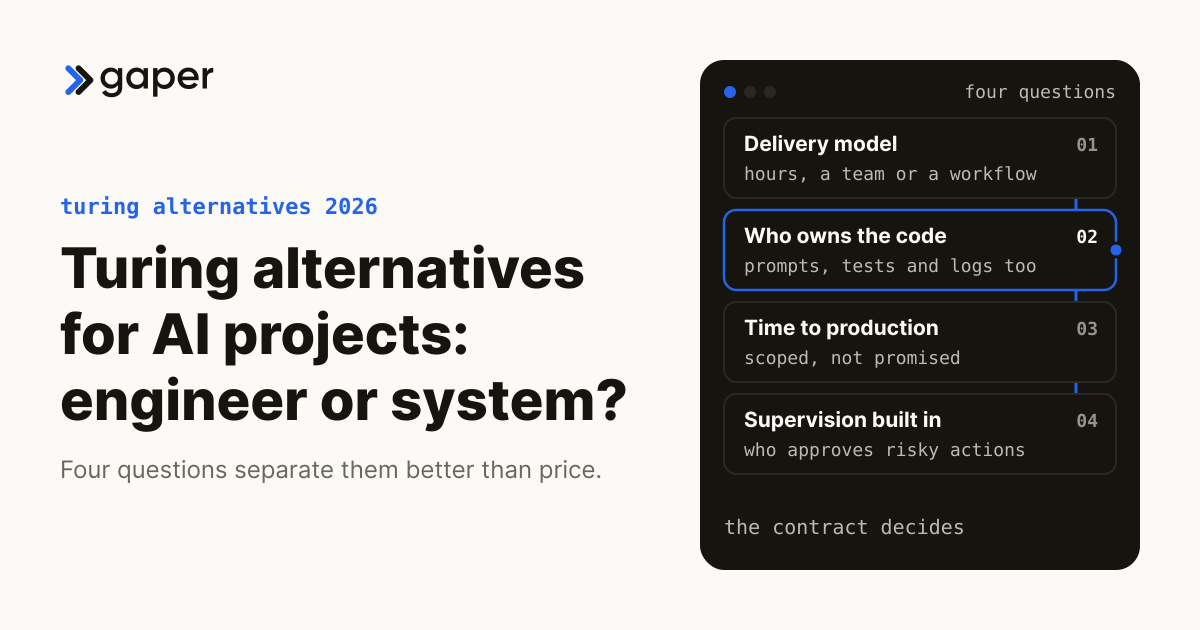
The right Turing alternative depends on what you wanted from Turing. If you need a remote engineer to join your team, talent networks such as Andela, Lemon.io, Arc, Revelo, X-Team and UpStack still work that way; if you need an AI workflow running in production, compare implementation partners on delivery model, who owns the code, time to production and supervision. Turing itself has moved on: its client-facing pages now lead with AI training data for frontier labs and embedded engineers with an agent platform for large enterprises, with engineer hiring now a smaller line of embedded AI talent pods.
What happened to Turing's developer hiring?
Turing no longer leads with it. On 9 October 2026, turing.com led with data and RL environments for frontier AI labs, and engineers plus an agent platform for Fortune 500 companies. Its old hire-developers address shows the homepage, though a separate page still offers embedded AI engineers to enterprises.
Turing describes two businesses on its company page. Frontier AI produces datasets, evaluations and reinforcement learning environments for AI labs, supported by an expert network that posts paid AI evaluation work for engineers, scientists and clinicians. Enterprise AI embeds forward-deployed engineers inside large companies and operates the resulting agents through what Turing calls the Turing Intelligence Platform. In its own words, "Our FDEs build the agents you need."
The direction was visible in 2025. Turing's $111 million Series E announcement, at a $2.2 billion valuation, put research for frontier labs and enterprise AI systems first, while still promising to expand talent placement (company announcement). By October 2026 the homepage pitched labs and enterprises, and hiring had become one line among several.
So "Turing alternative" now covers two different searches. Some readers want what Turing was known for: a screened remote engineer, billed by the hour or the month. Others are weighing Turing's enterprise offer and want another way to get AI agents built. This page covers both and keeps them apart.
How does Turing vet its engineers now?
Turing says each candidate for its embedded AI talent line goes through technical challenges, peer interviews and an assessment by Turing's own AI models, and is then matched to a client team (company-stated, October 2026). That is the vendor's account, so ask to see the assessment used for your role.
Its AI talent page offers AI engineers, full-stack developers and product leaders who join a client's team as embedded pods, with an FAQ saying a client can grow from one engineer to a full team. So Turing still belongs on a shortlist for a hired engineer. What changed is the emphasis: the old hire-developers pages now show the homepage, and the talent offer sits inside an AI company pitching enterprises.
What we kept and what we dropped from the old list
The earlier version of this page listed 23 platforms. We rechecked all 23 in October 2026 against one test: does the company still operate under its own name and supply engineers or a team for custom software or AI work? Fifteen stay, Gaper included, and eight are gone for the reasons below; among open freelance platforms we keep Upwork and Fiverr as the examples. We also removed every price we could not confirm on the company's own site.
| Dropped | Why |
|---|---|
| Adeva | Acquired by Toptal, announced in May 2026; adevait.com now redirects to Toptal |
| YouTeam | Acquired by Toptal in January 2025; youteam.io now redirects to Toptal |
| Crew | crew.co now redirects to Dribbble's designer pages |
| Dribbble and DesignBro | Design services (Dribbble for freelance designers, DesignBro as a design agency), not software or AI builds |
| Codeable | WordPress specialists only, a single-platform service rather than custom software or AI work |
| Hubstaff Talent | A free job board for general freelance work, where you post the role and screen applicants yourself |
| Guru | A general freelance platform of the same type as Upwork and Fiverr; our Upwork alternatives page compares that group |
How we compared Turing alternatives
Four questions separate these options better than price or pool size, and they apply whether you hire a person or a partner.
- Delivery model. Are you buying a person's hours, a managed team that builds to your spec, or a workflow running in production?
- Who owns the code. For an AI system that also means the prompts, the tests and the logs, and whose cloud account the agent runs in. Check the IP clause, not the sales page.
- Time to production. Talent platforms quote time to a shortlist or a hire. That is the start of the build, not a working system, and nobody can honestly promise the rest without seeing your workflow.
- Supervision built in. Who approves risky actions, who is named as the owner, and is there an audit log? With a hired engineer that design is your job. With a partner it should be in the scope.
Talent networks: when you want an engineer, not a system
A talent network fits when you already have a clear spec, someone to manage the work and a team that will own what gets built. You rent capacity: the network screens and supplies people, and your organization directs them, reviews the code and runs the result. Ownership of the code normally passes to you under the contract, so read the assignment terms before anyone starts. Turing's own AI talent line, described above, sits in this group.
Andela
Andela has rebuilt its pitch around AI. Its site now offers AI-native engineers placed in blended teams, AI system work such as retrieval and agent deployment, and AI training for engineering teams. It fits larger companies that want remote engineers with AI experience working under their own engineering leads.
Lemon.io
Lemon.io screens engineers from Europe, Latin America, the US and Canada and introduces a short list of candidates for contract or in-house roles, with startups as its main audience. It fits a founder or small team that needs one or two engineers, including AI engineers, and can manage them directly.
Arc
Arc covers freelance and full-time remote hiring across developers, designers and other roles. Its pricing page lists freelance hires at $15 to $110+ an hour, with a risk-free trial of up to two weeks, and full-time hires at 20 percent of annual salary (checked October 2026). It fits teams that want to compare freelance and permanent options in one place.
Revelo
Revelo supplies Latin American engineers in US time zones and handles payroll, benefits and compliance. Like Turing, it now also sells AI training data to AI labs, and it offers end-to-end software development. Its pricing page says rates vary with experience, stack and seniority, and its homepage offers a 14-day risk-free trial. It fits US teams that want nearshore engineers on long engagements.
X-Team
X-Team embeds senior remote engineers into existing teams, from startups to large brands, with industry pages for fintech, gaming, health tech and media. It fits a product team whose roadmap has outrun its headcount and that wants people who join its sprints.
Gun.io
Gun.io supplies freelance software developers and wraps them in what it calls a governance layer: sourcing, contracts, compliance and delivery management. It fits companies that want a freelancer with more process around the engagement than an open platform provides.
UpStack
UpStack supplies vetted remote engineers and runs the hiring process with you, from the first call to help managing a distributed team; its old upstack.co address now redirects there. It fits a company that wants hands-on hiring support for a remote role rather than a self-serve search.
Flexiple
Flexiple has narrowed to offshore teams in India: individual contractors, dedicated managed teams and help setting up a Global Capability Center. It fits companies building a long-term engineering presence in India.
CloudDevs
CloudDevs supplies Latin American developers and designers. Its old domain now redirects to hiredevelopers.com, which also offers payroll and compliance services. It fits teams that want nearshore contractors with the admin handled.
Pangara
Pangara is a software development company that sells managed projects or dedicated tech teams, with implementation and integration work on business systems such as Shopify, HubSpot, SAP and Visma. It fits a company that needs those systems built or connected more than it needs an AI build.
Toptal and Upwork appear on every list like this one, and both still operate. Toptal is a screened freelance network that also sells consulting and AI services, and it now includes YouTeam and Adeva; our Toptal review covers its pricing, vetting and terms. Upwork is an open freelance platform for hourly and fixed-price work, where you review proposals and manage the freelancer yourself, and Fiverr sells packaged gigs, including AI coding services. Upwork and Fiverr suit small, well-defined tasks you can check yourself.
Implementation partners: when you want a workflow running
An implementation partner is paid for a working system, not for hours. It scopes one workflow, builds it inside your systems, puts approval gates on the risky steps, and then either hands it over or runs it under an agreement. What an AI-native implementation partner is covers the category in depth; these are the Turing alternatives in it.
Turing Enterprise AI
Turing's own enterprise arm is now an implementation offer. It says its engineers come from frontier AI labs and work in the client's codebase and sprints, that agents run on the client's infrastructure, and that "You own the code, the IP, and the direction." After launch, Turing says it keeps deploying, managing and scaling agents through its platform rather than handing them off. It fits Fortune 500 companies that want a vendor to stay involved long term.
Gigster
Gigster sells fully managed delivery, dedicated teams and engineers on demand, and prices each project from its size, scope and budget. Its FDE talent line supplies forward-deployed engineers to companies implementing platforms such as Databricks, Snowflake and Palantir Foundry. It fits enterprises that already bought a data or AI platform and need specialists to make it deliver.
Gaper
Gaper builds one supervised workflow at a time. A Gaper engineer works forward-deployed: embedded with your team, the engineer scopes the workflow from your existing process and builds the agent in your own repo, with evals, guardrails and human approval on risky actions. The agent goes into supervised production in your cloud with an audit trail and a named owner, and your team gets the code and runbook so it can operate the agent without us. It fits accounting firms, law firms and mid-size companies with one workflow that writes to a ledger, a matter system or a CRM, or handles client data you answer for.
Turing alternatives compared on the four criteria
| Option | Delivery model | Who owns the code | Time to production | Supervision built in |
|---|---|---|---|---|
| Open freelance platforms (Upwork, Fiverr) | Hours or fixed-price tasks | You, under the platform terms; check them | Depends on you; the platform supplies a person | Yours to design |
| Screened talent networks (Turing's AI talent line, Toptal, Andela, Lemon.io, Arc, Revelo, X-Team, Gun.io, UpStack, Flexiple, CloudDevs) | Hourly or monthly rates; some charge a placement fee | Usually you, by contract; check the assignment clause | Depends on your team; quoted times run to a shortlist or hire | Yours to design |
| Managed teams (Gigster, Pangara, Revelo software development) | A team builds to your spec | Set in the contract | Set in the project plan | Only if you specify it |
| Embedded engineers plus vendor platform (Turing Enterprise AI) | Engineers build; the vendor keeps operating agents | You own code and IP, Turing says; check what you keep if you leave its platform | Scoped with Turing | Through the vendor's governance controls |
| Implementation partner with handover (Gaper) | One supervised workflow, built in your systems | You: code, prompts, evaluation set, runbook, audit trail | Scoped up front from your real workflow | Designed in at scoping: approval gates and a named owner |
Read the rows as models, not scores. One firm can sell more than one of them, and the contract, not the brochure, tells you which one you are buying.

The Rent-vs-Own test for a Turing alternative
The Rent-vs-Own test settles the choice one workflow at a time: rent a point tool for narrow, common work, and own a supervised agent when it touches systems of record, data or risk. Hiring through a talent network is renting too, of capacity rather than software, and for many projects that is the right call.
It goes wrong in two ways. The first is an AI system that writes to your ledger, matter system or CRM and is understood by one contractor who then leaves. The second is a partner who builds the agent while the runtime, evaluation set and logs stay on the vendor's side. Gartner put a number on that second risk on 29 September 2026: it predicts that by 2028, 70 percent of enterprises will abandon agentic AI built by vendor forward-deployed engineering, because costs climb and they cannot evolve it on their own. That is a prediction, not a measured result, and Gartner's advice is to settle IP ownership, knowledge transfer and an exit strategy from day one.
That applies to every embedded-engineer vendor, Gaper included. For a Turing Enterprise AI contract, the question to settle is what still works if you stop paying for its platform. For a hire through a talent network, it is who else can maintain the system when that person moves on. The implementation partner guide linked above lists what you should hold at handover, and if any piece of it stays with the vendor when the contract ends, you are still renting and should budget for it that way. For the wider build-or-buy call, see build vs buy AI agents.
Is Gaper a staffing agency?
No. Gaper is the AI-native implementation partner that deploys supervised AI agents you own. Unlike Turing's talent line, it does not supply engineers to fill roles. It builds one supervised workflow inside your systems, with human approval on anything material, and hands the result to your team.
If a role is what you need, one of the talent networks above will serve you better than we would.
Every engagement follows the Gaper method: Assess, Scope, Build, Supervise, Hand over. During scoping, the Gaper Ownership Map places each step of the workflow in one of three tiers: Automated; Agent-drafted, human-approved; or Human-owned, where the agent never runs it alone. For every step in the middle tier, the map records who signs off, how quickly they must respond and what happens when they cannot, and our guide to human-in-the-loop AI shows how such gates work in practice. Where a Chief AI Officer or an AI steering group sets the priorities, the finished map shows them who answers for each step.
How does Gaper compare to Turing?
Both now embed engineers to build AI agents. Turing's enterprise arm serves Fortune 500 companies and keeps operating agents through its own platform after launch. Gaper builds for accounting firms, law firms and mid-size companies, and designs every build for handover, with your team or us running it under an agreed SLA.
Turing also still places embedded AI engineers through its talent line, which Gaper does not do. The difference that matters most is who holds the system once the engagement ends. Neither model is wrong for every buyer. Ask your risk owners which one they want before you sign, and get the answer into the contract.
Which Turing alternative fits your project?
Match the option to what you need to hold at the end, not to the rate card. A talent network fits when you need people and can manage them, a managed team fits when you need a product built to a spec, and an implementation partner fits when one workflow must run in production under your control.
- You have a spec and a manager, and need one or two engineers: a screened talent network such as Lemon.io, Arc, X-Team or UpStack, or Turing's own AI talent line.
- You want nearshore or offshore engineers on a long engagement: Revelo or CloudDevs for Latin America, Flexiple for India, Andela for blended global teams.
- The task is small, well defined and easy to check: an open freelance platform such as Upwork or Fiverr.
- You want a whole product built to your spec: a managed team such as Gigster.
- You need e-commerce, CRM or ERP systems implemented or connected: a software firm such as Pangara.
- You bought a data platform and need it implemented: Gigster's FDE talent line.
- You are a large enterprise that wants embedded engineers and a vendor's agent platform: Turing Enterprise AI.
- One workflow touches systems of record, client data or risk, and you want to own the result: an implementation partner. If that is your project, book a free AI assessment: we map the workflow, make the build or buy call, and say plainly if nothing is worth building yet.
- A product already does the job as sold: buy the product. Nobody needs to build it.
What does a Turing alternative cost?
Talent networks price people: Arc publishes hourly and placement-fee rates (see above), and Revelo says its rates vary with experience and seniority. Implementation partners price a scoped workflow plus a monthly run cost. Compare the cost of a workflow that runs, not the hourly rate.
Gaper publishes illustrative build and run bands for accounting firms: one workflow is modeled at $12,000 to $34,000 to build and about $690 to $2,630 a month to run once the reviewer's time is counted (Gaper, September 2026). Those are modeled ranges, not quotes, and the page shows the assumptions behind them.
If you would rather hire, the US Bureau of Labor Statistics reported a median annual wage of $135,980 for software developers in May 2025. That is salary alone; benefits, recruiting fees and any premium for AI skills come on top, and the bill arrives whether or not the workflow ships. A partner engagement should instead come with a fixed scope, a stated monthly run cost and one metric that proves it worked. AI agent development cost covers what drives those numbers.
Which Turing alternatives are cheapest?
Open freelance platforms such as Upwork and Fiverr have the lowest entry prices, because you do the screening and the management. Screened networks cost more per hour and do the screening for you. The cheapest per finished outcome is whichever option leaves you the least rework and supervision to carry.
A low rate on an AI project can hide the expensive part. Someone still has to write the evaluation set, wire the integrations, design the approval gates and keep the system working when a model is retired. If that someone is your team, count their time in the price.
How long does it take to hire through a Turing alternative?
It varies by company and role. Revelo cites a 14-day average time to hire, and Arc says full-time roles can be filled in as little as 14 days (company-stated, October 2026). Those figures measure time to a hire, not time to a working AI system.
For an AI workflow, the honest timeline depends on the integrations and approvals it needs. It should be scoped from your real process, with each step placed on the Ownership Map, rather than promised before anyone has seen the work.
Questions to ask any Turing alternative before you sign
Labels like "AI engineer", "forward-deployed" and "agentic" now appear on many of these homepages, from Turing and Gigster to Andela and Lemon.io, so judge the contract instead. These questions suit a buyer leaving a talent platform or weighing a vendor-run platform:
- If we leave your platform, what keeps running, and on whose account?
- Which of your people stay after launch, and what does that cost each month?
- Can we see the evaluation set, run on our own data, before we sign?
- If the engineer you place leaves, who else can maintain what they built?
- Where is each approval step recorded, and who on our side signs it off?
- When would you tell us to buy a product instead?
A provider that answers all six plainly, in writing, is worth a second call, whichever category it sits in.
Thirty minutes, no commitment. We map one workflow, make the build or buy call, and scope the smallest thing worth shipping.
Frequently asked questions
What happened to Turing's developer hiring?
How does Turing vet its engineers now?
Is Gaper a staffing agency?
How does Gaper compare to Turing?
Which Turing alternative fits your project?
What does a Turing alternative cost?
Which Turing alternatives are cheapest?
How long does it take to hire through a Turing alternative?
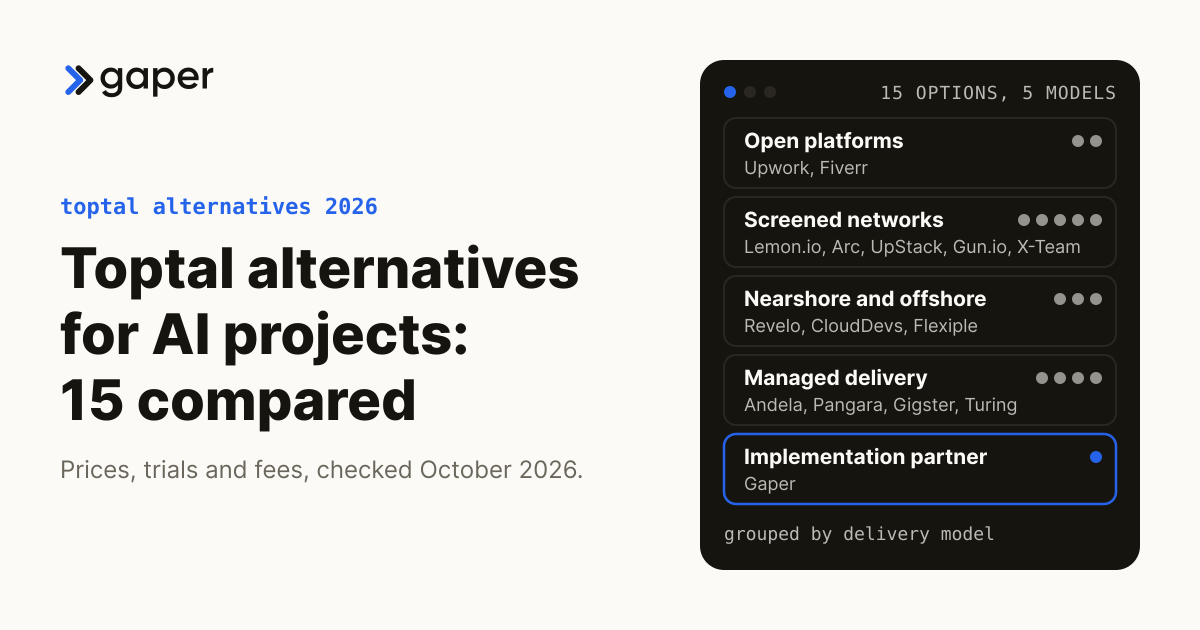
Toptal Alternatives for AI Projects (2026)
AI agents7 Reasons AI Agent Projects Fail (and How to Avoid Them)
Most AI agent projects die between the demo and production. Here are the seven failure modes that kill them, and the operating decisions that get agents shipped.
Mar 27, 2026
12 Projects to Build With Generative AI
Ready to turn AI into execution?
Book a free assessment of one workflow. We map it, make an honest build versus buy call before any code, and if an off the shelf product covers the job we will tell you so.