
5 Common Accounting Challenges Solved by AccountsGPT
Tax prep, records, fraud, payroll and legacy systems: how AccountsGPT handles five accounting firm problems, plus the Section 7216 and Safeguards rules.
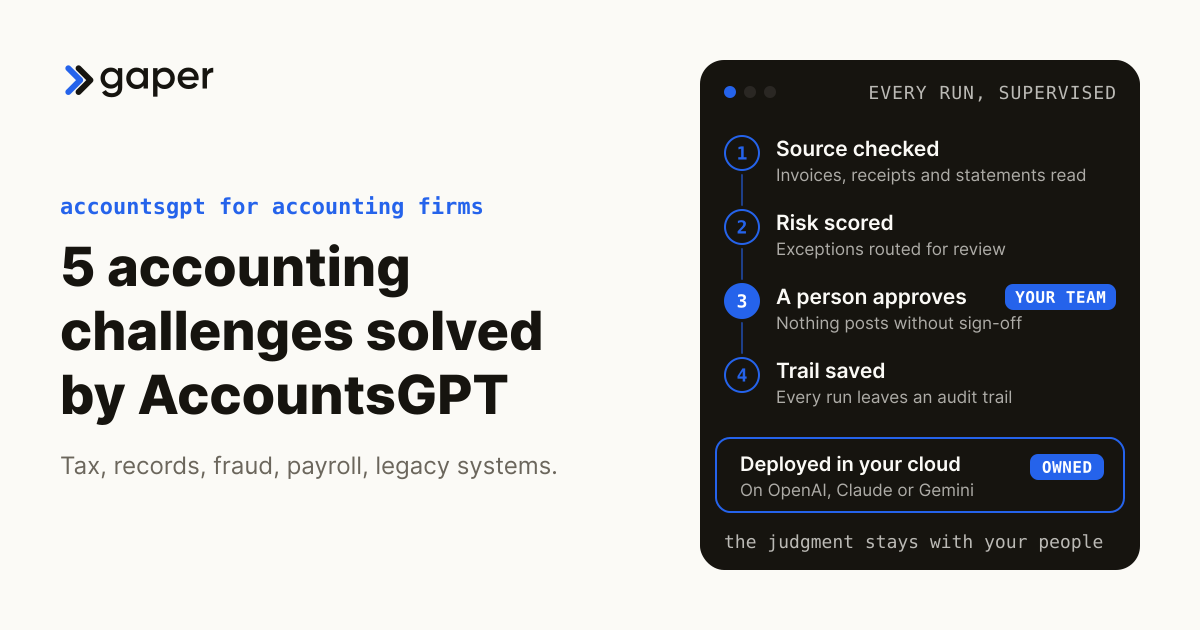
AccountsGPT, Gaper's accounting AI agent, takes on the five recurring problems that bring accounting firms to an accounting agent: tax preparation and compliance, inaccurate financial records, fraud detection, payroll and expense management, and outdated technology. It automates the repeatable work inside each one, while a person on your team approves anything that posts to the books.
In 2026, accounting is not the same as it was. More pressure than ever is being placed on accountants, CFOs, and tax preparers due to the ongoing changes in tax laws, the tighter compliance requirements, and the increasing need for accurate financial reporting.
Firm owners feel that pressure in the hours. In the Thomson Reuters Institute's 2026 State of Tax Professionals Report (June 2026, 600 respondents from tax, audit and accounting firms of all sizes), 50% of respondents said they spend too much time on low-value, low-margin work, and 57% named AI as their top technology investment priority, up from 35% two years earlier. Every manual step in a return or a close is also a place where a deduction can be missed or a figure keyed in wrong.
This is where AI-powered solutions like AccountsGPT step in to revolutionise the game. Imagine having a highly qualified assistant who can handle complicated tax preparation, spot mistakes, and automate repetitive accounting duties. It's not just another software; it's a tool designed to simplify your processes, save time, and reduce stress.
AccountsGPT is designed to meet your needs, whether you're a tax preparer attempting to stay ahead of the constantly evolving tax codes, a CFO managing numerous financial reports, or an accountant overburdened by manual reconciliations.
In a world where businesses lose billions annually to accounting errors and inefficiencies, isn't it time to let AI help you work smarter?

Challenge #1: Managing Tax Preparation and Compliance
Tax professionals face an uphill battle when managing tax preparation and compliance. With constantly changing tax regulations, the stakes are higher than ever. In the Thomson Reuters Institute's 2025 indirect tax report (June 2025, 206 indirect tax professionals in the US, Canada, the UK and Germany), regulatory compliance overtook technology and automation as the most cited top challenge, named by 54% of respondents against 50% for technology and automation. A year earlier, in the 2024 edition (June 2024, more than 180 indirect tax professionals in the US, Canada and the UK), 37% called staying compliant amid rapidly changing tax laws across multiple jurisdictions a significant concern.
The Problem
Understanding complex tax codes and making sure that accurate filings are made are essential to navigating the complexity of compliance and avoiding expensive errors. The bottom lines and reputations of businesses are often impacted by errors that arise from manual processes, which can lead to missed deductions or penalties.
The 2026 filing season shows how fast the ground moves. The One, Big, Beautiful Bill Act (P.L. 119-21), signed in July 2025, added new federal deductions, including one for qualified overtime compensation, and the IRS was still updating its questions and answers on that single deduction in August 2026 (IRS FS-2026-13). Each change reaches the return, the workpapers and the review checklist at once.
Rules outside the United States move too, which matters for any client with operations abroad:
- The OECD's Pillar Two global minimum tax: a 15% minimum effective rate for multinational groups with annual revenue of at least 750 million euros. In January 2026 the OECD/G20 Inclusive Framework agreed a "side-by-side" package that adds new safe harbours, including one for groups whose parent sits in a qualifying jurisdiction (KPMG, 5 January 2026). When it was published, the United States was the only jurisdiction listed as qualifying (Mayer Brown, January 2026).
- Digital economy taxation: unilateral digital services taxes mean a client selling online across borders can owe where it has no office.
- Environmental, social and governance (ESG) considerations: investors and regulators now read tax transparency as a reputational issue, not only a filing one.
The Solution: AccountsGPT
With AccountsGPT, staying compliant is no longer a struggle:
- Automated Tax Preparation: AccountsGPT makes preparation easier and guarantees that your filings reflect the most recent tax laws and regulations.
- AI-Powered Compliance Checks: It eliminates possible errors, flags inconsistencies, and cross-checks entries in its role as a trustworthy AI tax assistant.
- Error-Free Filings: AccountsGPT saves crucial time during tax season and lowers the possibility of errors by minimising manual intervention.
- Scalable Tax Software: AccountsGPT offers solutions for any level of complexity and adjusts to your workflow, whether you're working with corporate tax teams or individual accountants.
By integrating AI tax software like AccountsGPT, businesses and accounting professionals can tackle the compliance maze with confidence. As one of the best tax software for tax preparers, it simplifies complex processes, making tax filing seamless for 2024 and beyond.
A note on client tax data. The moment a tax preparation tool touches a client's return information, two federal regimes apply to your firm. Under 26 CFR 301.7216-3(a), a preparer may disclose or use tax return information as the taxpayer directs once it has the taxpayer's written consent, and 301.7216-3(b)(1) requires that consent before the disclosure or use, never after. For 1040 clients, Rev. Proc. 2013-14 sets the consent's format and required wording, and 301.7216-3(b)(4) generally bars consent to disclose the client's social security number to a preparer outside the United States. Separately, the FTC Safeguards Rule (16 CFR part 314) treats accountants and other firms that complete income tax returns as financial institutions, and 314.4(f) requires them to oversee the service providers that handle customer information. AccountsGPT runs in your cloud, which changes where the data sits and who controls the logs, but owning the tool does not remove the consent duty. Our guide to Section 7216 consent for AI tools sets out what a valid consent must say and what is still unsettled. This is information, not legal advice.
Challenge #2: Handling Inaccurate Financial Records
Financial reports can be severely damaged by inaccurate data entry and inadequate validation procedures, which can result in disparities that jeopardise compliance and decision-making.
The Problem
Accounting teams frequently find it difficult to generate accurate financial statements in the absence of sufficient validation and automated reconciliation. Errors are more likely to occur when entries are made by hand. Identifying these errors can be time-consuming and prone to blunders.
Financial journalist Russ Banham made the stakes plain in Risk Management Magazine (September 2019): business comes down to numbers, and when the numbers underneath are imprecise, the risk of an accounting restatement rises, and he notes that a restatement typically sends the company's share price down sharply.
For an accounting firm, the cost lands one step earlier. Client books that arrive with miscoded entries or unreconciled accounts flow straight into the return, the review notes and the advisory conversation, so every error you catch late is billed as rework or written off.
The Solution: AccountsGPT
AccountsGPT eliminates these challenges with cutting-edge AI capabilities:
- Advanced AI Validation: The platform ensures that financial data is accurate before it is reported by using sophisticated algorithms to find mistakes and anomalies.
- Automated Reconciliation: The reconciliation process is streamlined by AccountsGPT, which matches entries from various ledgers and finds discrepancies for prompt resolution.
- Compliance-Ready Adjustments: Your reports will be accurate and compliant if your financial records are in line with the most recent accounting standards.
- Real-Time Insights: AccountsGPT makes financial reporting easy and dependable while providing real-time adjustments to maintain perfect data.
In practice the agent reads invoices, receipts and statements, matches transactions across systems, and routes the exceptions to a person to clear. Nothing posts to the ledger without an approval step your firm controls, so the reviewer spends time on the entries that need judgment rather than on the ones that already tie out.
Challenge #3: Fraud Detection and Prevention
The Problem
Organisations are at serious risk of financial fraud when they have inadequate internal controls. Unauthorised transactions, data manipulation, and intentional misreporting are all examples of vulnerabilities that can result in compliance breaches, legal liabilities, and substantial financial losses. Traditional systems frequently fail to monitor transactions in real time, allowing fraudulent activity to thrive.
The scale is well documented. The Association of Certified Fraud Examiners' Occupational Fraud 2026: A Report to the Nations, built on 2,402 cases across 143 countries, estimates that organizations lose 5% of revenue to fraud each year, with a median loss of $104,000 per case and a median of 12 months before a scheme is detected; 43% of cases were uncovered by a tip (Accounting Today, 12 May 2026). A year of undetected activity is a year of transactions that nobody looked at closely.
How AccountsGPT Solves It
- AI-Powered Fraud Detection: Advanced AI algorithms are used by AccountsGPT to track financial activity and transactions in real time. It rapidly detects any fraud by examining trends and spotting irregularities. This process lowers the possibility of mistakes going unnoticed or deliberate manipulation.
- Secure, Cloud-Based Data Protection: AccountsGPT is built on a secure cloud infrastructure, ensuring that sensitive financial data is encrypted and protected from cyber threats. This secure environment prevents unauthorised access and protects critical business information from breaches or malicious activity.
- Compliance-Centric Monitoring: AccountsGPT helps companies stay in compliance with national and international tax laws by detecting fraud and offering practical insights to improve internal controls.
For a firm, protecting client financial data is a legal duty as well as good practice. The Safeguards Rule, at 16 CFR 314.4(c)(3), requires encryption of customer information in transit over external networks and at rest, or compensating controls your Qualified Individual approves where encryption is infeasible, and an AI tool that processes that information belongs in your written information security plan alongside every other vendor.
Challenge #4: Streamlining Payroll and Expense Management
The Problem
Errors in payroll and inadequate tracking of expenses can impair compliance, interfere with cash flow, and reduce employee satisfaction. These problems are frequently brought on by inconsistent systems that don't offer real-time insight into financial operations, manual computations, and delayed updates.
Payroll got more exacting in 2026. Beginning with tax year 2026, employers report qualified overtime compensation on Form W-2 in box 12 with code TT, and for tax years after 2025 an employee can deduct only the qualified overtime the employer reported there, so an omission sends the employer back to file a Form W-2c (IRS FS-2026-13, August 2026). Cash tips reported to the employer get their own code, TP, with the tipped occupation code in new box 14b, under the 2026 Form W-2 instructions. Payroll that lumps every overtime hour together no longer produces a correct W-2.
How AccountsGPT Solves It
- Automated Payroll Calculations: AccountsGPT automates payroll procedures, doing away with human computations. This covers correct tax deductions, benefit distribution, and adherence to tax laws. Payroll adjustments are guaranteed to smoothly incorporate the most recent tax laws and employee changes thanks to its real-time updates.
- Real-Time Expense Tracking: Businesses may use AI-powered solutions that automatically track and classify spending using AccountsGPT. Better financial planning and precise reporting are made possible by this function, which gives you more control over operating expenses.
- Integrated Financial Workflow: AccountsGPT guarantees consistency across financial operations, streamlines workflows, and lowers administrative overhead by combining payroll and expense management onto a single platform.
Challenge #5: Outdated Accounting Technology
The Problem
The adaptability and functionality required to satisfy contemporary corporate objectives are sometimes absent from legacy accounting systems. They put businesses at a disadvantage because they find it difficult to handle complicated tax regulations, integrate with cutting-edge equipment, and adjust to regulatory changes.
Most firms already know this, and the obstacle is rarely the will to change. In the Thomson Reuters Institute's 2026 report, 51% of respondents named lack of time and resources and 47% named the cost of implementation as the main barriers to automating more of their tax workflow, and 25% cited data security or privacy concerns. Only 11% said their firm uses no automation at all, down from 18% in 2025. The real gap is between firms whose systems talk to each other and firms where every handoff is a re-key.
How AccountsGPT Solves It
- AI-Driven Modernization: AccountsGPT offers a cutting-edge, AI-powered platform designed to replace outdated systems. Its scalability ensures that businesses of all sizes can seamlessly manage accounting and tax preparation processes with enhanced accuracy and speed.
- Enhanced Tax Preparation Tools: AccountsGPT streamlines the preparation and submission of tax returns and is designed to meet 2025 standards. It supports multi-state and international compliance, ensuring businesses stay ahead of regulatory changes while optimising tax deductions and credits.
- Future-Proof Technology: AccountsGPT is designed to grow with you, unlike legacy software. It stays in line with new industry demands thanks to frequent updates and AI-driven innovation, providing businesses with a competitive advantage.
Why Choose AccountsGPT?
Because it is built to work inside the systems a firm already runs, on OpenAI, Claude or Gemini, deployed in your cloud, with a human approving anything that posts and the code, evaluations and runbook handed to your team.
Unique Features That Set AccountsGPT Apart
- AI-Powered Precision: AccountsGPT leverages state-of-the-art AI technology to deliver unmatched accuracy in accounting, tax preparation, and compliance. Its ability to adapt to complex tax codes and regulations ensures businesses stay ahead of the curve.
- End-to-End Automation: AccountsGPT automates time-consuming processes like payroll management, tax return preparation, and fraud detection through real-time data analysis and workflows. This integration improves operational efficiency, decreases human error, and saves time.
- Scalability for Every Business: AccountsGPT's cloud-based platform can grow with your business, regardless of how big or small your accounting firm is. Its adaptable tools free accountants and tax preparers from tedious work so they can concentrate on value-added services.
Conclusion
AccountsGPT is not just another accounting tool, it's a game-changing solution designed to address the core challenges of modern accounting and tax preparation. Businesses, tax preparers, and accountants can increase productivity, accuracy, and compliance by incorporating state-of-the-art AI technology. AccountsGPT offers measurable advantages, such as automated payroll, fraud detection, and scalable tax solutions for 2025.
Businesses require solutions that adjust to the changing environment in a world where financial complexity is growing. The robust features, safe cloud infrastructure, and easy-to-use interface of AccountsGPT make it stand out for both small and large businesses.
Gaper is the AI-native implementation partner that deploys supervised AI agents you own. For a managing partner, that means the agent runs on your data and your auth, the judgment calls stay with your people, and what we build stays with the firm.
Are you prepared to advance your accounting operations? With AccountsGPT, discover the accounting of the future now. Simplify your procedures, lower risks, and concentrate on what really counts: expanding your company. Start your journey with AccountsGPT now.
Thirty minutes, no commitment. We map one workflow, make the build or buy call, and scope the smallest thing worth shipping.
Does AccountsGPT prepare tax returns and run payroll?
Yes. AccountsGPT handles tax preparation and payroll, alongside document intake, reconciliation, fraud monitoring and report drafting. A person on your team approves anything that posts, so the agent does the repeatable work and the professional judgment stays with your staff.
The agent removes the manual handling that makes each of the five problems above expensive. It does not remove the reviewer, the partner sign-off or the firm's responsibility for the return.
Can a firm put client tax data into AccountsGPT under Section 7216?
Treat it as needing the client's written consent first. 26 CFR 301.7216-3(a) permits disclosure or use as the taxpayer directs once a valid written consent is in place, and 301.7216-3(b)(1) bars consent after the fact. Running the agent in your own cloud does not change that.
What deployment in your cloud does change is control: the data stays in your environment, under your auth and audit logging, so where it is processed and who can see the logs are your decisions. That matters most for 1040 clients, because 301.7216-3(b)(4) generally bars consent to disclose a 1040 client's social security number to a preparer outside the United States, with a narrow exception in (b)(4)(ii) for disclosure through an adequate data protection safeguard. Whether routing data through a model API counts as a disclosure at all is unsettled, so the safe posture is consent before the first transfer, using the checklist in the guide linked in Challenge #1.
Does the FTC Safeguards Rule apply when a firm uses AI?
Yes, for most firms. The FTC Safeguards Rule, 16 CFR part 314, treats tax and accounting professionals as financial institutions, a point the IRS repeated in IR-2026-92 on 18 August 2026. It requires a written security program and oversight of every service provider that handles customer information.
The provision that reaches an AI tool is 314.4(f): take reasonable steps to choose a provider able to protect the data, require those safeguards by contract, and reassess the provider periodically. A vendor whose tool processes client data, even without keeping a copy, fits the rule's definition of a service provider in 314.2, so it belongs in your WISP. The exception for fewer than 5,000 consumers removes only a few requirements, as our Safeguards Rule under 5,000 consumers guide explains.
Does anything post to the ledger without a person approving it?
No. A human approves anything that posts to the ledger. AccountsGPT handles intake, extraction and reconciliation and routes exceptions, such as low-confidence matches, policy exceptions or protected data, to a person who signs off before anything reaches the books.
Every run leaves an audit trail: the source is checked, the risk is scored, a person approves, and the trail is saved.
How is AccountsGPT priced?
AccountsGPT is set up for your systems and deployed in your cloud, and its pricing scales with volume. That is why the first step is a free assessment that identifies one high-leverage workflow and scopes the smallest production release, rather than a price list.
For a custom workflow around your own systems, our guide to AI implementation cost for accounting firms sets out illustrative bands by scope.
Can ChatGPT solve accounting problems?
Yes, ChatGPT can help solve a variety of accounting difficulties by automating computations, providing insights into financial data, and producing reports. AccountsGPT goes a step further with advanced AI integration. However, it is most effective as a tool to supplement, rather than replace, professional competence.
One caution for firms: pasting a client's return information into a public chatbot is a disclosure question under Section 7216 and a vendor question under the Safeguards Rule, whatever the account settings say. Our guide to how CPAs use ChatGPT for accounting covers the safe uses and where it stops.
What are the 5 main areas in accounting?
The five main areas of accounting are financial accounting, managerial accounting, cost accounting, tax accounting and auditing. Each serves a different audience, from outside investors and lenders to management, the tax authorities and regulators.
- Financial Accounting: Focuses on preparing financial statements for external stakeholders.
- Managerial Accounting: Involves analysing data to help management make strategic decisions.
- Cost Accounting: Tracks, records, and analyzes production costs to optimize operations.
- Tax Accounting: Deals with compliance and planning related to tax laws.
- Auditing: Verifies the accuracy of financial records and ensures adherence to regulations.
What are the challenges faced by accountants?
Accountants face shifting tax rules, fraud risk, technology upgrades, secure handling of client data, and tight deadlines in peak tax season. In 2026 the talent squeeze sits behind all five: 40% of respondents to the Thomson Reuters Institute survey said talent issues constrain their firm's capabilities or put them at risk.
Accountants face several challenges in today's financial landscape, including:
- Managing Complex Tax Regulations: Keeping up with constantly shifting laws.
- Fraud Detection: Implementing effective controls to prevent financial irregularities.
- Technology Upgrades: Moving from conventional systems to ones based on AI.
- Data Management: Securely handling huge amounts of financial information.
- Time Constraints: Meeting tight deadlines during peak tax seasons.
What are the 5 key principles of accounting?
The five key principles of accounting are revenue recognition, matching, cost, full disclosure and consistency. Together they make financial statements comparable from period to period and trustworthy to the people who rely on them.
- Revenue Recognition Principle: Revenue should be recognized when earned, not when received.
- Matching Principle: Expenditures need to be equated with the revenue they generate.
- Cost Principle: The original cost of an asset's purchase should be used to record it.
- Full Disclosure Principle: Financial statements should disclose all relevant information.
- Consistency Principle: Businesses must use the same accounting methods over time for comparability.
These principles ensure transparency and accuracy in financial reporting.
Thirty minutes, no commitment. We map one workflow, make the build or buy call, and scope the smallest thing worth shipping.
Frequently asked questions
Does AccountsGPT prepare tax returns and run payroll?
Can a firm put client tax data into AccountsGPT under Section 7216?
Does the FTC Safeguards Rule apply when a firm uses AI?
Does anything post to the ledger without a person approving it?
How is AccountsGPT priced?
Can ChatGPT solve accounting problems?
What are the 5 main areas in accounting?
What are the challenges faced by accountants?
What are the 5 key principles of accounting?


Ready to turn AI into execution?
Book a free assessment of one workflow. We map it, make an honest build versus buy call before any code, and if an off the shelf product covers the job we will tell you so.