
AI Agent Maintenance: Who Runs Your Agents After Go-Live
AI agent maintenance explained: who owns a live agent, four ways to staff it, run SLA terms, model deprecations, incident runbooks and running costs.
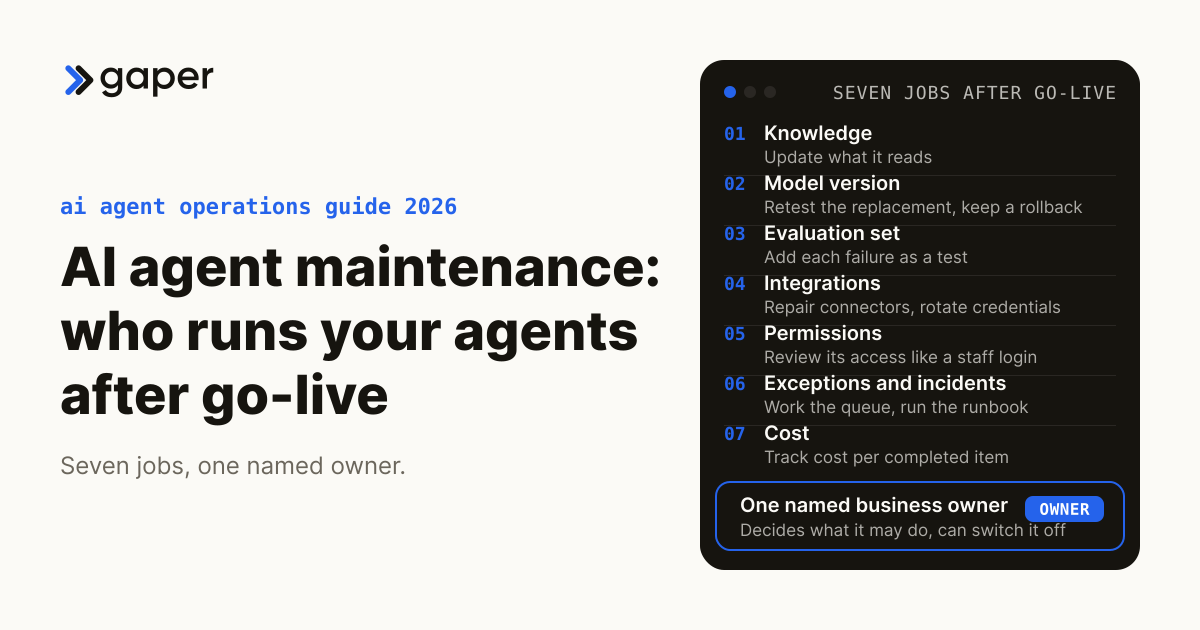
AI agent maintenance is the ongoing work of keeping a live agent accurate, connected and safe: updating what it knows, retesting it when the model changes, repairing integrations, working its exceptions and handling incidents. Someone at the firm has to own that job by name before go-live, even when an IT provider, the builder or a platform does the hands-on work.
What does AI agent maintenance involve?
It covers seven jobs: keeping the agent's documents and rules current, managing model versions, rerunning its evaluation set, repairing integrations, reviewing permissions, working exceptions and incidents, and watching cost. Telemetry tells you something changed. Maintenance is deciding what to do about it, and doing it.
Shipping an agent, covered in deploying AI agents, ends a project and starts an operations job. The old DevOps lesson applies: a dashboard login does not make someone an operator.
| Job | What changes underneath | What the maintainer does |
|---|---|---|
| Knowledge | Procedures, templates, fee schedules | Update what it reads; remove stale material |
| Model version | Providers retire models | Retest on the replacement, switch, keep a rollback |
| Evaluation set | Production surfaces untested cases | Add each failure as a test; rerun before any change |
| Integrations | Ledger, practice management and document system APIs | Repair connectors, rotate credentials |
| Permissions | People and systems change | Review its access like a staff login |
| Exceptions and incidents | Inputs it cannot handle | Work the queue, escalate, run the runbook |
| Cost | Volume grows | Track cost per completed item |
Traces and drift alerts are covered in AI agent observability. This page is about who does the work, and who pays.
Who should own an AI agent after go-live?
Name one business owner: the leader whose team the agent works for, with a written job scope. A technical maintainer, inside or outside the firm, keeps it running. The owner decides what it may do, reviews its results and can switch it off.
Project teams disband at launch, and an agent with no owner drifts until something breaks. Manage it like a role:
- A job scope. One page: the workflow, what it may read and write, and what it must hand to a person.
- A review cadence that loosens as trust is earned. Review every output at first, sample as the record supports it, and tighten after any incident or model change. The gates are covered in human-in-the-loop AI.
- Role-style metrics. Throughput, exception rate, rework rate (the share of outputs a reviewer changes) and cost per completed item. Pick one as the number it answers for.
- A register. Every live agent, its owner, its maintainer, the model it calls, its last evaluation run and its next review date.
What are the four ways to staff AI agent maintenance?
In-house staff, the firm's existing IT provider, the builder under a service-level agreement, or a managed platform that hosts and runs the agent. Each can work. They differ on who holds the code and logs, who knows the workflow, and how hard it is to switch later.
| Option | Works well when | Watch for | Who holds code, logs and model choice |
|---|---|---|---|
| In-house | You have an engineer with time for it and plan several agents | One person becomes a single point of failure; the job needs evaluation and prompt skills, not only infrastructure | You |
| Your IT provider | The agent runs in your cloud and the provider already handles access and on-call | A contract written for devices and networks may not cover evaluation sets or prompts; get scope in writing | You, with the provider holding access |
| The builder under an SLA | The workflow is complex and the builder wrote the evaluation set you own | Renting back your own capability; insist on exit terms | You, if the contract says so |
| A managed platform | The work is narrow, common and away from client data | The vendor often decides when the model changes, and exit can be harder; check export and model-pinning terms | Usually the vendor |
For in-house, the US Bureau of Labor Statistics put the median annual wage for software developers at $135,980 in May 2025, before benefits (BLS, 2025), and one agent may not fill that person's week.
Mixing works, but the owner should sit inside the firm.
What does a managed AI service cover after go-live, and what should the firm keep?
A run service should cover monitoring, incident response, integration repairs and routine fixes. Check in writing whether it also covers evaluation-set upkeep, prompt changes, model migrations, output review and the exception queue. The firm keeps the code, prompts, evaluation set, runbook, audit trail, credentials and pause switch.
Renting the operator is fine; renting back your own capability is the trap, so change approval stays with the firm too. The Rent-vs-Own test applies to the agent, not the labor: rent for narrow, common work, own when it touches systems of record, data or risk. AI employees covers that decision in full.

What should a run SLA for an AI agent specify?
A run SLA should state what is covered, response targets by severity, and that the evaluation set is rerun before any model, prompt or tool change. It should also set change approval, incident reporting, data access and exit terms.
- Scope: which agents and systems, and whether migrations and integration repairs are included.
- Response targets by severity, set from the workflow's risk.
- Evaluation before change, with results shared first.
- Change approval and a change log, with the owner approving material changes.
- Deprecation handling: a migration plan well before retirement.
- Incident reporting: what counts, how fast you hear, and a written account afterwards.
- Data access: who can see client data, from where, under what written terms.
- Exit: everything the firm keeps handed back, help moving operators, and deletion of client data the provider holds.
How do model upgrades and deprecations affect a live agent?
Providers retire models on their own schedules, so every agent will need a model change. Each change means rerunning the evaluation set on the replacement, fixing what regresses, switching with a rollback ready, and recording what changed and who approved it.
Policies as of 19 October 2026:
| Provider | Stated notice | Example from the page |
|---|---|---|
| OpenAI | At least 6 months for generally available models, 3 for specialized variants, much shorter for previews, such as 2 weeks, unless safety or compliance concerns require faster | 14 Oct 2026: GPT-4o, GPT-4o mini, GPT-4.1 and GPT-4.1 mini leave the API on 14 Jan 2027 |
| Anthropic | At least 60 days before retirement for publicly released models | 30 Sep 2026: Claude Sonnet 4.5 retires from the Claude API on 30 Nov 2026 |
| Google, Gemini API | Listed shutdown dates are the earliest possible; the exact date comes with advance notice; no minimum notice period stated | gemini-3.1-flash-lite (released 7 May 2026): earliest shutdown 7 May 2027; gemini-3.5-flash and gemini-3.7-flash now route automatically to newer models |
OpenAI's 14 Oct 2026 notice gave GPT-4o and GPT-4.1 about three months, shorter than the six-month minimum the same page lists for generally available models. The notice gives no reason, and the policy allows faster timelines for safety or compliance. Plan from the shortest notice you have seen, not the policy.

Amazon Bedrock and Google Cloud set their own retirement schedules for Claude, Anthropic says, so dates depend on where your agent calls the model. The same goes for Gemini: Google Cloud publishes its own retirement dates, which it says will not move earlier (Google Cloud). Anthropic warns that deprecated models are likely to be less reliable than active ones, so do not wait for the last day. And Google's routing shows a model ID can switch to a newer model without a shutdown: pin exact versions where allowed, and check each deprecations page on a schedule.
A safe migration starts from a list of every model ID the agent calls, with retirement dates in the owner's calendar, and ends with a period of full review after the switch.
Self-hosting moves the schedule in-house. Gaper fine-tunes and self-hosts open-weight models for clients; no provider retires them, but someone owns hosting, patching and upgrades.
What goes in an AI agent incident runbook?
A runbook names who carries the pager and when, and sets severity levels with first moves for each. Typical moves: pause the agent or drop it to draft-only, roll back to the last known-good prompt, tool or model, route the work back to people, then log the incident and add the failing case to the evaluation set.
Agent incidents often do not look like outages: the agent stays up and is confidently wrong, or a connector fails quietly while work piles up.
| Severity | Example | First moves |
|---|---|---|
| High | A wrong action in a system of record, or something sent to a client | Pause, notify the owner, start the firm's incident process |
| Medium | Wrong outputs caught in review | Drop to draft-only, roll back, find the cause |
| Low | More exceptions than usual | Investigate recent changes and the provider's status |
Rehearse it like a DevOps operations simulation: in a test environment, revoke a credential or feed in a malformed document, then check how quickly the owner finds out and whether the work lands with a person. The voluntary NIST AI Risk Management Framework lists, as an outcome, processes for tracking, responding to and recovering from incidents that are followed and documented (NIST AI RMF 1.0, 2023).
What should you budget for AI agent maintenance each year?
Budget six lines: model usage, hosting and integrations, telemetry tools, evaluation upkeep and model migrations, the review hours the agent creates, and whoever maintains it, in staff time or a service fee. Prices change often, so price each line from current quotes.
An agent that saves preparer hours but adds manager hours has moved the work, not removed it.
Run services are priced as a retainer, by usage, by time per change, or inside a platform subscription. Whatever the shape, ask the month-13 question before signing: what year two costs, and whether a model migration sits inside the fee. AI agent development cost breaks down the build side.
When should you change, retrain or retire an AI agent?
Change an agent when the work changes, rework it when evaluation scores or the rework rate drift, and retire it when the workflow ends, a product now does the job better, or it cannot be kept inside the limits its owner set. Retiring means revoking its access, archiving its logs and returning the work to people.
The NIST framework also lists assigned responsibility for deactivating AI systems that perform outside their intended use, and processes for decommissioning them safely. In May 2026 Gartner forecast that 40% of enterprises will demote or decommission autonomous agents by 2027, once production incidents expose governance gaps (Gartner, 2026). Moving an agent to draft-only or a narrower scope is often the right call, and cheap when the runbook says how.
What do accounting and law firms need for change control, review duty and audit trail?
Treat every change to a live agent like a change to a system that holds client data: approved, tested, logged and reversible. A professional still reviews and signs the work, and the firm keeps its own audit trail of which model, prompt version and approver produced each output.
Change control. If your firm is covered by the FTC Safeguards Rule, as firms that complete income tax returns are (16 CFR 314.2), 16 CFR 314.4 already asks for most of this. Paragraph (c)(7) requires change management procedures and (c)(8) requires logging of authorized users' activity, which should include the agent and its maintainers. Paragraph (f) requires you to select, contract with and periodically assess service providers: an IT provider, a builder running the agent and, where it receives customer information, the model provider. Paragraph (h) requires a written incident response plan, unless the firm holds information on fewer than 5,000 consumers (16 CFR 314.6), and (j) requires notifying the FTC as soon as possible, and no later than 30 days after discovery, of unauthorized acquisition of unencrypted customer information involving at least 500 consumers, so the runbook should name who files.
Who maintains it is a Section 7216 question. If the agent is software used to prepare returns, a contractor who maintains, repairs or tests it may receive tax return information only as far as the job requires, and only after every individual who will see it gets written notice of sections 6713 and 7216 (26 CFR 301.7216-2(d)(2)). That contractor is itself a tax return preparer. Other disclosures need the taxpayer's consent under 301.7216-3 unless another exception applies, and 301.7216-3(b)(4) generally bars consent to sending a 1040 client's SSN to a preparer outside the United States, with a narrow safeguard exception. Owning the agent changes who controls the data, not these duties. Section 7216 consent for AI tools covers what a valid consent needs.
Review duty in law firms. ABA Formal Opinion 512 (29 July 2024) says managerial lawyers must establish clear policies on generative AI and supervisory lawyers must make reasonable efforts to ensure compliance, and it applies Model Rule 5.3 vendor diligence to the tool's provider (ABA, 2024). In practice, tell the responsible lawyer about any maintenance change that alters output. The Model Rules bind only as states adopt them, and bar opinions are advisory.
The audit trail. Keep it in your own systems, with the evaluation run that cleared each version. The accounting workflow automation matrix shows which workflows an agent can run alone, which need approval and which stay human. This is information, not legal advice.
The decisions to settle before go-live
Write the answers into the runbook:
- Who owns it by name, and who is the backup?
- Who carries the pager, in which hours, and what happens outside them?
- Who approves changes, and who can pause it without asking?
- What review record earns a looser cadence, and which number does it answer for?
Reference build: illustrative, not a client engagement. A bank reconciliation exception agent at a CPA firm. Owner: the client accounting services manager. Maintainer: the builder under an SLA, with the firm's IT provider holding identity and access. Review cadence: every proposed match, then a sample, tightened after any model change. Change control: owner approval after an evaluation rerun. Incident first move: draft-only, open items to staff. Measured by: rework rate on proposed matches.
Across several agents, the portfolio needs an owner too: a Chief AI Officer, which Gaper offers as a fractional role, or an AI steering committee. To draw up the run plan for your first agent, book a free AI assessment.
Where Gaper fits
Gaper is the AI-native implementation partner that deploys supervised AI agents you own. We are not a staffing agency. Our forward-deployed engineers build the agent in your repo and your cloud, with evals, guardrails and human approval on risky actions, following the Gaper method: Assess, Scope, Build, Supervise, Hand over.
At handover the code, prompts, evaluation set, runbook and audit trail are yours, and your team can run the agent or Gaper can run it under an agreed SLA. Timelines depend on the integrations and approvals the workflow needs, so they are scoped up front. If the Rent-vs-Own test says a platform covers the job, we will tell you to rent it.
Thirty minutes, no commitment. We map one workflow, make the build or buy call, and scope the smallest thing worth shipping.
Frequently asked questions
What does AI agent maintenance involve?
Who should own an AI agent after go-live?
What are the four ways to staff AI agent maintenance?
What does a managed AI service cover after go-live, and what should the firm keep?
What should a run SLA for an AI agent specify?
How do model upgrades and deprecations affect a live agent?
What goes in an AI agent incident runbook?
What should you budget for AI agent maintenance each year?
When should you change, retrain or retire an AI agent?
What do accounting and law firms need for change control, review duty and audit trail?
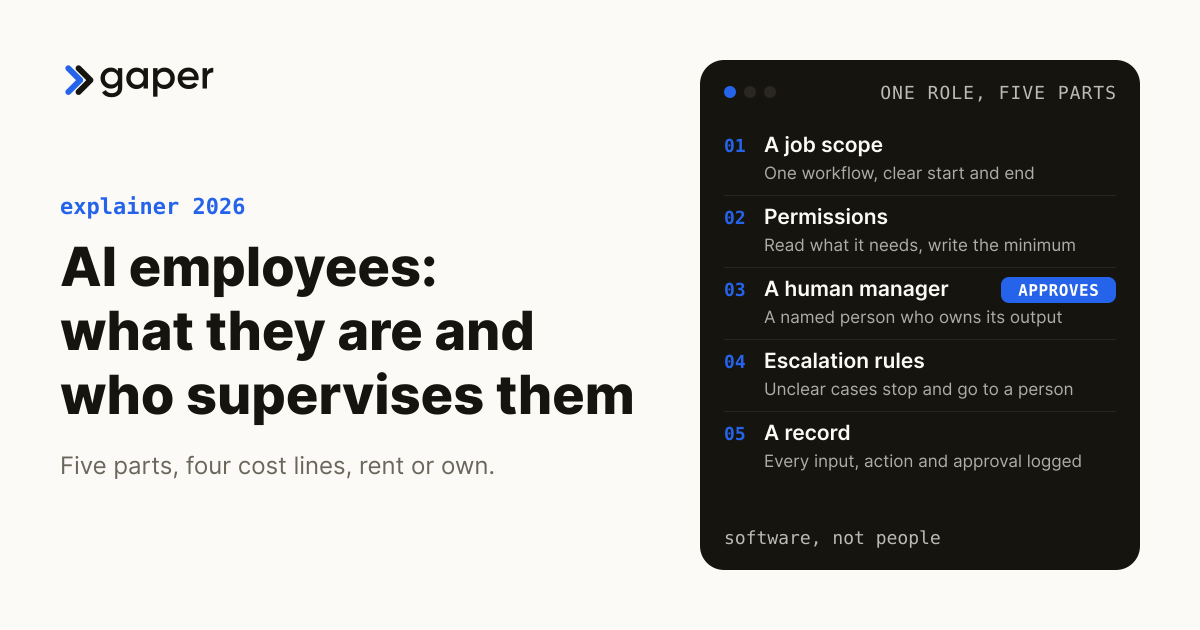
AI Employees: What They Are, What They Cost to Run, and Who Supervises Them
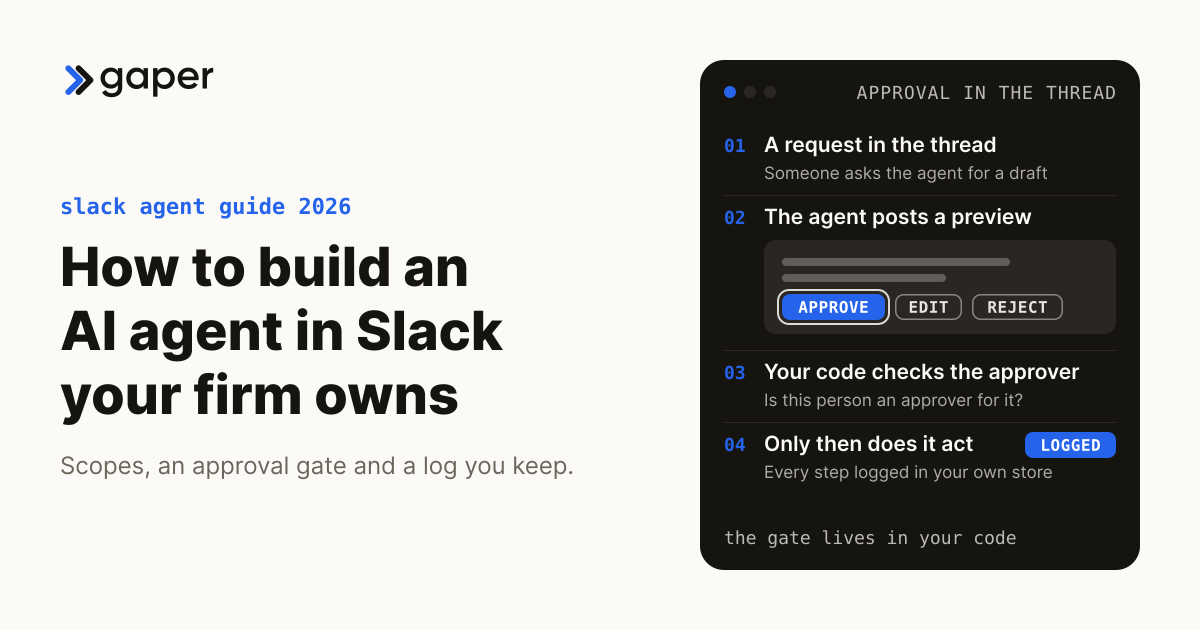
How to Build an AI Agent in Slack That Your Firm Owns
IndustryAI Agent Data and Privacy: What Enterprises Need to Know Before Production
A practical guide to AI agent data privacy for enterprises: what agents touch, where data leaks, and the controls that get a pilot safely into production.
Jun 23, 2026Ready to turn AI into execution?
Book a free assessment of one workflow. We map it, make an honest build versus buy call before any code, and if an off the shelf product covers the job we will tell you so.