
CTO vs. Chief AI Officer: Who Should Own AI at a Startup?
Should your CTO own AI, or do you need a Chief AI Officer? When each fits, when a fractional CAIO works, and how to hire a startup CTO in 2026.
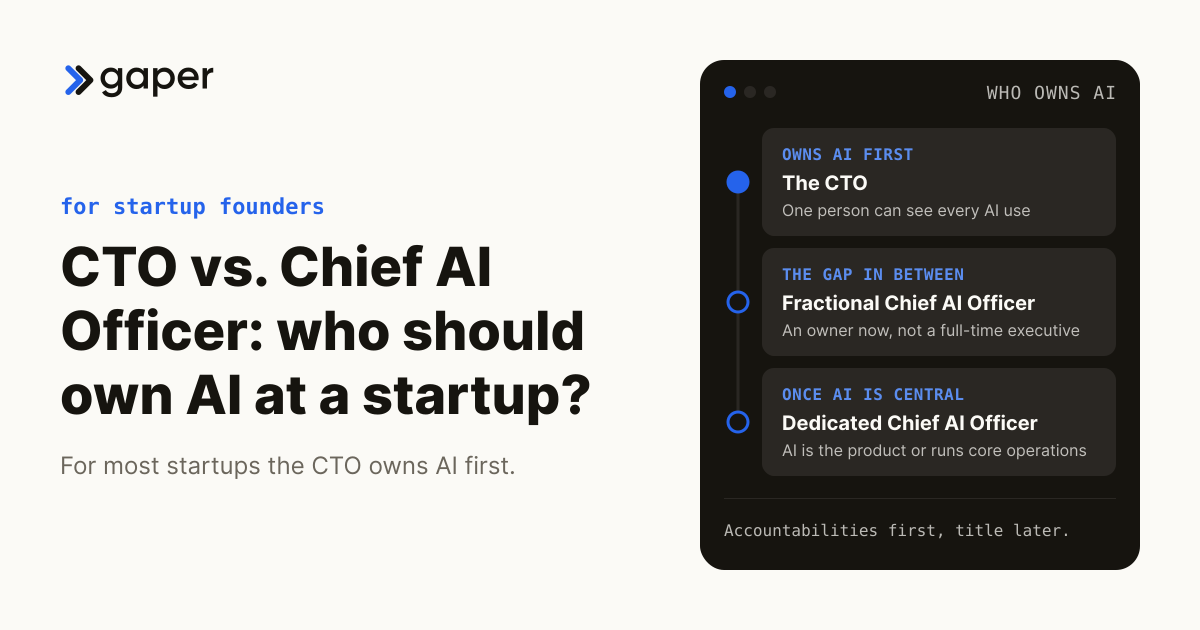
At most startups the CTO should own AI until its uses outgrow one person's time, because the CTO already owns the stack, the data and the engineers who build with models. A dedicated Chief AI Officer earns the seat when AI spreads across teams, customer data and spend and nobody can say whether it pays off; a fractional Chief AI Officer fits the gap in between. This guide covers both decisions: who should own AI, and how to hire the CTO who will hold most of it.
Founders usually face two separate questions on the technology side: who leads it, and who builds it day to day. In the latter case, most businesses are able to build sustainable, long-term developer teams through software development partnerships (similar to those that Gaper offers). But often, when trying to scale your business, executives and leaders in the tech sector are often hard to find, particularly when you have to be a bit conservative about using your resources.
It is important for business owners to understand how to hire a CTO because a lot of the tasks associated with managing and leading a tech team can be unfamiliar and overwhelming. Setting up a product plan, choosing the architecture, picking the tech and maintaining the product are sometimes beyond founders with an exclusively business mindset.
And this is exactly where the CTO takes charge.
A CTO's job is to ensure that a business keeps up with tech trends and competition no matter how many come and go. They make sure that the startup soars high with efficient leverage of technology. And how do they do that? By providing the startup with the best technology stack, tech experts, developers, etc. In 2026 that also means deciding how the product and team use AI, which is where the Chief AI Officer question begins.
If you are in the market to hire a CTO for your company but can’t decide whether or not you should, feel free to set up a quick remote appointment with us to discuss how a CTO could help with your business goals, objectives, and growth. This article goes over the major steps every business owner should look to tick off when hiring a dedicated CTO for their company.
Who is a CTO?
A CTO, or Chief Technology Officer, is the executive who owns a company's technology: the stack, infrastructure, security, engineering hiring and the technical direction of the product. At a startup the CTO is often a technical co-founder.
CTO stands for Chief Technology Officer. A CTO handles all matters of an organization that are related to technology. They could be a technical co-founder, a technology partner, or a technology specialist with entrepreneurial expertise, and they set the company's technological path through strategic plans for technology use. The role holds the same weight as a CFO's or a CEO's, and at a startup the CTO often sits among the founders.
Here are the main responsibilities of a CTO:
- Assuring Quality In Code: The CTO owns quality assurance and must see the product tested before release.
- Building Tech Team: The CTO hires everyone on the technology and product development team, remote or in-house.
- Ensuring IT Security: CTOs keep the company's IP, code and documents safe from cyber theft.
- Product Planning & Management: They make sure product planning and development go according to plan.
- Act As DevOps Engineer: At an early startup the CTO is often expected to work as the DevOps engineer so the team follows the same practices.
- Maintain & Update Application Architecture: One of the CTO's duties is keeping the application architecture up to date as it scales.
- Build Relationships With Vendors, Stakeholders, And Customers: On integrations, progress and API enhancements, the CTO strengthens ties with all three.
- Debugging: The CTO gets bugs fixed by assigning each to the right developer.
- AI In The Product: Deciding which models the product uses, how they are tested, and who approves an AI feature before customers see it.
Why do startups hire CTOs?
Startups hire a CTO when the product and the tech team have grown past what the founders can direct themselves, and someone has to set technical direction, hire and vet engineers, and answer for what ships.
Hiring a CTO may need little thought at FAANG or any other big company, but startups do need to make a judicious decision. Does your organization need one? Very likely, yes: once your tech team has a lot to contribute to the business, a development team without a technical head is incomplete.
The newer question is whether that same person should also own AI.
Who should own AI at a startup: the CTO, a Chief AI Officer or a fractional CAIO?
In most startups, the CTO, until AI spans several teams, vendors and customer-data uses. Add a fractional Chief AI Officer when ownership gaps appear before a hire is affordable, and a dedicated CAIO when AI results are core to the business and need one accountable executive.
The two roles answer for different things. A CTO answers for the technology the company builds or sells. A Chief AI Officer answers for whether the company's use of AI is approved, governed and paying off, including AI nobody in engineering built, such as AI features switched on inside software you already pay for. Our Chief AI Officer guide covers the full role.
| Who owns AI | Fits when | Watch for |
|---|---|---|
| The CTO | AI is one part of the product and one person can see every AI use | AI bought by sales, support or finance that the CTO never hears about |
| A fractional Chief AI Officer | AI decisions, policy and measurement need an owner now, but not a full-time executive | Decision rights left unwritten, so the part-time owner only advises |
| A dedicated Chief AI Officer | AI is the product or runs core operations, and investors or customers ask who answers for it | A CAIO and a CTO who both think they own the engineering of agents |
The title is spreading faster than any agreement on its shape. IBM's 2026 CEO Study (with Oxford Economics, released 4 May 2026) reports that 76% of surveyed organizations have a Chief AI Officer, up from 26% in 2025, self-reported by 2,000 CEOs and equivalent senior leaders (IBM, May 2026). A narrower, invitation-only survey of senior data and AI leaders at nearly 110 Fortune 1000 companies and leading global brands found 38.5% had named a CAIO or equivalent, up from 33.1%, and that 33.9% of those CAIOs report to technology leadership (Data & AI Leadership Exchange, 2026 AI & Data Leadership Executive Benchmark Survey).
Neither survey reports figures for startups. Even the US federal government lets the CTO hold the role: OMB memorandum M-25-21 (3 April 2025) gave each agency head 60 days to retain or designate a Chief AI Officer, and allowed an existing chief technology officer to serve if that person has significant AI expertise (OMB M-25-21, still listed by OMB with no rescission shown in October 2026). Assign the accountabilities first and settle the title later.

Inside each workflow, the Gaper Ownership Map draws the line between agent and person. Every step is Automated; Agent-drafted, human-approved; or Human-owned, meaning the agent never runs it alone. Our guide to human-in-the-loop AI covers those approval gates. If your CTO can keep that map current for every AI use, the CTO is your AI owner.
When does a startup need a dedicated Chief AI Officer?
When AI is the product or runs core operations, when several teams buy or build AI on their own, and when investors, customers or regulators ask who answers for it. If the CTO cannot give those answers on top of the engineering job, AI needs its own owner.
The signs usually arrive together: sales, support and finance switch on AI tools the CTO learns about from an invoice; an enterprise customer's security review asks who owns AI risk; the board asks what the AI spend returned and the answer is a guess; and every AI decision waits on the one person also running engineering.
A dedicated CAIO does not replace the CTO. The cleanest split is that the CTO owns how AI is engineered (models, infrastructure, evaluation, security) and the CAIO owns which uses are approved and whether each meets its agreed metric. Write that split down before the hire. Before reaching for the title at all, an AI steering committee chaired by the CEO, with the CTO on it, can approve uses, vendors and policy on a schedule.
There is no reliable public benchmark for Chief AI Officer pay: BLS does not track the title, and the figures circulating online come from aggregators that model their numbers. Budget for it like any other C-level hire, salary plus equity.
When does a fractional Chief AI Officer make sense?
When a startup needs someone accountable for AI decisions, policy and measurement now, but the workload or budget does not yet justify a full-time executive.
A fractional CAIO works like the technical advisor covered below, with one difference: the role needs decision rights. Agree in writing which uses they approve, which they can pause, and what they report and when. The first 90 days should end with decisions and baselines, not a launch date.
Gaper also provides a fractional Chief AI Officer for firms that need the role before they can justify a hire. Gaper is the AI-native implementation partner that deploys supervised AI agents you own. The Chief AI Officer sets the agenda and the scorecard, and Gaper builds against them. At handover you own what was built: the code, prompts, evaluation set, runbook and audit trail.
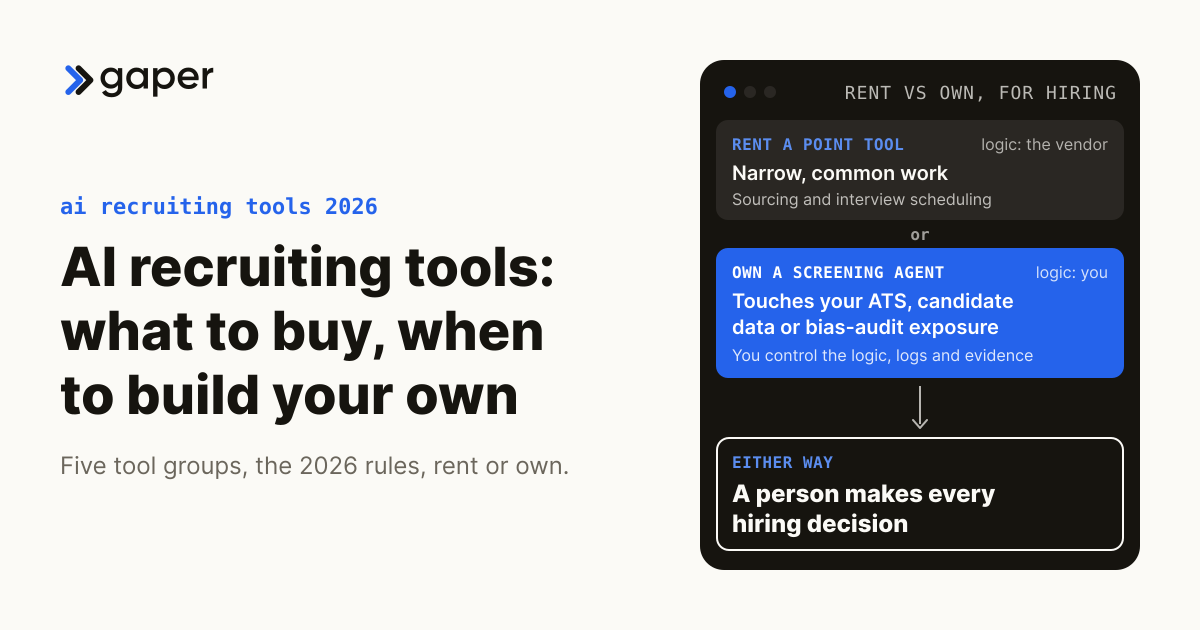
Build or buy calls are made one workflow at a time. The Rent-vs-Own test keeps them consistent: rent a point tool for narrow, common work, and own a supervised agent when it touches systems of record, client data or risk. Build vs buy AI agents works through the trade-offs.
Whichever model you choose, the CTO still holds most of the technical work. So, how do you assess the capabilities of a CTO? What should you look for when hiring one?
Key Areas To Assess CTO Candidates In
Now, the most important thing is to consider the fact that hiring a CTO is very different from hiring other tech experts or developers for a product team. The process should be more thorough, since the person you hire will have a big role and a bigger team to manage.
Here are the things that need attention:
Experience
Aim for a CTO with close to a decade of experience. Do not hand a product team to an entry-level or mid-level expert with no leadership experience; a CTO often stands in the founder's position and needs depth in both technical and leadership roles. For the wider occupation that includes CTOs, BLS lists 5 years or more of work experience in a related occupation as typical (BLS Occupational Outlook Handbook).
Technology Expertise
CTOs handle everything related to tech, from frameworks and libraries for the front end and back end to programming languages. Assess this technical skill set together with their soft skills and business inclination.
Oftentimes, there is no one else in a startup or small business who can effectively test and evaluate the suitability of a CTO candidate. In such a case, go for collaborations and partnerships with businesses that are well-reputed in this field. Gaper makes sure that senior technical experts that we hire for our clients are as well-versed in business development concepts as they are in tech. Since senior experts vet these individuals, our clients do not have to go through the hassle or compromise on the quality of talent they are hiring.
Passion
For an executive role, gauge how passionate and motivated candidates are about their work. It shapes their faith in your ideas and their drive to reach your goals; without it, the team they lead and the strategies they set won't bear optimal fruit.
Growth-Oriented Learner
One universal fact about technology is that it changes very frequently. This is why the CTO you choose should be an eager learner who can keep up with market trends, competition and business growth. A CTO needs a learning mindset that tailors strategy to what is needed at the time. AI raises the stakes: vendors release, change and retire models on their own schedules, and a CTO has to plan for that.
This soft skill is complemented by a CTO's inclination to be flexible. 2020 taught us that this was perhaps the most important quality a business could have. Make sure your leadership is keeping up with the times.
Leadership Skills
Last but not least, a CTO must have excellent leadership skills. Unlike a senior developer, they set the direction for everyone, motivate other employees and lead the team.
AI Judgment
If the CTO will own AI, test for it directly. Ask when they would buy a tool rather than build an agent, how they would evaluate an agent before customers see it, which steps stay human-owned, and what they would log. A candidate who talks only about models, never approval and measurement, can build AI but is not yet ready to own it. For the governance side, see our guide to ethical AI decision-making.
What steps should you follow in order to hire a CTO? Let's go over them.
Define Your Requirements
The first thing you need to do is define your requirements, such as:
- Responsibilities: The responsibilities the role carries.
- Cultural Fit: Your company's culture, so candidates know whether they fit in.
- Skills: Eagerness to learn, leadership, entrepreneurial skills, out-of-the-box thinking and others.
- Technology Stack: The technologies the product needs, so the candidate's experience lines up.
- Personality: A CTO has to fill many shoes, so say plainly that they will cover multiple positions.
- AI Ownership: Say whether the CTO will hold the AI accountabilities alone, share them with a fractional Chief AI Officer, or work alongside a dedicated CAIO.
Do you need a technical advisor before a CTO?
Often, yes, if nobody on the team can vet a CTO. A technical advisor works with your team part time, reviews code, gives technical direction, and can screen and interview CTO candidates without giving up their existing work.
Before hiring a CTO on your own, check whether you can actually vet the candidates. If you lack in-house expertise, one option is a technical advisor. They do not work for you 9 to 5; about once a month they review code with your tech team, give technical direction and recommend changes for senior engineers to make. They can also vet and interview CTO candidates, and give feedback to remote development teams, without giving up their existing work. A fractional Chief AI Officer applies the same logic to AI.
Another way to rid yourself of multiple hiring processes is simply to let another company do it for you as long as you are satisfied with their vetting process. You can discuss Gaper’s vetting process by scheduling a quick meeting with us.
Education and Experience
A CTO usually needs at least a bachelor's degree in computer science, software engineering, information systems or a related field, and a business or management degree is a plus. Many CTO applicants hold a master's degree or even a PhD, but do not reject candidates just because they lack one.
Certifications show whether a CTO keeps their skills polished: development, cybersecurity, cloud computing, database administration, machine learning or related fields.
Finally, a CTO should ideally have over 7 years of experience in a tech and management role, with some time also spent in leadership roles. It is hard to quantify soft skills. If you are hiring a CTO on your own, look for as many demonstrable examples of their abilities as possible.
Prioritize Requirements
Next, prioritize your requirements. Every startup is different, and the candidate needs to know your top priorities to function well as your CTO. If AI is on the list, rank it honestly: is the first job to ship the core product, or to put AI into it? The answer changes which candidate fits.
Search Different Platforms
Search many platforms when looking for a CTO. The position matters too much to rush.
Moreover, searching for a CTO online does not only stand if you want to hire a virtual CTO, but this method is also accurate even if you want an in-house CTO.
CTO Job Description Template
Feel free to use the following as a CTO job description template if you choose to hire a CTO on your own. The last two preferred skills are for a CTO who will also own AI; drop them if a Chief AI Officer will hold that work.
Preferred Skills:
- Planning and setting a direction for how technology will be used in the company.
- Ensuring the company is equipped with the appropriate technological resources for both short and long-term purposes.
- Set out objectives and a plan for the growth and development of the company with respect to technology.
- Project management skills that involve a timely development and deployment of all tech-related products and services.
- Able to take timely, executive decisions with respect to the company's technological objectives and requirements.
- Leadership skills to lead, manage, guide and set directions for the tech teams in the company.
- Business knowledge that ensures the candidate is aware of market trends and is able to take consumer-centric decisions when setting plans and directions for product and service development.
- Take part in HR processes and collaborate with the HR department wherever tech resources are concerned.
- Managing technology budgets and timelines.
- Ensure adherence to appropriate regulatory standards.
- Keep one inventory of every AI use in the company, with a named owner, a risk level and a review date for each.
- Set a baseline before each AI use goes live and report its measured result to the founders or the board.
Minimum Requirements
- Master’s degree in computer science or related field.
- MBA preferred, but appropriate courses in the business field can work too.
- At least 7 years of work experience in a technological role.
- At least 5 years of experience in a managerial/leadership position.
- Excellent team and project management skills.
- Verbal and written communication skills and the ability to communicate with global teams and clients.
- Efficient delegation of tasks whenever needed.
- Appropriate business, market, and industry knowledge with a growth-oriented mindset.
- Ability to work flexibly and work with remote teams of developers.
What does a CTO do?
A CTO handles every technology matter in a company: stack selection, infrastructure, security, development process, developer hiring and product team management. CTOs set the company's technical path, and at most startups today they also decide how the product uses AI.
Do I need a CTO for my company?
Yes, if you need someone to lead your tech teams, run hiring and vetting, and handle the tech-focused work your growth depends on. If you don't need someone full time, look into a technical advisor first, and give AI ownership to a fractional Chief AI Officer if the gap is AI.
How should I hire a CTO for my company?
Write a job description that lists the responsibilities you plan to give the CTO, including whether they will own AI. Share it on job boards and in your network, then judge applicants on experience, technical depth, leadership, learning mindset and AI judgment.
The assessment areas above and the job description template give you a starting structure. Alternatively, share your job description with us so we can find and vet an appropriate candidate for you.
How much does a CTO earn yearly?
BLS does not track CTOs separately. For computer and information systems managers, the occupation that includes CTOs, the US median was $175,140 in May 2025, and in the New York metro area the median was $215,300, with the top 10% above $322,410.
The 2022 version of this guide put New York City CTO pay at roughly $250,000 to $350,000, which overlaps the top quarter of the occupation in the newer data: in the New York, Newark and Jersey City metro area the 75th percentile was $285,570 in May 2025 (BLS Occupational Employment and Wage Statistics, May 2025; national figures from the BLS Occupational Outlook Handbook). OEWS wages count commissions and production bonuses but leave out nonproduction bonuses, and equity is not counted as a wage (BLS OEWS technical notes).
Pay depends on background, company size and responsibilities, and varies widely by country. A non-founder CTO will usually ask for equity too; public CTO-specific grant benchmarks are thin, so set it with your counsel against your stage and cap table.
Conclusion
Hiring a CTO is different from hiring a team member or manager: you need the requisite skills and someone on the same page about your objectives and growth plans. Finding one through your network has become harder as more people leave jobs to start their own ventures, so it may be better to look at remote CTOs for flexibility and for the cost and skill advantages that come with them.
The AI question sits on top of that hire. For most startups the CTO owns AI first; a fractional Chief AI Officer or a steering committee takes over the accountabilities when AI outgrows one person, and a dedicated CAIO follows once AI results are central to the business. Whatever the title, write down who approves each AI use, who can stop one, and how you will know it paid off.
Thirty minutes, no commitment. We map one workflow, make the build or buy call, and scope the smallest thing worth shipping.
Frequently asked questions
Who is a CTO?
Why do startups hire CTOs?
Who should own AI at a startup: the CTO, a Chief AI Officer or a fractional CAIO?
When does a startup need a dedicated Chief AI Officer?
When does a fractional Chief AI Officer make sense?
Do you need a technical advisor before a CTO?
What does a CTO do?
Do I need a CTO for my company?
How should I hire a CTO for my company?
How much does a CTO earn yearly?

Ready to turn AI into execution?
Book a free assessment of one workflow. We map it, make an honest build versus buy call before any code, and if an off the shelf product covers the job we will tell you so.