
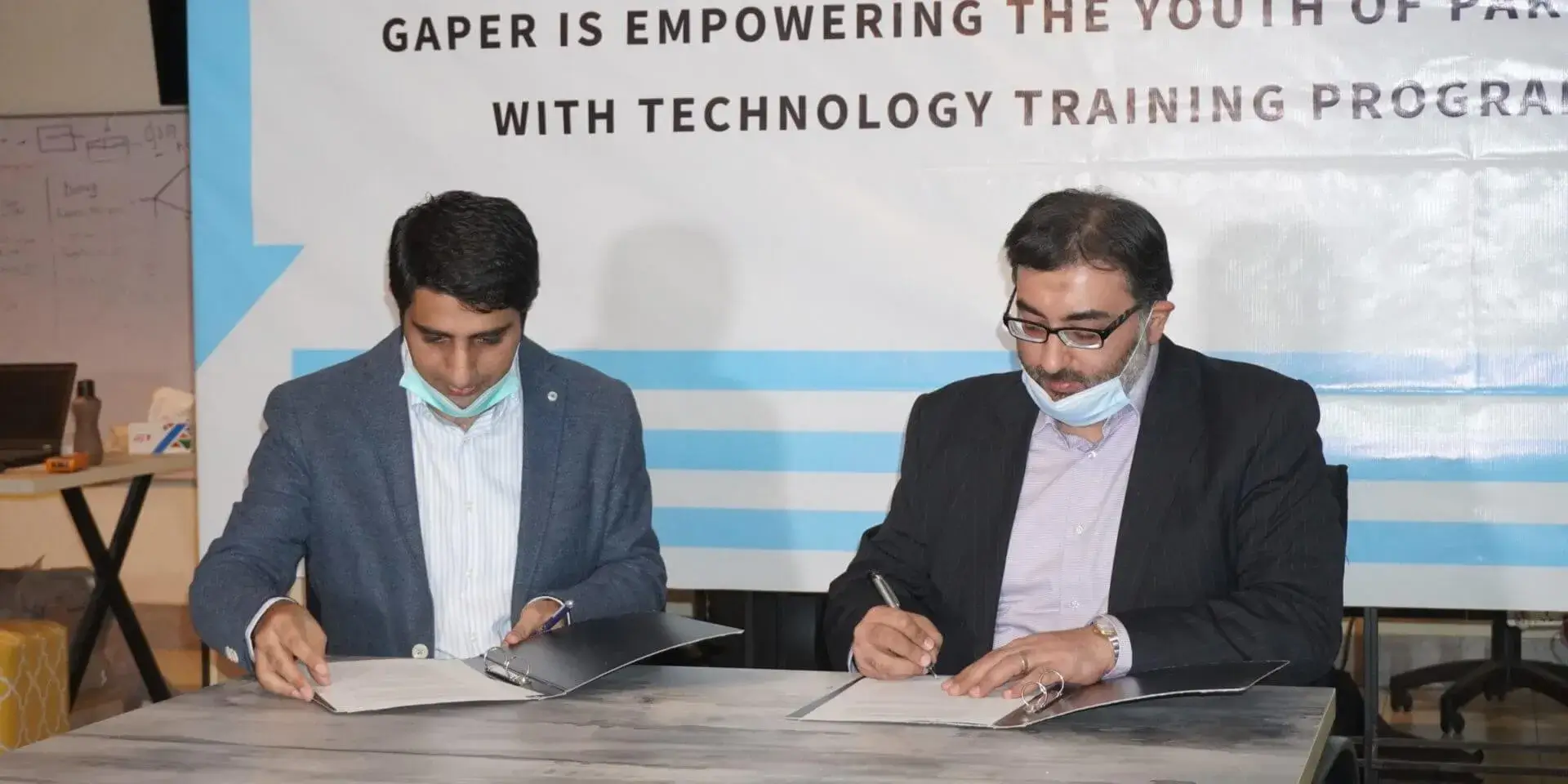
Gaper.io launched its training as part of their corporate social responsibility initiative, in partnership with the local state and city governments.
Written by Mustafa Najoom
CEO at Gaper.io | Former CPA turned B2B growth specialist
Quick Summary
Table of Contents
Free assessment. No commitment.
Pakistan has emerged as a critical node in the global software development supply chain, and the statistics tell a clear story. The country’s IT sector is not a footnote. It is a $3.2 billion industry with 650,000+ software professionals, and it is growing faster than most people realize.
Three factors make Pakistan a different kind of talent market in 2026.
First, the sheer scale of developers trained annually. Pakistan’s engineering universities graduate 45,000 computer science students per year. The bootcamp ecosystem has added another 12,000 to 15,000 trained developers annually since 2021. That is a pipeline of 57,000 to 60,000 new software professionals entering the market every single year. For context, the entire United States graduates about 70,000 computer science students per year. Pakistan is close to parity.
Second, the cost economics are sustainable, not predatory. When your average hourly rate in Lahore, Karachi, or Islamabad is $35 to $50, and Western rates are $80 to $150, the arbitrage seems obvious. But that narrative misses what is actually happening. Developers in Pakistan are not cheap because they are bad. They are cheaper because of purchasing power parity, currency strength, and the cost of living. A mid level full stack developer earning $45 per hour in Pakistan has comparable quality of life to a developer earning $120 per hour in San Francisco. The productivity is comparable. The skills are comparable. The math works because the economics work, not because you are extracting value.
Third, geopolitics and market maturity are converging. Tech outsourcing to India has become saturated and expensive. The Philippines and Vietnam are growing but still building institutional depth. Pakistan’s tech sector has 20+ years of stability and professional operations. Every major tech company (Microsoft, Apple, Google, Amazon) has hired directly from Pakistan for the past decade. The infrastructure for professional tech work exists. The cultural and organizational expectations are already set.
Pakistan’s developer base skews young, educated, and specialized. The median age of a professional developer in Pakistan is 28 years old, which means most of the talent pool came up during the AI boom and cloud native era. They did not learn software development on deprecated stacks. They learned it in 2015 to 2026.
The skills distribution breaks down as follows based on market data and GitHub language analytics from Pakistani developers:
| Skill Category | Distribution | Notes |
|---|---|---|
| Backend Languages | Python 32%, JavaScript/Node.js 28%, Java 18% | Modern, AI-friendly stack |
| Frontend Frameworks | React 45%, Vue.js 18%, Angular 15% | Global standards |
| Cloud & DevOps | AWS 62%, Azure 28%, Kubernetes 35% | Cloud native skills dominant |
| Databases | Postgres 38%, MongoDB 32%, MySQL 22% | Modern databases, not legacy |
| Specialized Domains | ML/AI growth 120% since 2022 | TensorFlow, PyTorch, LangChain widely known |
What this skill distribution tells you is that Pakistani developers have trained in the same tools and languages that Silicon Valley favors. There is no expertise gap. There is a cost gap.
Generation, a nonprofit focused on training underrepresented populations for digital skills, launched its Pakistan program in 2018 and has trained over 2,400 tech professionals through full immersion bootcamps since then. The program is significant not because it is large, but because of where those graduates go and what skills they bring.
Generation’s Pakistan program focuses on full stack development, cloud engineering, and data analytics. Graduates complete a 12 to 16 week intensive program, do a 4 week job placement phase, and enter the market with production ready skills. The program targets low income individuals, women, and underrepresented groups in tech, which means it is building diversity into the pipeline upstream.
Gaper has become a primary employment partner for Generation Pakistan graduates. Over 850 Generation alumni now work through Gaper’s platform, making Generation graduates a meaningful slice of the 8,200+ engineer network. These are not senior engineers. Most are junior to mid level developers, 0 to 5 years of professional experience. But they are structured, disciplined, and trained in frameworks (React, Node, cloud architecture) that companies need immediately. Generation’s boot camp model produces developers faster than university programs and with more direct job readiness.
The partnership between Gaper and Generation also signals something important to the market. It means that hiring talent from Pakistan does not require you to gamble on unknown individuals found on freelance platforms. You can hire from a curated network of trained professionals with a 4 week job track record and verified skills.
Hiring developers from Pakistan is not the same as hiring from a domestic market, but the differences are operational, not cultural. Here is how to do it right.
Pakistani developers respond well to clear job descriptions and specific technical requirements. Ambiguity is expensive. If you hire a contractor and the role is vague, you will lose 2 to 4 weeks to clarification calls and misaligned work.
Write a technical job description that includes:
The more specific you are upfront, the faster candidates self select and the faster you make a hiring decision.
Hiring the first developer from Pakistan? Avoid generic freelance platforms. Instead, use:
The key principle: Use a network where there is reputation risk for the person recommending or placing the candidate. That aligns incentives.
Pakistani developers are distributed across UTC+5, which is 10 to 13 hours ahead of US time zones. Synchronous interviews are expensive for both sides. Instead, send a technical assessment that candidates complete async.
A good technical assessment for a junior to mid level developer takes 3 to 4 hours and includes:
Send the assessment via email, give them 48 hours, and grade the results before scheduling a call. This filters out candidates who are unmotivated or who lack English communication skills early, and it respects their timezone.
Once a candidate passes the technical assessment, schedule a synchronous conversation. But schedule it strategically.
Pakistani timezone (UTC+5) means:
If you can, schedule interviews at 5:00 to 6:00 PM Pakistan time (8:00 to 9:00 AM US Eastern). Respect the timezone mismatch, and candidates will respect you.
The first 30 days determine whether the hire works. Set it up right:
The first 30 days of any remote hire is about building trust. Explicit communication makes trust faster.
Gaper’s approach to Pakistan hiring reflects the lessons learned across 8,200+ engineer placements globally.
Gaper’s talent team runs every engineer through a three stage filter before they appear in the available network:
Developers who pass all three stages enter Gaper’s available pool. They have a score (1 to 5 stars, updated quarterly based on client feedback), region, timezone, and skill tags. When a client needs developers, Gaper matches them based on skill alignment and availability.
Pakistani developers make up about 12% of Gaper’s available pool (roughly 1,000 engineers). By region, Pakistan is the 4th largest source, after India (32%), Eastern Europe (25%), and Latin America (18%).
The Pakistani cohort skews toward:
For clients hiring engineers from Pakistan through Gaper, the process is: request a skill match, receive 3 to 5 candidate profiles with verified work history and client references, conduct interviews (Gaper coordinates timezone friendly scheduling), and complete a 2 week paid trial period before the engagement converts to ongoing. If the trial does not work out, Gaper replaces the engineer at no cost.
A junior developer from Pakistan on Gaper starts at $35 per hour. A mid level developer is $45 to $55 per hour. A senior developer is $60 to $75 per hour. These rates are lower than US or Western Europe equivalents, but the value proposition is not about paying less for the same person. It is about scaling teams faster.
Here is the math for a startup that needs 3 engineers for a 4 month project:
The Pakistan engineers cost 29% of the US FTE equivalent and 45% of the US contractor equivalent. But the person doing the work is competent, trained, and verified. You are not buying low cost. You are buying smart cost plus verified quality.
Pakistan is not the only offshore tech talent option. India dominates by volume. Eastern Europe is popular for senior engineers. Latin America has strong timezone overlap with US markets. So why hire from Pakistan specifically?
India’s IT services sector is mature and expensive. A mid level developer from India through a major vendor costs $60 to $85 per hour. Pakistan’s rates are 25% to 40% cheaper while skill levels are equivalent. The cost advantage is real and legal, and it exists because of purchasing power parity, not because developers are underpaid.
UTC+5 is perfectly positioned to cover overlapping hours with both Asian markets (Hong Kong is UTC+8, close enough) and European markets (London is UTC+0, easy 5 hour difference). A Pakistan developer can have live meetings with teams in London at 3:00 to 5:00 PM Pakistan time (10:00 AM to 12:00 PM UK time). That same developer can overlap with San Francisco 2:00 to 5:00 AM Pacific, which is tight but viable for async heavy teams.
Generation Pakistan is distinctive. It is a structured, verified bootcamp that reports student outcomes, maintains relationships with employers, and places graduates into verified roles. When you hire a Generation graduate through Gaper, you know their background. That is rare in offshore hiring.
Pakistan’s official language is Urdu, but English is widely spoken in professional and educational settings. Technical documentation, coding comments, and pull requests are in English. The education system teaches English from primary school onward. For a US or UK company hiring engineers, communication does not require translation or special accommodation.
This is a practical advantage that gets overlooked. An engineer who communicates clearly in English means 2 fewer meetings per week to clarify requirements. That is 100 hours per year of context switching you do not have to do.
Pakistan’s tech sector has weathered political and economic volatility for 20+ years. Tech companies operate independently of political cycles (because tech exports are valuable foreign revenue). Major multinational tech companies have offices and operations in Pakistan. The ecosystem has professional HR practices, legal employment frameworks, and business continuity plans.
Free assessment. No commitment.
Gaper’s partnership with Generation Pakistan and commitment to hiring 1,000+ engineers from Pakistan is not a cost play. It is a scale play.
Gaper.io is a platform that provides AI agents for business operations and access to 8,200+ top 1% vetted engineers. Founded in 2019 and backed by Harvard and Stanford alumni, Gaper offers four named AI agents (Kelly for healthcare scheduling, AccountsGPT for accounting, James for HR recruiting, Stefan for marketing operations) plus on demand engineering teams that assemble in 24 hours starting at $35 per hour.
Pakistan is a critical part of the “$35 per hour” promise. Because of verified talent, clear hiring processes, and partnerships like Generation, Gaper can assemble a team of junior to mid level engineers in 24 hours at cost points that previously required compromising on skill or reliability.
The global engineering shortage is real. In 2026, there are more product ideas than there are developers to build them. Companies that can scale engineering teams fast and cost effectively win. Pakistan is a part of that equation because it has the developers, the training infrastructure, the timezone position, and increasingly, the institutional maturity to be a reliable part of a global tech supply chain.
8,200+
Top 1% Vetted Engineers
24 Hours
Team Assembly Time
$35/hour
Starting Rate
Top 1%
Skill Tier
Free assessment. No commitment.
1. Is There a Language Barrier?
Not meaningfully. English proficiency among Pakistani tech professionals is high because English is the language of software engineering globally. Most Pakistani developers trained at universities or bootcamps where English was the instruction language. Pull requests, code comments, and technical discussions are all in English. However, there are regional accents and communication styles that take a call or two to understand. This is not a barrier. It is a normal onboarding cost with any remote team. Invest one extra synchronous meeting to calibrate communication style, and the problem is solved.
2. What Time Zone Should I Expect for Meetings?
Pakistan Standard Time is UTC+5. That means 2:00 to 4:00 PM Pakistan time = 5:00 to 7:00 AM US Eastern (early, viable) and 5:00 to 7:00 PM Pakistan time = 8:00 to 10:00 AM US Eastern (morning, good). For European teams, Pakistan time overlaps well with morning or early afternoon. Async work dominates outside these windows, which is fine for most teams.
3. What Is the Political and Security Risk?
Pakistan has experienced political instability historically, but the tech sector is insulated from most of it. Major multinational companies (Microsoft, Google, Amazon, Apple) operate offices in Pakistan. Gaper has 1,000+ engineers on the platform with 99.8% uptime on project delivery. That said, Pakistan does experience occasional internet outages (typically 4 to 8 hours annually) in some cities. Hire developers from major metro areas (Karachi, Lahore, Islamabad) where infrastructure is robust. Build into your project timeline a 1% buffer for unexpected infrastructure issues.
4. What Is the Attrition Risk?
Pakistani developers tend to stay in roles longer than freelancers from other regions because full time employment offers visa sponsorship pathways and career stability that freelancing does not. Typical attrition for a hired developer from Pakistan is 18% per year, which is lower than US freelance (30% to 40% annual turnover) and comparable to traditional employment. However, the top tier talent (5+ years, senior level) faces frequent recruitment from larger tech companies offering visas for emigration. If you hire a very senior Pakistani engineer, know that they may leave within 18 to 24 months for an immigration opportunity.
5. How Do I Handle Payments and Legal Compliance?
Gaper handles all the legal and payment infrastructure. You pay Gaper, and Gaper pays the engineer in Pakistan rupees. Gaper is responsible for all tax and employment compliance, as well as international payment processing. If you hire directly, you need to set up payment methods like Wise (formerly Transferwise), tax documentation, and employment contracts. Hiring through Gaper or another vetted platform eliminates the compliance overhead.
6. What If the Fit Is Not Right?
Hiring is not perfect. Sometimes a candidate who looked good on paper does not perform. Gaper’s trial period (typically 2 weeks paid work) is designed for this. If the fit is not right, you can replace the engineer. In general, give any new remote hire 4 weeks before you decide it is not working. The first week is setup and context building. Weeks 2 and 3 are productivity ramp. By week 4, you know whether the person is reliable, communicates clearly, and does quality work. If after 4 weeks the fit is still bad, move on and hire someone else.
Free assessment. No commitment.
Top quality ensured or we work for free