

We got featured in
We got featured in


Experts in Java development work worldwide to create and implement IT solutions that help companies remain competitive and relevant in their markets.

Choosing the right Java developer can be a complex process. Because of the rapid increase in the market's need for these professionals, the number of resources available can seem too limited.

Several industries, platforms, and technologies use Java as one of the most adaptable programming languages, making it an industry leader. As a result, the demand for highly-skilled Java developers continues to rise.

Instead of dumping candidates, we thoroughly analyze your requirements and help you hire Java developers.
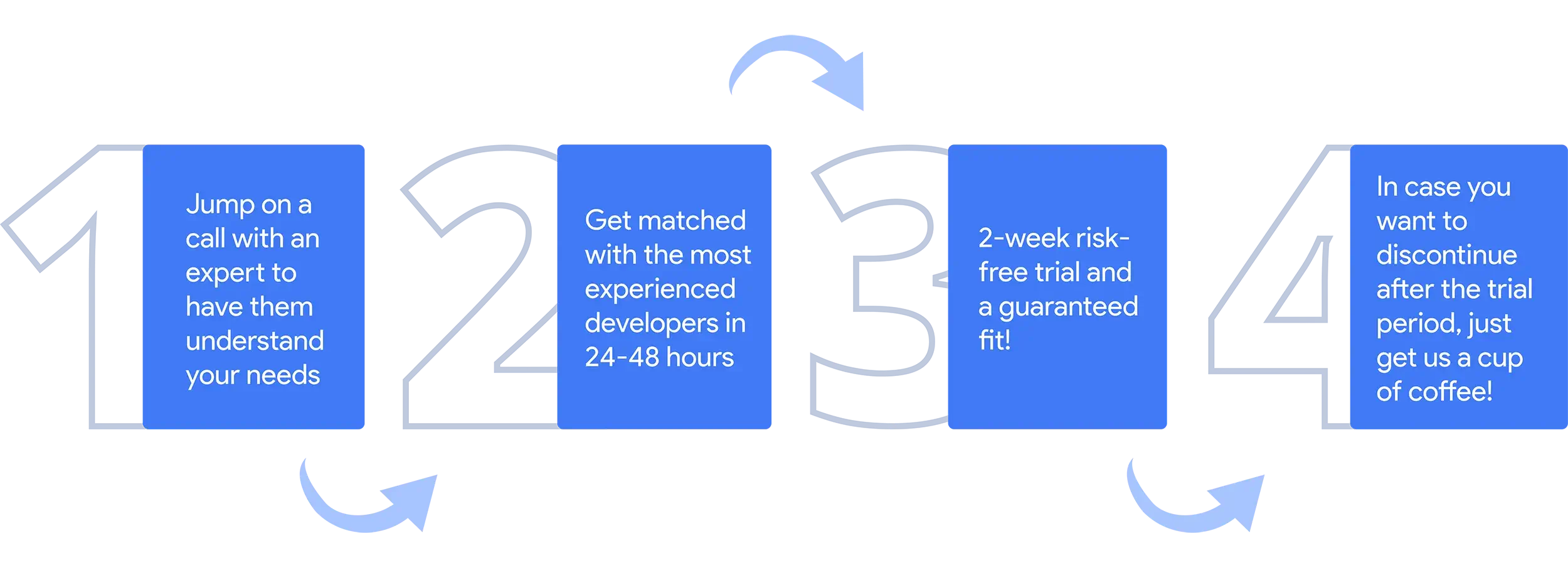
Our hiring process is simple. Ever walked into your favorite coffee shop and felt completely relaxed knowing your barista’s got your back? That’s the experience we want to replicate when you come to us for hiring engineers.
We take time to ensure your exact needs are understood, and only the most suitable Java programmers are hired by our clients.
If you do not feel like the “match” was suitable, we will simply match you with another.

We exist to unlock human potential at scale. We envision a world where the most talented people can build a career commensurate with their ability – not their race, gender, or geography.
Our Engineers
have worked for
Our Engineers
have worked for

Browse through hundreds of profiles and find your dream match

Experience
Hourly Rates

Experience
Hourly Rates

Experience
Hourly Rates

Experience
Hourly Rates








Written by Mustafa Najoom
🕑 12 min readCEO at Gaper.io | Former CPA turned B2B growth specialist
View LinkedIn ProfileTL;DR: Java Developer Hiring in 2026
Java remains the second-most-in-demand backend language globally. Hiring qualified Java developers is fast becoming a competitive advantage. Here's what you need to know about process, timeline, and cost.
Table of Contents
Our engineers ship production Java at
Need Java developers fast? Skip the 6-month hiring cycle.
Gaper assembles vetted Java engineers in 24 hours. 8,200+ top 1% specialists ready to build your application starting at $35/hr. No long-term commitment, no recruiter fees.
Hire Engineers NowJava was born in 1995. Thirty-one years later, it is more relevant and more demanded than ever. The staying power is remarkable. Here is why.
Market Reality: The global Java market is valued at $33 billion and growing at 7.2% annually according to Gartner. 90% of Fortune 500 companies run critical systems on Java, including banking platforms, insurance systems, retail infrastructure, and government services. 15 million Java developers exist globally, yet demand continues to outpace supply. The IEEE Spectrum Developer Survey (2025-2026) ranks Java as the number 2 most-wanted backend language, behind only Python.
Business Impact: Java Drives Revenue
Companies using Java for backend systems report 99.5%+ uptime, 60% faster development cycles compared to legacy systems, and 40-50% lower infrastructure costs compared to equivalent systems in alternative languages.
When evaluating Java candidates, distinguish between core language competencies (non-negotiable) and advanced specializations (differentiators). Here is what to look for at each level.
Java Language Fundamentals: Generics and parametric polymorphism. Collections (List, Set, Map) and their performance characteristics. Streams and functional programming (Java 8 and later). Exception handling with checked vs unchecked exceptions. Object-oriented design with inheritance and interfaces.
Spring Framework Mastery: Dependency injection and Spring's bean lifecycle. Spring MVC and the request-response cycle. Controllers, interceptors, error handling. Spring Data JPA for database interaction. Spring Boot auto-configuration. Building REST APIs.
SQL and Database Performance: Writing efficient SQL queries with joins, subqueries, and indexing strategies. Understanding query plans. Knowing when to normalize vs denormalize. Database design and optimization.
Concurrent Programming: Thread safety. Synchronized blocks, volatile keywords, AtomicInteger. Concurrency utilities like locks, semaphores, thread pools. Java Memory Model and happens-before relationships. Red flag: candidates who cannot explain memory visibility or difference between synchronized and ReentrantLock will cause production issues.
JVM Performance and Profiling: Heap memory management. Garbage collection tuning. Choosing appropriate GC collectors. Heap sizing and avoiding full GC pauses. Using profiling tools like JProfiler, YourKit, and Java Flight Recorder (JFR).
Cloud and Container Experience: Docker containerization and image optimization. Kubernetes deployment and scaling. Serverless Java (AWS Lambda, GCP Cloud Functions) with their 18+ second cold start penalties. Observability with structured logging, metrics (Prometheus), and distributed tracing.
| Skill Area | Junior (0-2 yrs) | Mid-Level (2-5 yrs) | Senior (5+ yrs) |
|---|---|---|---|
| Spring Boot and REST APIs | Build basic endpoints with guidance | Design APIs, handle errors, optimize | Architect microservices, API gateways, versioning |
| Database and JPA | Query writing, basic relationships | N+1 query optimization, transactions, denormalization | Sharding, replication, scaling databases |
| Testing and Quality | Unit tests with guidance | Unit, integration, end-to-end testing. TDD. | Test strategy, test infrastructure, mutation testing |
| Performance and Observability | Recognize slow queries | Profile applications, optimize hotspots | GC tuning, distributed tracing, cost optimization |
Use these questions in screening and technical interviews. The quality of answers reveals depth and production experience.
| Hiring Method | Cost | Timeline | Best For |
|---|---|---|---|
| Freelancer (Upwork, Fiverr) | $50-$100/hr | 2-4 weeks to hire | Small projects, specific features, high variability |
| Toptal (Curated) | $75-$150/hr | 3-4 weeks | Quality-critical projects, longer engagements |
| Staff Augmentation (TrueBlue, Apex) | $60-$120/hr | 1-2 weeks | Scaling team quickly, less control |
| Gaper (24-Hour Assembly) | $35-$80/hr | 24 hours | Ongoing projects, scaling, rapid hiring |
| Full-Time Hire (Salary) | $120k-$200k/year | 12-16 weeks | Long-term product development, core team |
Cost Per Feature: A typical mid-size feature (login redesign, payment integration, reporting dashboard) costs different amounts depending on your hiring method. DIY hiring plus onboarding takes 8-12 weeks and costs $30-60k in salaries plus recruiter fees. Gaper teams deliver the same feature in 2-4 weeks at $7-14k. Teams assemble in 24 hours; you start paying for work immediately, not for recruiting overhead.
Toptal: Rigorous vetting focused on top 3% of global talent. Rates run $75-$150/hour. Hiring takes 2-4 weeks. Best if: you want the highest confidence in quality and can wait for the hiring process.
Gun.io: Backend-focused, curated pool of engineers. Rates run $100-$180/hour. Hiring takes 2-3 weeks. Best if: you want specialists and don't mind premium rates.
Gaper: 8,200+ vetted engineers, 24-hour assembly, $35-$80/hour, top 1% focus. Best if: you need teams fast and want cost-effective options with quality.
LinkedIn Recruiter: Largest network. Expensive (recruiter cuts). Slow (8-16 weeks). Best for: large companies with recruiting budgets and long hiring cycles.
Stack Overflow Jobs: Java developers self-select here. Quality candidates. Moderate cost. Best for: companies that want to tap the active developer community directly.
Ready to assemble your Java team? Skip the 6-month hiring cycle.
James, Gaper's HR recruiting AI agent, assembles vetted Java developer teams in 24 hours. Productive from day one. Pay weekly, no long-term commitment.
Hire Engineers NowGaper.io in one paragraph
AI Workforce Platform
Gaper.io is a platform that provides AI agents for business operations and access to 8,200+ top 1% vetted engineers. Founded in 2019 and backed by Harvard and Stanford alumni, Gaper offers four named AI agents (Kelly for healthcare scheduling, AccountsGPT for accounting, James for HR recruiting, Stefan for marketing operations) plus on demand engineering teams that assemble in 24 hours starting at $35 per hour.
James, the HR recruiting AI agent, streamlines the entire Java hiring process from sourcing through technical assessment to offer negotiation. Rather than spending 12-16 weeks in traditional recruiting, James assembles vetted Java developer teams in 24 hours.
1. Screening Resume Flow: James reads 500+ Java developer applications, scores them against your job description, and surfaces the top 20 for human review. This saves 8-12 weeks of initial screening work. You stop sorting resumes and start evaluating qualified candidates.
2. Technical Assessment Administration: James administers your custom Java coding challenges. The interview questions provided in this guide can be converted to automated technical assessments. James tracks scores, execution time, code quality metrics, and compares candidates to your benchmarks.
3. Interview Scheduling and Feedback Aggregation: James coordinates interviews across your team, sends reminders, collects feedback from interviewers, and ranks candidates. Eliminates calendar hell and feedback silos.
4. Background Verification: James validates employment history, GitHub profile contributions, open-source history, and checks references. Automated verification prevents surprises after hire.
5. Market Data and Offer Negotiation: James provides real-time market data for Java developers in specific regions, geographic cost-of-living adjustments, and helps you set competitive offers that land candidates.
Hire through James (Full-Time): 4-6 weeks, Gaper vets, helps with offer and onboarding. Cost: standard recruiting fees ($20k-$50k depending on salary). Best for: building long-term core teams.
Contract via Gaper: 24 hours, top 1% engineers, pay weekly, $35-$80/hr, no hiring risk. Best for: scaling, project work, experimentation.
Many successful teams use both strategies: hire 1-2 core architects full-time (James helps recruit), then scale with Gaper contractors for project work and feature development.
Need a Java team immediately? Gaper assembles 1-5 developers in 24 hours. All are vetted with shipped production Java code. They can jump into Spring Boot projects on day 1. No recruiter markup, no long-term commitment, pay weekly based on hours used. Total cost for a two-developer team over 8 weeks: $8,960-$25,600 depending on experience level. Compare to: $80k-$160k for traditional recruiting plus 12-16 weeks of waiting.
8,200+
Vetted Engineers
24hrs
Team Assembly
$35/hr
Starting Rate
Top 1%
Vetting Standard
Free assessment. No commitment. Let's build your Java team together.
Traditional recruiting takes 12-16 weeks from job posting to first day. Breaking it down: 2 weeks to post and screen, 3-4 weeks of interviews, 2 weeks to negotiate offer, 2 weeks for background check and onboarding. With Gaper, you assemble a team in 24 hours and have them productive in 1-2 weeks after onboarding. That is a 10x speed advantage.
US freelancer rates: $75-$150/hour depending on experience and specialization. Offshore rates (Eastern Europe, India, Brazil): $25-$60/hour with similar quality but timezone coordination overhead. Gaper rates: $35-$80/hour for top 1% vetted talent globally. Full-time salary in major US cities: $120k-$200k annually. Gaper's model offers the cost efficiency of offshore talent combined with quality vetting.
Ask: "Design a REST API that handles user registration, login, and role-based access control. How would you implement authentication using JWT versus sessions? How do you prevent SQL injection and CSRF attacks?" Their answer reveals depth quickly. You should hear about dependency injection, proper HTTP status codes, database transactions, and security best practices. If they describe implementing auth from scratch instead of using Spring Security, they lack production experience.
Red flags: (1) Cannot explain thread safety or Java memory model. (2) Never profiled a Java application or optimized garbage collection. (3) Doesn't write tests or understand TDD. (4) All experience is with ancient Java versions (6 or 7); hasn't kept current. (5) Can code but struggles to communicate technical decisions clearly. (6) No production experience with Spring Boot or microservices. These red flags suggest they will struggle in modern production systems.
Hybrid approach wins. Hire 2-3 core engineers full-time for product architecture and long-term vision. They become domain experts and mentors. Contract 2-3 developers (Gaper, Toptal) for feature work, scaling peaks, and experimentation. Full-time gives you institutional knowledge. Contractors give you flexibility and cost efficiency. Most successful startups and mid-market companies use both models.
Pay competitively. Java developers know their market value and will leave if you underpay. Give autonomy in technology choices and architectural decisions. Invest in their growth through conference attendance, training, and certifications. Rotate them through different systems to prevent boredom. Connect technical work to business impact so they see the "why" behind their code. Celebrate their work publicly.
Scale Your Java Team
Skip 6 months of recruiting. Start in 24 hours.
Gaper assembles vetted Java engineers that start immediately and ship quality code.
8,200+ top 1% engineers. 24 hour team assembly. Starting $35/hr. No long-term commitment.
Hire Engineers Now14 verified Clutch reviews. Harvard and Stanford alumni backing. No commitment required.
Our engineers work with teams at
Rates starting from $50-$80 per hour.