

We got featured in
We got featured in


Our NGINX developer vetting process consists of two stages. The first part is the assessment phase. The second part comprises a language proficiency test. After clearing these tests, NGINX developers can join Gaper.

Since most workplaces are hybrid or remote, our NGINX developers are ready to work with you through each project phase. Customer support, and maintaining client communication are one of our primary goals.

Gaper’s software developer community consists of a diverse pool of NGINX developers. You can find software engineers according to your project needs. The list includes entry-level NGINX developers, senior NGINX developers, etc.
Our NGINX developers work hard to maintain constant contact with the client. Even if time zones are different, we find time for clients and NGINX programmers to discuss projects.
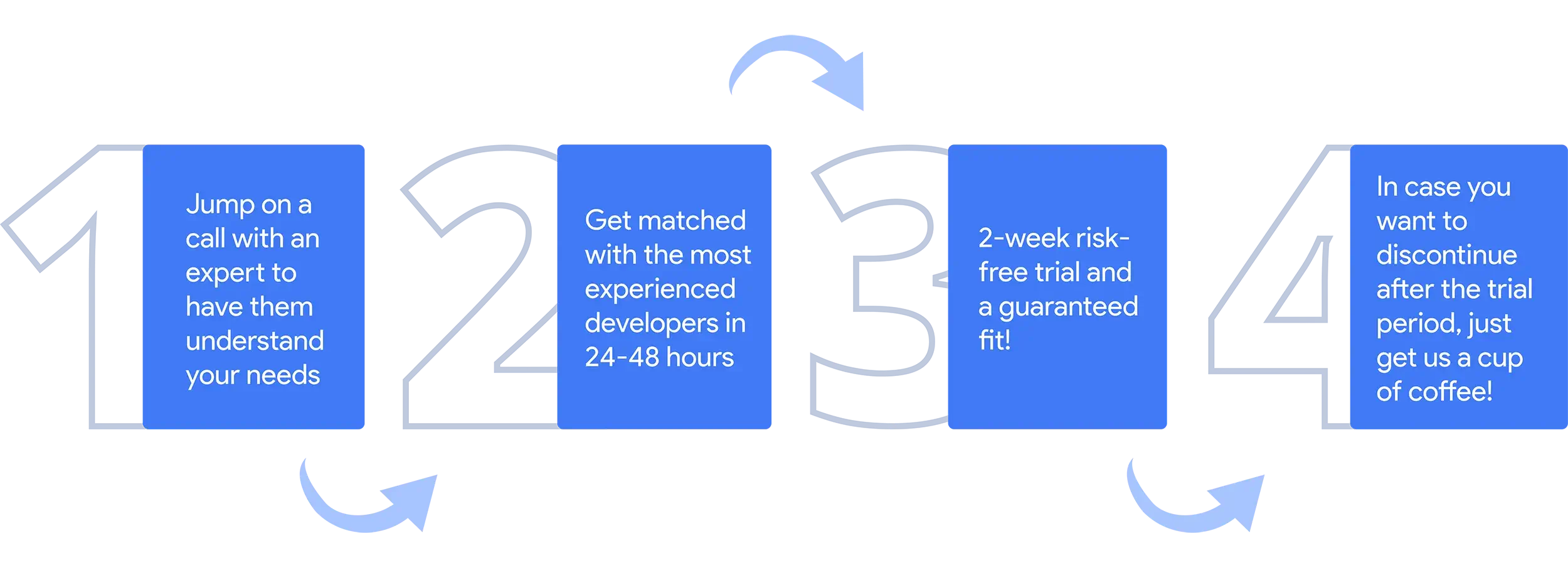
Our hiring process is simple. Ever walked into your favorite coffee shop and felt completely relaxed knowing your barista’s got your back? That’s the experience we want to replicate when you come to us for hiring engineers.
We take time to ensure your exact needs are understood, and only the most suitable NGINX programmers are hired by our clients.
If you do not feel like the “match” was suitable, we will simply match you with another.

We exist to unlock human potential at scale. We envision a world where the most talented people can build a career commensurate with their ability – not their race, gender, or geography.
Our Engineers
have worked for
Our Engineers
have worked for

Browse through hundreds of profiles and find your dream match

Experience
Hourly Rates

Experience
Hourly Rates

Experience
Hourly Rates

Experience
Hourly Rates








Written by Mustafa Najoom
CEO at Gaper.io | Former CPA turned B2B growth specialist
View LinkedIn ProfileTL;DR: Finding Expert Nginx Developers Requires Strategic Evaluation
Table of Contents
8,200+ Engineers | Top 1% Talent | 24-Hour Assembly | Starting $35/hr
Need Nginx expertise on short notice?
Gaper assembles vetted Nginx infrastructure engineers in 24 hours. 8,200+ top 1% specialists ready to optimize your infrastructure starting at $35/hr. No long-term commitment.
Get a Free AI AssessmentNginx has evolved from a niche alternative to Apache into the dominant web server powering over 35% of all websites globally and the overwhelming majority of high-traffic properties. Yet hiring developers with production-grade Nginx expertise remains surprisingly difficult. Most engineers have surface-level familiarity with Nginx configuration, but deep knowledge of performance tuning, load balancing, security hardening, and debugging complex infrastructure issues separates competent engineers from those delivering real value.
Nginx's explosive growth created a unique labor market dynamic. Most engineers learning web technologies today encounter Nginx through containerized environments (Docker) or cloud platforms (AWS, GCP, Azure), but rarely dive deep into its internals. This creates a supply-demand imbalance where basic familiarity is common but expert-level knowledge is scarce.
Market Insight: Supply-Demand Imbalance
According to W3Techs 2025 analysis, Nginx powers 35-40% of all websites with known server technology, yet infrastructure specialization attracts fewer practitioners than full-stack development, explaining both the premium compensation and difficulty in hiring.
Nginx expertise spans multiple levels, each with distinct capabilities and value. Understanding these levels helps you recruit at the right seniority and avoid overpaying for basic skills or underpaying for advanced expertise.
This level represents perhaps 60-70% of engineers claiming Nginx experience. It includes installing Nginx from package managers, basic configuration of virtual hosts and server blocks, proxy pass routing to upstream applications, static file serving, and basic SSL/TLS setup. This level is sufficient for straightforward deployments but inadequate for optimizing complex systems or debugging performance issues. Most engineers acquire this through tutorials rather than deep study.
Intermediate engineers can handle upstream load balancing configuration, connection pooling and keepalive optimization, caching strategies, rewrite rules and URL routing logic, basic performance optimization including worker process tuning, HTTP/2 and gzip compression configuration, and access control with IP whitelisting and authentication. They can optimize moderately complex deployments and handle most operational requirements, representing a real upgrade from basic knowledge and capable of improving application performance measurably.
Advanced engineers possess deep understanding of Nginx architecture (master process, worker processes, event loops), custom module development and compilation, advanced load balancing strategies (consistent hashing, sticky sessions), session persistence and distributed session management, complex traffic routing based on headers and request patterns, performance bottleneck identification and kernel-level tuning, Nginx module ecosystem mastery (ngx_lua, ngx_perl), metrics collection and observability integration, rate limiting and DDoS mitigation strategies, advanced caching invalidation, and comprehensive Nginx troubleshooting through logs, metrics, and system profiling.
Expert engineers combine advanced technical knowledge with Nginx contributions to open source or internal forks, strategic understanding of infrastructure architecture, mentorship of other engineers in Nginx practices, ability to predict performance bottlenecks in production systems, implementation of novel architectural patterns, deep knowledge of Nginx evolution and roadmap, and understanding of lower-level networking affecting Nginx behavior. Expert engineers are extremely rare, commanding premium salaries of $200k-$350k+ and creating specialized infrastructure architecture roles in their organizations.
Finding Nginx specialists requires understanding where they congregate and what channels surface the most qualified candidates. Top-tier Nginx engineers don't actively job search; they're discovered through targeted recruitment and specialized platforms.
Nginx's open-source project attracts expert practitioners. Contributors on the Nginx GitHub repository, maintainers of popular Nginx modules (openresty, ngx-modules), and active participants in community forums often represent top-tier talent. Look for engineers who contribute to Nginx core, maintain popular modules, answer Stack Overflow questions with deep knowledge, write technical deep-dives about Nginx internals, and speak at infrastructure conferences (USENIX, KubeCon, AWS re:Invent).
Developers who've worked at companies running massive Nginx deployments developed practical expertise. These include large cloud providers (AWS, Google Cloud, Azure) with extensive infrastructure teams, CDN operators (Cloudflare, Akamai, Fastly), high-traffic technology companies (Netflix, Uber, Airbnb), and platforms with serious API infrastructure (Stripe, Twilio). Candidates from these backgrounds bring proven, battle-tested expertise and deep production experience.
Gaper's network of 8,200+ vetted engineers includes infrastructure specialists and DevOps engineers with deep Nginx expertise. Unlike generic job boards, Gaper pre-vets technical capability, enabling rapid hiring. James, Gaper's HR recruiting agent, automates technical screening for infrastructure roles, reducing hiring timelines from weeks to 24 hours while ensuring quality. For companies needing Nginx specialists on short notice, this efficiency matters significantly.
James HR Recruiting Agent
Gaper's James agent automates technical pre-screening for infrastructure roles, enabling rapid assembly of qualified Nginx teams in 24 hours without the typical 6-12 week hiring timeline.
Evaluating Nginx expertise requires going beyond resume screening and generic interview questions to assess real-world problem-solving capability. The following strategies reveal true technical depth.
Ask candidates about production Nginx configurations they've built: What scale did the system handle (requests per second, concurrent connections)? What was the primary performance bottleneck you encountered? What Nginx configuration changes did you implement to optimize? How did you measure the impact of your optimizations? What unexpected challenges emerged during optimization? Strong candidates remember specific numbers, bottlenecks, and learning moments. Weak candidates speak generically without concrete details or struggle to articulate specific optimizations.
Provide a moderately complex Nginx configuration with room for optimization. Ask candidates to explain what the configuration does, identify performance issues or suboptimal settings, propose improvements with reasoning, and discuss trade-offs. A well-constructed test case might include upstream configuration with suboptimal load-balancing strategy, excessive buffer sizes causing memory waste, missing connection pooling or keepalive settings, cache configuration without proper cache busting, and inefficiently verbose logging. Strong candidates identify multiple issues and explain trade-offs (more aggressive caching improves performance but complicates invalidation).
Present a realistic scenario: "Design the Nginx layer for a system handling 100k requests per second with 50ms p99 latency targets. Requests are 80% reads to read-heavy data and 20% writes. Some requests need session stickiness; others can be distributed randomly. You have 10 servers. Walk me through your architecture." Listen for separation of read and write traffic, load balancing strategy selection with reasoning, caching strategy decisions, session management approaches, metrics collection and observability design, handling of failover scenarios, and security considerations like rate limiting. Advanced engineers naturally discuss trade-offs; intermediate engineers suggest reasonable approaches without deep trade-off analysis.
Present a realistic problem: "Production Nginx is handling requests but p99 latency has degraded from 10ms to 300ms. CPU is at 40%, memory at 30%, network utilization at 25%. Access logs show all upstream servers are responding normally. How would you diagnose this?" Strong candidates walk through systematic diagnosis: Check if latency degradation is in Nginx or upstream applications, examine Nginx logs and metrics (active connections, queue lengths), profile CPU usage (context switches, worker count), check for recent configuration changes, monitor per-upstream latency, examine kernel network stack metrics, and check for increasing request or response sizes affecting buffer efficiency. Weak candidates suggest generic solutions ("add more servers," "increase buffer sizes") without diagnosis.
| Evaluation Method | What It Reveals | Good Signal |
|---|---|---|
| Portfolio Review | Production experience, scale handled, learning from failures | Specific numbers, documented optimizations, measurable results |
| Configuration Review | Technical depth, optimization thinking, trade-off understanding | Identifies 3+ issues, explains reasoning, discusses trade-offs |
| Architecture Design | Systems thinking, scaling knowledge, holistic approach | Considers multiple concerns, discusses alternatives, addresses observability |
| Troubleshooting | Diagnostic methodology, systems knowledge, debugging skill | Systematic approach, uses appropriate tools, eliminates hypotheses |
Ready to hire Nginx expertise?
James agent pre-screens infrastructure engineers in minutes, compressing typical 8-12 week hiring timelines into 24 hours of team assembly.
Hire Engineers NowBeyond theoretical discussions, assessing how candidates handle real production problems reveals their true capability and systems thinking approach. These evaluation methods predict on-the-job performance better than standard interviews.
Give candidates access to a sample application and ask them to optimize Nginx for handling high load. Provide the application code or description, a test harness they can run locally, and a target performance level (e.g., "sustain 10,000 req/s with less than 50ms p95 latency"). Watch them work through running initial tests and establishing baselines, identifying bottlenecks through metrics and logs, proposing Nginx configuration changes, testing changes and measuring impact, and iterating toward the goal. This exercise reveals problem-solving methodology, comfort with profiling tools, and persistence in optimization work.
Describe a production incident: "At 3 AM, customer monitoring alerts show 50% of requests timing out. The application servers are responding normally. Nginx error logs show 'too many open files' errors. Customers are losing money. What do you do first?" Strong candidates immediately recognize the file descriptor limit issue, know how to quickly increase it, understand the root cause (possible connection leak), know diagnostic approaches to identify the leak source, and discuss prevention strategies. This tests both technical knowledge and incident response methodology essential for production systems.
Ask about a major optimization they've implemented: What was the baseline performance? What was the optimization goal? What did you try that didn't work? What unexpected challenges emerged? What did you learn? Real experience produces concrete answers and learning narratives. Generic experience produces vague responses. This reveals whether candidates have deep practical experience or surface-level knowledge.
Nginx expertise commands premium compensation reflecting both specialization and scarcity. Understanding market rates ensures you compete effectively for top talent while avoiding overpaying for mid-level skills.
| Role | Experience | San Francisco | US Hubs | Europe |
|---|---|---|---|---|
| DevOps Engineer (Nginx) | Mid (2-5 yrs) | $140k-$200k | $110k-$170k | $70k-$120k |
| Infrastructure Engineer | Senior (5+ yrs) | $180k-$280k | $140k-$220k | $100k-$160k |
| Site Reliability Engineer | Senior (5+ yrs) | $190k-$300k | $150k-$240k | $110k-$180k |
| Principal Infrastructure | Expert (8+ yrs) | $280k-$400k+ | $220k-$350k | $160k-$260k |
Hiring one strong Nginx engineer matters; building sustainable infrastructure teams requires systematic thinking about hiring, architecture, and knowledge sharing. Organizational structure and knowledge retention determine whether you build long-term competitive advantage or experience expertise silos.
Effective infrastructure teams aren't purely Nginx specialists. A sustainable team composition might include 1-2 senior infrastructure engineers with deep Nginx and broader systems knowledge, 2-3 mid-level DevOps or infrastructure engineers with solid Nginx and cloud platform knowledge, and 1-2 junior engineers or SRE rotations learning infrastructure. This mix balances expertise with learning opportunities and cost efficiency while maintaining knowledge continuity.
Infrastructure expertise concentrates heavily in individuals. Systematic knowledge capture prevents expertise loss. Document architecture decisions in RFCs or design documents, maintain runbooks for common operational tasks, record post-mortems for significant incidents with root cause analysis, share learnings through internal talks or blog posts, and pair senior engineers with mid-level engineers on complex problems. Organizations losing Nginx engineers often lose months of hard-won knowledge; intentional documentation mitigates this risk significantly.
Infrastructure rapidly evolves (Kubernetes, service mesh, observability). Strong teams allocate time for engineers to learn new tools (10-20% of time), budget for conferences (KubeCon, USENIX LISA, SREcon) where infrastructure professionals gather, support internal project time to experiment with new technologies, and create rotation opportunities (6-12 months working on different infrastructure problems). Engineers who stop learning become stale; organizations investing in continuous learning retain talent better and maintain competitive technical advantage.
Gaper.io Platform for Infrastructure Teams
Gaper helps companies build well-rounded infrastructure teams. Beyond Nginx specialists, Gaper has access to DevOps engineers, SREs, Kubernetes specialists, and security-focused infrastructure engineers with James agent automating technical assessment for rapid team assembly.
Gaper.io in one paragraph
AI Workforce Platform
Gaper.io is a platform that provides AI agents for business operations and access to 8,200+ top 1% vetted engineers. Founded in 2019 and backed by Harvard and Stanford alumni, Gaper offers four named AI agents (Kelly for healthcare scheduling, AccountsGPT for accounting, James for HR recruiting, Stefan for marketing operations) plus on demand engineering teams that assemble in 24 hours starting at $35 per hour.
Building infrastructure with Nginx requires deep expertise in performance optimization, load balancing, and troubleshooting at scale. Gaper's infrastructure engineers specialize in Nginx-heavy systems and have built production infrastructure for startups to Fortune 500 companies. Rather than hiring full-time engineers or waiting weeks for freelancers, Gaper's teams start in 24 hours and are productive immediately.
8,200+
Vetted Engineers
Top 1%
Vetting Standard
24hrs
Team Assembly
$35/hr
Starting Rate
Free assessment. No commitment. Let James agent find your Nginx team.
Nginx uses event-driven architecture handling thousands of connections with few processes; Apache traditionally spawned a process per connection, limiting scalability. Nginx has dominated new deployments since 2015 and requires fundamentally different expertise. When hiring, look for Nginx-specific engineers rather than Apache-experienced ones transitioning to Nginx.
This depends on scale. At modest scale (less than 10k RPS), backend engineers with Nginx knowledge suffice. At large scale (100k+ RPS), specialized infrastructure engineers are essential. They understand performance optimization, kernel tuning, and troubleshooting that generalists miss. For hiring, clarify your scale requirements before recruiting.
Managed load balancers provide simplicity and reduced operational burden; Nginx provides flexibility and cost control at scale. Many companies use both: managed load balancers for entry point, Nginx for application-layer routing and optimization. The choice depends on complexity, scale, and operational preferences. Consider hybrid approaches rather than all-or-nothing decisions.
Typical projects achieve 20-50% latency reduction and 30-60% throughput improvement through configuration optimization without code changes. Gains vary enormously depending on initial configuration efficiency. Poorly configured Nginx improves dramatically; well-tuned systems see smaller gains. Hire engineers experienced with optimization to maximize returns.
Essential tools include ab and wrk for load testing, nginx-module-vts for metrics collection, prometheus for metric aggregation, Grafana for visualization, strace for system-level debugging, tcpdump for network analysis, and flame graphs for CPU profiling. Strong engineers are fluent with these tools and understand why each matters. Include tool proficiency in hiring assessment.
Junior engineers can develop Nginx expertise through intentional study and projects, but deep expertise requires 3-5 years of practical experience at scale. Most Nginx experts learned through solving real production problems. Junior engineers accelerate learning by studying hard, seeking mentorship from experienced practitioners, and pursuing roles with infrastructure responsibility. Consider hiring junior engineers for growth potential alongside experienced staff.
Assemble Your Nginx Team
Skip 8-12 weeks of hiring. Start in 24 hours.
Gaper assembles vetted infrastructure engineers with deep Nginx expertise that start immediately and optimize production systems from day one.
8,200+ top 1% infrastructure engineers. 24 hour team assembly. Starting $35/hr. No long-term commitment. James agent pre-screens for Nginx expertise in 2026.
Get a Free AI Assessment14 verified Clutch reviews. Harvard and Stanford alumni backing. No commitment required.
Our engineers work with teams at
Rates starting from $50-$80 per hour.