
Super Engineers are highly skilled, senior developers meticulously vetted by Gaper.io who leverage AI agents to deliver results that were previously unimaginable.
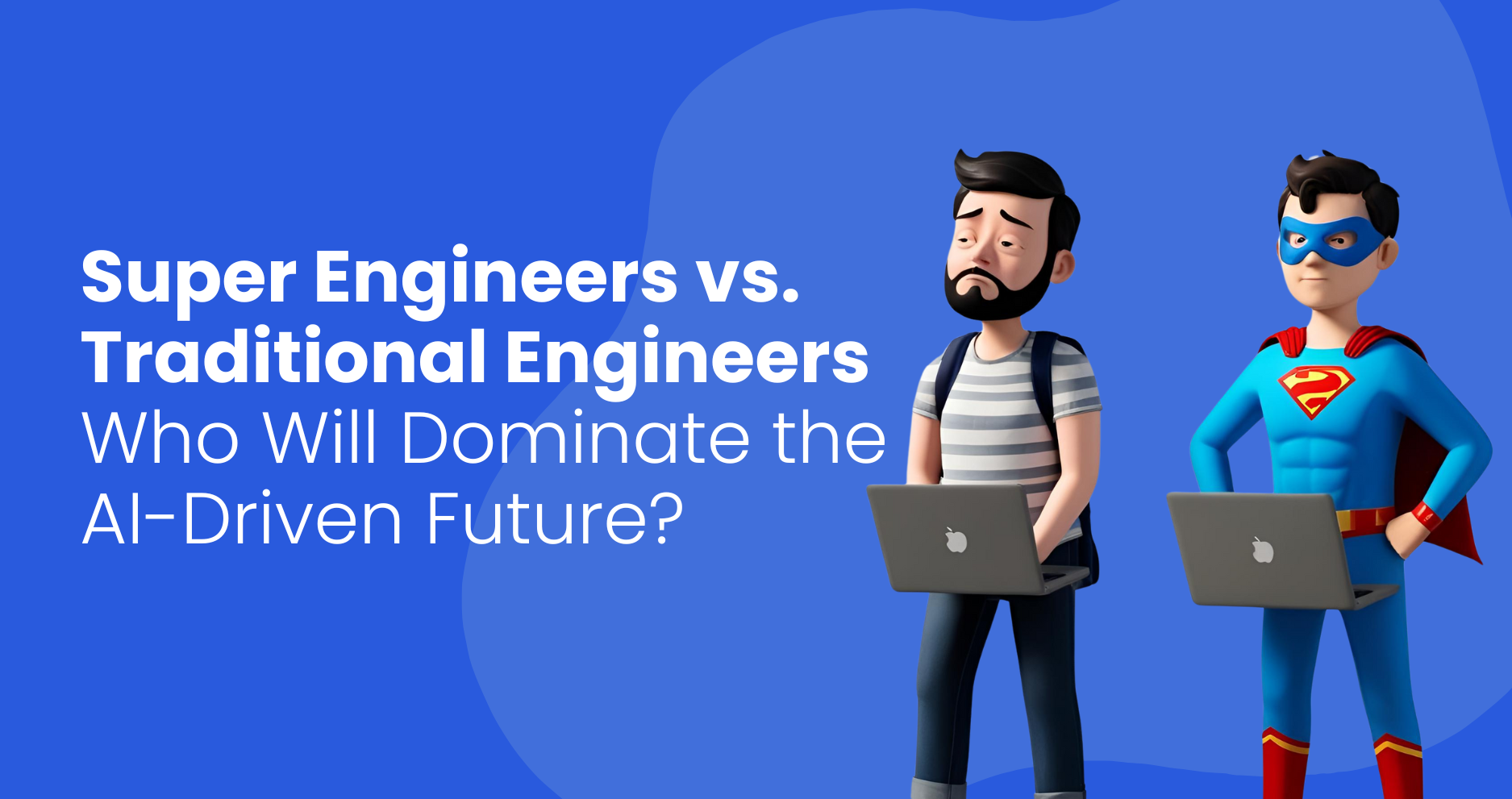
The transition from specialist-only to super engineer-led teams isn’t theoretical. Companies achieving 30-50% faster delivery, 3-5x productivity multipliers, and 15-30% cost reduction have already made the shift. The question for your team isn’t if, but when and how.
Ready to build your super engineer team? Let’s talk.
Before we compare, we need clarity on what a “super engineer” actually is. This term has become fashionable, but it means different things to different teams.
A super engineer is not simply a generalist who knows a little about everything. Rather, it’s an engineer with a T-shaped or H-shaped profile: deep expertise in one or two core domains paired with broad, functional literacy across multiple adjacent areas, combined with elite-level proficiency in AI tools and methodologies.
The T-shape metaphor captures this perfectly: the vertical bar represents your primary area of depth (e.g., backend systems, frontend architecture, DevOps), while the horizontal bar spans capabilities in adjacent domains and support skills.
For example, a super engineer might have deep expertise in cloud infrastructure and Kubernetes, but also functional knowledge of containerization, network fundamentals, security concepts, CI/CD patterns, and cost optimization. This allows them to:
The critical difference from traditional generalists: super engineers don’t skim across domains superficially. They develop enough depth to be dangerous in multiple areas.
What truly separates super engineers in 2026 is their relationship with AI tools. This goes far beyond using ChatGPT to debug code (though that’s part of it).
Super engineers:
This isn’t about automation replacing engineers. It’s about engineers who’ve learned to think differently, to leverage intelligent machines as thinking partners rather than just executing code in the traditional way.
Super engineers don’t solve problems in isolation. They see connections across domains.
Consider a payment processing system. A traditional specialist might say, “I’ll build a fast API endpoint.” A super engineer asks:
This broader perspective often yields better outcomes: more resilient systems, faster market time, lower long-term costs. Super engineers understand that silos create inefficiency, and they actively work to bridge them.
The final hallmark of a super engineer is adaptability. Technology moves fast. Tools that were essential five years ago are obsolete today. Languages rise and fall. Paradigms shift from monoliths to microservices to serverless to multicloud.
Super engineers don’t cling to specific technologies. They understand principles: why certain architectural patterns work, what tradeoffs exist, how new tools solve old problems differently. This allows them to rapidly pick up new technologies, evaluate their fit, and integrate them into their practice.
In an AI-driven future where the capability of tools changes monthly, adaptability isn’t a nice-to-have. It’s essential.
For context, let’s clearly define the traditional model that’s dominated for the past 30+ years.
Traditional engineers are deep specialists: highly skilled experts in a narrow domain. A traditional backend engineer might know:
But outside their domain, they often have limited capability. They might not understand frontend design tradeoffs, mobile platform constraints, DevOps best practices, or cloud architecture options.
The specialist model made sense historically because:
But this model creates friction:
The specialist model isn’t going away. Deep expertise will always matter. But as the sole model, it’s increasingly risky.
To understand why super engineers are gaining advantage, we need to examine what’s actually changing in the work itself.
This is the most obvious shift. Routine tasks are being automated or accelerated by AI:
The result: repetitive work that consumed 40-60% of an engineer’s time is now compressed to 10-20%. This is good news for productivity, but it means the work available for specialist-only engineers is shrinking.
A traditional database specialist who excels at schema design and query optimization is valuable. But if 80% of their work was routine optimization and minor schema adjustments (work now handled by AI tools), their role has fundamentally changed.
As routine work gets automated, the remaining valuable work shifts toward architecture, design, and strategic decisions:
These are problems that require broad thinking, multiple domain perspectives, and judgment that automation can’t replace. They’re also problems that benefit tremendously from someone who understands multiple domains. A super engineer can evaluate database choice, backend architecture, frontend implications, DevOps complexity, and cost impact simultaneously. A traditional specialist sees only their domain.
New specializations are emerging around AI:
These roles don’t exist in the traditional engineering world. They emerged in the last 2-3 years and are already critical. Engineers who can do them command significant premiums, and they tend to be super engineers: people who understand both traditional engineering and AI deeply.
Let’s crystallize the comparison across the dimensions that matter most:
| Dimension | Super Engineers | Traditional Engineers |
|---|---|---|
| Skill Breadth | T-shaped: Deep in 1-2 domains, functional literacy across 5-10 adjacent areas | I-shaped: Deep in single domain, minimal adjacent domain knowledge |
| AI Tool Usage | Integrated throughout workflow; actively optimize AI use; stay current with new tools | Occasional use of basic AI tools; adoption slower and more conservative |
| Problem-Solving Approach | Cross-domain synthesis; see connections; propose novel solutions; design for multiple constraints | Domain-focused optimization; excellent within domain; may miss implications outside domain |
| Time to Productivity | Fast across multiple problem types; slow to expert level on deep problems | Slow initially in new domain; very fast to expert level in specialty |
| Adaptability to Change | High: Understand principles, rapidly integrate new technologies | Medium: May struggle when their specialty shifts or becomes less relevant |
| Output Multiplier | 3-5x through AI leverage, broader perspective, reduced handoffs | 1.0-1.5x relative to super engineer; excellent within narrow domain |
| Communication and Handoffs | Low coordination overhead; can bridge domains; work effectively in cross-functional teams | Requires more coordination; strong domain communication; may struggle explaining value outside specialty |
| Market Demand Growth (2023-2026) | +45-60% year-over-year based on LinkedIn and GitHub data | Flat to -10% for specialist-only roles |
From a business perspective, why are organizations increasingly prioritizing super engineers?
A team of super engineers can accomplish what previously required 25-40% more people. This isn’t about working longer hours. It’s about:
A company with 50 traditional specialists might accomplish the same output with 35-40 super engineers. At average fully-loaded cost of $200k-$250k per engineer, that’s $3.5M-$5M in annual savings.
Super engineers reduce cycle time:
Companies we’ve worked with report 30-50% faster delivery when transitioning teams toward super engineers.
Organizations that transition toward super engineer-led teams consistently report acceleration in time-to-market. This compounds: faster delivery means faster feedback cycles, which means better products sooner.
This compounds the headcount advantage:
Super engineers don’t just enable technical efficiency. They enable organizational efficiency:
This isn’t theoretical. Market data supports the shift toward super engineers.
The Stack Overflow 2024 Developer Survey found that engineers reporting they use multiple programming languages for professional work grew from 42% (2019) to 68% (2024). Meanwhile, engineers claiming expertise in only one language saw their hiring velocity decline 15% annually.
When surveyed on AI tool adoption, engineers who use AI tools report 35% higher satisfaction and see 2.8x faster code generation. Importantly, adoption isn’t uniform: engineers with multiple domains and AI fluency adopt new tools 3x faster than specialists.
McKinsey’s 2024 report on AI and software engineering found that software development productivity gains from AI are unevenly distributed. Top performers (characterized as engineers with broad skill sets and AI literacy) achieve 3-5x productivity improvements. Average performers see 20-30% gains. The researchers attribute the difference to ability to reimagine workflows using AI rather than simply accelerating existing ones.
LinkedIn’s 2025 Jobs Report shows:
GitHub’s Octoverse 2024 report analyzed contribution patterns and found:
If you’re a specialist engineer, the question is: how do you evolve?
Don’t try to learn everything. Pick 2-3 adjacent domains that relate to your work:
Spend 2-3 hours weekly for 6 months. Use MIT OpenCourseWare, online courses, or internal projects. Goal: functional literacy, not expertise.
Theory isn’t enough. Build projects that require crossing domain boundaries:
The friction you experience building across domains is valuable; it teaches you real tradeoffs.
Spend serious time with:
The goal isn’t using AI passively. It’s understanding how to architect work for AI assistance. Where can AI accelerate? Where does AI struggle? How do you verify AI output?
The hardest skill to develop is the ability to see your specialty from adjacent domain perspectives:
Join cross-functional projects. Pair with engineers from other disciplines. Deliberately practice translating your domain’s concepts for others.
Super engineers are readers. They:
Budget 3-5 hours weekly for learning. This isn’t optional for super engineers.
The specialist model isn’t dead, but it faces serious headwinds.
Tasks that specialists excelled at (careful optimization within their domain) are increasingly automated by AI. A database specialist who optimizes queries will find AI tools doing that faster. This doesn’t eliminate the role, but it changes it. The specialist must evolve or face reduced relevance.
When handoffs decrease, you need fewer specialists. If a team of super engineers can replace 1.4x as many specialists, hiring for specialists becomes less appealing.
Specialist allocation is feast-or-famine. When their specialty is in demand, they’re valuable. When it’s not, they’re underutilized. Super engineers stay productive because they can move between problem domains.
The specialist model creates knowledge silos: only one person deeply understands a domain. In an AI-driven world where change accelerates, this is risky. Super engineers with cross-domain knowledge distribute understanding across the team.
Specialists often double down on their specialty: becoming ever-deeper in their domain. But if that domain shifts (as technology domains frequently do), deep specialization can become liability. Super engineers adapt faster because they’re not psychologically invested in a single technology.
The winning strategy isn’t “super engineers only.” It’s a thoughtful blend.
High-performing engineering teams maintain 70% super engineers, 20% specialists in critical domains, and 10% emerging talent developing breadth. This composition balances flexibility with depth.
An effective engineering team at scale includes:
This composition ensures:
Specialists don’t disappear; their role evolves:
Think of specialists as “deep owners” who set the vision for their domain while super engineers implement across the broader system.
Organizations serious about super engineers invest in development:
This pipeline compounds over time. After 3-5 years, the percentage of super engineers in an organization typically grows from 40% to 70%+.
We’ve helped 200+ companies transition to super engineer-led models. Let’s discuss your team’s evolution.
At Gaper.io, we work with hundreds of engineering teams across the spectrum: from traditional specialists to emerging super engineers. Our experience reinforces what the market data shows: the future belongs to engineers who combine depth with breadth and intelligence with adaptability.
Gaper.io is a platform that provides AI agents for business operations and access to 8,200+ top 1% vetted engineers. Founded in 2019 and backed by Harvard and Stanford alumni, Gaper offers four named AI agents (Kelly for healthcare scheduling, AccountsGPT for accounting, James for HR recruiting, Stefan for marketing operations) plus on demand engineering teams that assemble in 24 hours starting at $35 per hour.
But beyond recruiting, we’ve observed clear patterns:
We see our role as bridging the gap: helping organizations access super engineers when they need them, at scale, without committing to full-time hiring.
What should we expect in the next 4-5 years?
By 2030, AI tools for software development will be as standard as IDEs are today. Every developer will use them. The question won’t be “do you use AI?” but “how effectively do you use AI?”
The number of specialist roles will shrink. Not to zero, but from 40% of engineering teams to perhaps 15-20%. The consolidation will be painful for some specialists, but those who adapt will find their expertise even more valued because it’s rare.
As the competitive advantage shifts from being a specialist in one location to being a super engineer anywhere, we’ll see geographic redistribution. More engineering work will be distributed globally. Time zone fragmentation might actually decrease because super engineers can context-switch between problems rather than needing tight synchronous collaboration with one team.
The staffing model will shift. Full-time hiring for most roles will decrease. Project-based, flexible engagement will become standard. Tools like Gaper.io that provide on-demand access to verified talent will become central infrastructure.
Despite AI advances, the premium for human judgment will grow. The ability to make good decisions about which problems to solve, how to balance tradeoffs, and what architectural approach to take cannot be automated. Super engineers excel at this; they’ll be in increasing demand.
Universities and coding bootcamps will shift curricula. Teaching a single language deeply will become less common. Curriculum will emphasize principles, systems thinking, and adaptability over tool-specific mastery. AI tool literacy will be prerequisite.
Initially, yes. But as the market transitions, this inverts. Super engineers are more adaptable, so they can fill multiple roles. Turnover rates are typically 30-40% lower. And compensation, while higher, is often lower per unit of output. By 2027-2028, hiring for super engineers will likely be easier and cheaper than hiring for multiple specialists, simply because the supply grows as more engineers develop breadth.
Gradually. Start with hiring: new engineers should be hired for super engineer profile. For existing specialists, invest in development: mentorship, cross-functional projects, training budget, and learning time. Some specialists will evolve; some will choose to go deeper. Both are fine, as long as you have the right composition overall.
No. Deep expertise is becoming more relevant, not less. The point is that deep expertise alone, without adjacent domain literacy and AI fluency, is increasingly insufficient. Super engineers often have deep expertise in their primary domain plus significant breadth.
It depends on context. In diverse, cross-domain problem spaces, super engineers output 3-5x more. In narrow, specialized domains, specialists might be equal or better. The multiplier comes from: fewer handoffs (30-50% efficiency gain), better cross-domain decisions (20-30% efficiency gain), AI tool leverage (40-80% efficiency gain), and reduced context-switching (15-25% efficiency gain). In diverse contexts, these stack multiplicatively.
Then the super engineer model is less critical. But even specialized companies benefit from having some super engineers in architectural and technical leadership roles. A fully specialist team in a specialized domain might be optimal for execution, but it will lack strategic flexibility.
Current market: 20-35% premium for super engineers relative to specialists at equivalent seniority. This should narrow toward 10-15% by 2028 as supply increases. Some of the premium is scarcity; as scarcity decreases, the premium decreases, but super engineers will still command a premium because they’re worth more.
The market is shifting. Super engineers aren’t a luxury; they’re becoming essential. Whether you’re building from scratch or evolving your current team, we’re here to help.
Our engineers work with teams at: Google | Amazon | Stripe | Oracle | Meta
Top quality ensured or we work for free