


Browse our database of 8500+ engineers and hire top developers in San Francisco, California through Gaper’s intelligent matchmaking platform. 24 hours is all you need!

Companies with
whom we work with
Companies with whom
we work with

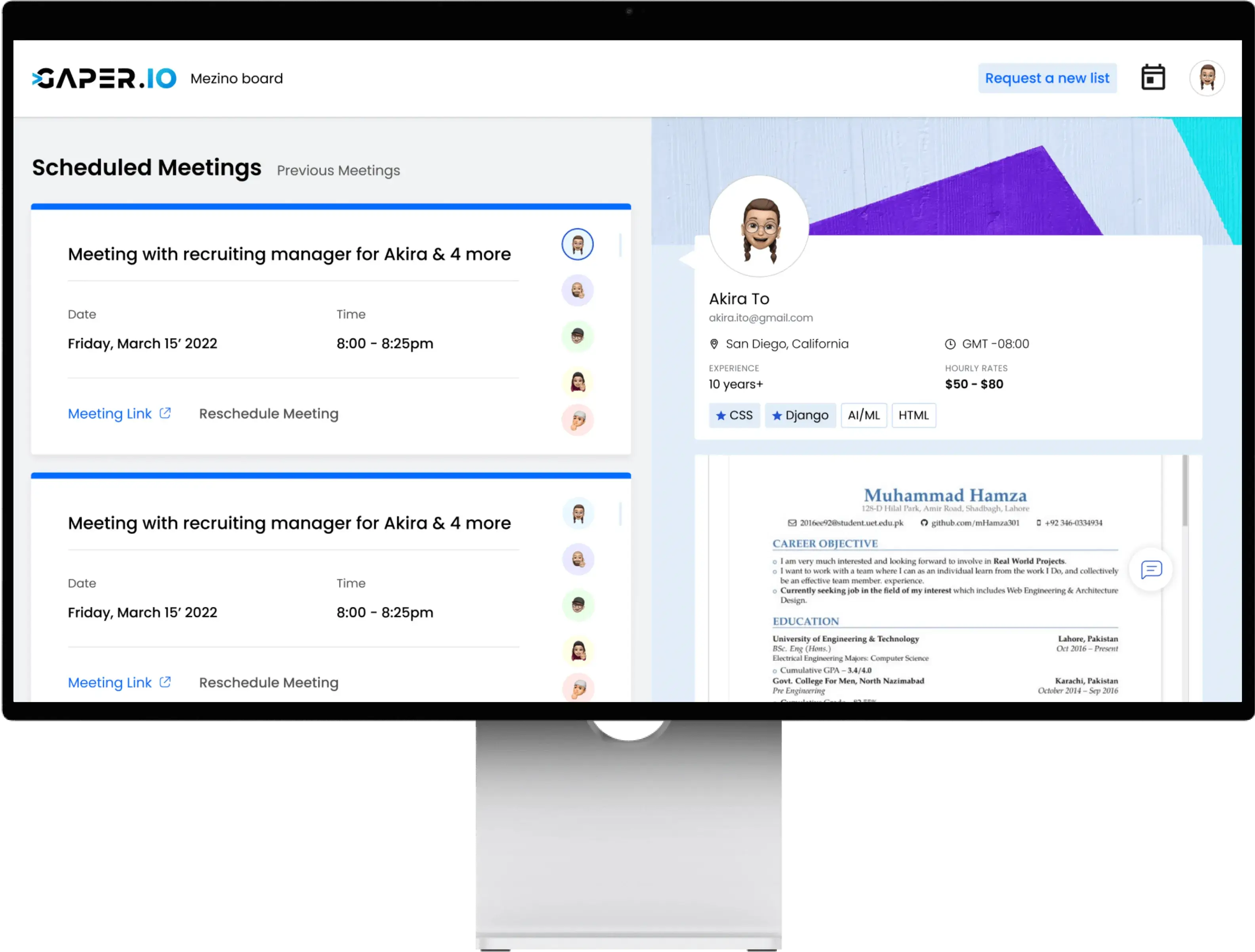
Tell us about your project, tech stack, and team size. Takes under 5 minutes.
➔Within 24 hours, get a curated shortlist of pre-vetted San Francisco-ready engineers.
➔Onboard your team and begin development. No long-term contracts required.
| Factor | Local San Francisco Hire | Gaper |
|---|---|---|
| Average Hourly Rate | $85 - $150/hr | $35 - $65/hr |
| Time to Hire | 4 - 8 weeks | 24 hours |
| Vetting Process | Internal interviews | Pre-vetted + AI-matched |
| Contract Flexibility | Full-time commitment | Flexible (weekly/monthly) |
| Scaling Speed | Weeks per developer | Add devs in 48 hours |
| Estimated Annual Savings | Baseline | Save 60-70% on dev costs |
AI/ML companies in San Francisco require developers with deep understanding of industry-specific compliance requirements, data security standards, and domain workflows. Gaper's vetting process includes industry-specific technical assessments to ensure every engineer meets these specialized demands.
San Francisco continues to reign as the world's premier destination for software development talent, despite the rise of remote work and distributed teams. The city's unique ecosystem combines world-class educational institutions, venture capital access, and a concentration of Fortune 500 tech companies that creates an unparalleled environment for software innovation. However, the traditional approach to hiring in this competitive market often comes with significant challenges that modern businesses must navigate strategically.
The San Francisco Bay Area hosts over 387,000 software developers, representing nearly 10% of all developers in the United States. This concentration includes graduates from Stanford, UC Berkeley, and other top-tier institutions, as well as seasoned professionals from companies like Google, Meta, Apple, and hundreds of successful startups. What makes this talent pool particularly valuable is not just the technical expertise, but the entrepreneurial mindset and exposure to cutting-edge technologies that define the Silicon Valley culture.
For businesses looking to tap into this talent, the traditional hiring process presents significant obstacles. Local salaries for senior software developers often exceed $200,000 annually, with total compensation packages reaching $300,000 or more when including equity and benefits. The competition is fierce, with average hiring cycles stretching 3-4 months and offer acceptance rates below 60% due to multiple competing offers. This creates a perfect storm of high costs, extended timelines, and uncertain outcomes that can derail critical projects.
Gaper.io transforms this dynamic by providing access to the same caliber of talent that defines San Francisco's reputation, but through a more efficient and cost-effective model. Our platform connects businesses with top 1% vetted engineers who possess the same quality standards as local San Francisco developers, but at rates starting from $35/hour – a fraction of traditional local hiring costs. These developers have worked with Fortune 500 companies and bring the same innovative thinking and technical excellence that makes San Francisco talent so sought-after, without the geographical constraints and premium pricing of the local market.
Understanding the complete financial impact of hiring software developers in San Francisco requires looking beyond base salaries to encompass the full spectrum of direct and indirect costs. While headline figures often focus on the $150,000-$250,000 salary ranges for experienced developers, the reality includes equity compensation, benefits, office space, recruiting fees, and opportunity costs that can double the actual investment required for each hire.
Direct costs begin with recruiting, where specialized technical recruiters charge 20-25% of first-year salary, translating to $40,000-$60,000 per successful hire. The hiring process itself consumes significant internal resources, with engineering managers and senior developers spending 15-20 hours per candidate on interviews, technical assessments, and decision-making processes. When factoring in the 3-4 month average hiring timeline, companies often face project delays that can cost hundreds of thousands in missed market opportunities or delayed product launches.
Beyond recruitment, operational costs in San Francisco add substantial overhead. Office space averages $80-$120 per square foot annually, translating to $12,000-$18,000 per developer workspace. Benefits packages typically add 30-40% to base compensation, including health insurance, retirement contributions, and the equity grants that have become standard in competitive offers. Equipment, software licenses, and onboarding costs contribute another $10,000-$15,000 per developer in the first year.
The hidden costs often prove most significant: the risk of mis-hires, cultural fit issues, and the high turnover rates that characterize the San Francisco tech scene. Average tenure for software developers has dropped to 1.5-2 years, meaning companies face continuous recruiting cycles and knowledge transfer challenges. When a developer leaves, the replacement cost includes lost productivity, project delays, and the full recruiting cycle investment repeated.
Gaper.io's model eliminates most of these cost factors while maintaining quality standards. Our vetted network of 8,200+ engineers means no recruiting fees, no office space requirements, no benefits overhead, and significantly reduced hiring timelines. Companies can deploy complete development teams within 24 hours, transforming months-long hiring processes into immediate productivity. With rates starting at $35/hour, businesses can access the same quality of talent that commands $150+/hour through traditional San Francisco channels, while redirecting saved resources toward product development and market expansion rather than administrative overhead.
Access pre-vetted engineers with local industry expertise - deployed in 24 hours.
Get Matched with Top DevelopersThe evolution of business operations in San Francisco's fast-paced environment demands more than just exceptional software development talent – it requires intelligent automation that can handle routine tasks while human engineers focus on innovation and complex problem-solving. This shift toward AI-augmented workflows has become essential for companies seeking competitive advantages in hiring efficiency, operational scaling, and resource optimization.
Modern development teams spend considerable time on non-coding activities: scheduling meetings, managing project communications, handling administrative tasks, and coordinating with various departments. These activities, while necessary, can consume 30-40% of a developer's productive time, effectively reducing the ROI of expensive San Francisco talent. Smart organizations are now implementing AI agents to handle these routine processes, allowing their technical teams to focus entirely on high-value development work.
The integration of AI agents becomes particularly powerful when supporting distributed or hybrid teams. As San Francisco companies increasingly adopt flexible work models, the coordination challenges multiply. AI agents can manage scheduling across time zones, automate status reporting, handle initial candidate screening for team expansion, and manage the complex logistics of project coordination. This becomes especially valuable when working with external development partners or scaling teams rapidly.
Gaper.io's suite of AI agents specifically addresses the operational challenges that complement software development projects. Agent Kelly streamlines scheduling and coordination, particularly valuable for development teams managing client communications and project milestone meetings. Agent James handles the recruiting automation that supports team scaling, managing candidate pipeline activities while your existing team focuses on technical interviews and architectural decisions. AccountsGPT manages the financial tracking and reporting that accompanies development projects, from budget monitoring to invoicing coordination. Agent Stefan supports the marketing technology implementation that development teams increasingly support, bridging the gap between technical capabilities and market execution.
This AI-augmented approach allows companies to maximize the value of their development investments, whether working with local San Francisco talent or Gaper's distributed teams. By automating routine tasks and improving operational efficiency, businesses can achieve higher productivity per developer, faster project delivery, and more strategic resource allocation. The combination of world-class development talent and intelligent automation creates a competitive advantage that pure hiring approaches cannot match.
The pandemic accelerated a fundamental shift in how San Francisco companies approach team building, with many discovering that distributed teams can deliver exceptional results while offering significant operational advantages. This evolution has moved beyond emergency remote work to strategic distributed team architecture, where companies deliberately build global talent networks that combine the best aspects of San Francisco's innovation culture with worldwide expertise and cost efficiency.
Successful distributed teams require more than just hiring remote developers; they demand thoughtful architecture around communication protocols, project management systems, and cultural integration. San Francisco companies leading this transformation have developed specific frameworks for maintaining their innovation pace while leveraging global talent. These frameworks typically include overlapping work hours for real-time collaboration, robust documentation standards, and clear decision-making hierarchies that prevent the communication delays that can plague remote teams.
The technical infrastructure supporting distributed teams has matured significantly, with cloud-based development environments, collaborative coding platforms, and sophisticated project management tools enabling seamless coordination across time zones. Many San Francisco startups now report faster development cycles with distributed teams, citing reduced meeting overhead, deeper focus time, and access to specialized expertise that might not be available locally.
However, building effective distributed teams requires careful partner selection and management processes. The key factors include technical vetting that matches local San Francisco standards, cultural compatibility with fast-paced startup environments, and communication skills that enable effective collaboration across different working styles. Time zone coordination becomes crucial for maintaining development velocity, particularly for projects requiring frequent iterations and stakeholder feedback.
Gaper.io has refined the distributed team model specifically for companies seeking San Francisco-quality results without the associated costs and constraints. Our 24-hour team deployment capability means companies can scale development capacity immediately when market opportunities arise, rather than waiting months for local hiring cycles. The extensive vetting process ensures that remote team members can integrate seamlessly with existing workflows and maintain the high-performance standards expected in competitive markets. With Harvard and Stanford alumni in our network, the intellectual caliber matches what companies expect from local San Francisco talent, but with the operational flexibility and cost advantages that enable faster scaling and market responsiveness.
The three dominant team models each carry distinct advantages for San Francisco businesses: See how Gaper supports remote teams →
San Francisco's diverse business ecosystem spans multiple industries, each with distinct software development requirements that demand specialized expertise and compliance understanding. Healthcare practices need HIPAA-compliant applications with robust security protocols, while fintech startups require blockchain integration and regulatory compliance features. Legal firms demand document management systems with advanced search capabilities and client portal functionality. Understanding these industry-specific needs is crucial for successful development project outcomes.
The healthcare sector in San Francisco presents particularly complex development challenges, combining technical sophistication with strict regulatory requirements. Medical practices need electronic health record integrations, telemedicine platforms, patient scheduling systems, and billing automation that must comply with HIPAA, HITECH, and state-specific privacy regulations. The development talent must understand not only the technical architecture but also the clinical workflows and compliance frameworks that govern healthcare operations. This specialized knowledge typically commands premium rates in the local market, often $180-$220/hour for experienced healthcare software developers.
Financial services companies face similar complexity with SOX compliance, PCI-DSS requirements, and sophisticated fraud detection systems. The development work often involves real-time transaction processing, advanced analytics, and integration with legacy banking systems. Legal practices require document automation, case management systems, and client communication platforms that handle confidential information with appropriate security measures. Each industry demands developers who understand both the technical implementation and the business context that drives requirements.
Startups in San Francisco often need rapid prototyping capabilities that can evolve quickly based on market feedback. This requires developers comfortable with agile methodologies, modern frameworks, and scalable architecture patterns. The development approach must balance speed-to-market with technical debt management, ensuring that initial versions can scale as user bases grow. Many startups also need developers experienced with cloud infrastructure, API design, and mobile-first development approaches that support modern user expectations.
Gaper.io's vetted network includes specialists across all major industries represented in San Francisco's market. Our healthcare developers understand HIPAA compliance and clinical workflows, our fintech specialists have experience with regulatory requirements and fraud prevention systems, and our startup-focused developers excel at rapid prototyping and scalable architecture design. Agent Kelly specifically supports healthcare practices with scheduling optimization and patient communication automation, while AccountsGPT handles the complex financial reporting requirements that accompany development projects. This industry-specific expertise, combined with our cost-effective pricing model, allows companies to access specialized knowledge without the premium rates typically associated with niche technical skills in the San Francisco market.

Healthcare scheduling automation - ideal for San Francisco's AI/ML companies
Get Agent Kelly
Financial automation and reporting - built for San Francisco's fintech sector
Get AccountsGPT

Marketing ops and campaign automation for San Francisco's blockchain businesses
Get Agent StefanThe journey from startup to enterprise in San Francisco's competitive landscape demands sophisticated approaches to scaling development teams that can maintain code quality, cultural cohesion, and delivery velocity while growing from 5 to 50+ engineers. This scaling challenge has derailed many promising companies that successfully built initial products but struggled to systematically expand their technical capabilities in pace with market demands and funding milestones.
Early-stage startups typically begin with 2-4 full-stack developers who handle everything from frontend user interfaces to backend architecture and DevOps responsibilities. This generalist approach works well for MVP development and initial market validation, but becomes a bottleneck as feature complexity increases and user bases grow. The transition to specialized teams – separate frontend, backend, mobile, and infrastructure groups – requires careful planning around code architecture, API design, and inter-team communication protocols.
Mid-stage companies face the challenge of maintaining startup agility while implementing enterprise-grade processes. This includes code review standards, automated testing frameworks, deployment pipelines, and documentation requirements that ensure consistency across larger teams. The cultural challenge becomes significant: preserving the innovation mindset and rapid decision-making that enabled early success while adding the structure necessary for coordinated development across multiple product areas.
Enterprise-scale development organizations must master additional complexities around security compliance, performance optimization, and integration with existing business systems. The technical architecture must support multiple concurrent development streams, A/B testing frameworks, and gradual feature rollouts that minimize risk for established user bases. Team structures often include technical leads, project managers, and quality assurance specialists who ensure that increased team size translates to proportional productivity gains rather than coordination overhead.
The traditional scaling approach in San Francisco often involves lengthy recruiting cycles that can take 6-12 months to double team size, during which market opportunities may be missed and product development velocity decreases. Each new hire requires extensive onboarding, cultural integration, and ramp-up time that can extend to 3-4 months before full productivity is achieved. The cumulative effect often results in scaling timelines that lag behind business needs, particularly for companies experiencing rapid growth or pivoting to new market opportunities.
Gaper.io enables a fundamentally different scaling approach that matches team capacity to business needs in real-time. Companies can add specialized developers within 24 hours, whether they need frontend specialists for user interface improvements, backend developers for API scaling, or mobile developers for cross-platform applications. Our Fortune 500 track record includes supporting companies through multiple scaling phases, from initial team augmentation through enterprise-level development operations. The combination of immediate availability and proven quality standards allows companies to maintain development velocity during critical growth phases, ensuring that technical capabilities support rather than constrain business expansion.
San Francisco's software development landscape is rapidly evolving toward hybrid models that combine the best aspects of local collaboration, distributed team capabilities, and AI-augmented workflows. This transformation reflects broader changes in how companies approach innovation, with successful organizations building flexible architectures that can adapt to changing market conditions, talent availability, and technological capabilities while maintaining the high-performance standards that define competitive advantage.
The emerging hybrid model typically includes a core local team handling strategic architecture decisions, customer-facing activities, and cultural leadership, supplemented by distributed specialists who contribute deep expertise in specific technical areas. This approach allows companies to maintain the collaborative innovation culture that San Francisco is known for while accessing global talent pools and cost efficiencies. The key to success lies in designing workflows that maximize the strengths of each component rather than simply replacing local resources with remote alternatives.
AI integration is becoming central to this evolution, with intelligent systems handling routine development tasks, automated testing, code review assistance, and project coordination activities. Advanced AI tools can generate initial code implementations, identify potential security vulnerabilities, optimize database queries, and even suggest architectural improvements based on performance analytics. This allows human developers to focus on creative problem-solving, user experience design, and complex system integration challenges that require strategic thinking and domain expertise.
The most sophisticated organizations are implementing AI agents that bridge the gap between technical development and business operations. These systems can automatically update project stakeholders on development progress, manage deployment schedules, coordinate testing activities, and handle the administrative tasks that traditionally consumed significant developer time. The result is higher productivity per developer, faster project delivery timelines, and more strategic resource allocation toward innovation rather than process management.
Looking ahead, successful San Francisco companies will likely operate with smaller core teams supplemented by global specialist networks and AI automation systems. This model provides the agility to scale rapidly when opportunities arise, the cost efficiency to extend runway during challenging periods, and the technical capabilities to compete with larger organizations while maintaining startup speed and innovation culture. The companies that master this hybrid approach first will have significant competitive advantages in both talent acquisition and operational efficiency.
Gaper.io represents this future-focused approach today, combining access to top 1% global development talent with AI agents that handle operational coordination and business process automation. Our platform enables companies to implement hybrid models immediately rather than building these capabilities internally over months or years. Agent Kelly, Agent James, Agent Stefan, and AccountsGPT provide the AI infrastructure that supports distributed development teams, while our vetted engineer network delivers the technical expertise that maintains San Francisco quality standards. This combination allows companies to focus their energy on product innovation and market execution rather than team coordination and administrative overhead, positioning them for success in an increasingly competitive and fast-moving market environment.
Combine Gaper's AI agents with specialized human developers for your industry.
Start Your Free AI AssessmentThe traditional approach to building software development teams in San Francisco – lengthy recruiting cycles, premium pricing, and operational complexity – no longer matches the pace and efficiency demands of modern business. Companies that continue relying solely on local hiring face extended timelines, escalating costs, and limited scalability options that can constrain growth and competitive positioning. The solution lies in embracing hybrid models that combine world-class talent access with AI-powered operational efficiency.
Gaper.io offers immediate access to this transformative approach. Our platform provides everything needed to build and scale development teams without the traditional constraints: 8,200+ vetted engineers available within 24 hours, AI agents that handle coordination and administrative tasks, and proven quality standards backed by Fortune 500 client success stories and outstanding Clutch reviews. Whether you're a healthcare practice needing HIPAA-compliant applications, a startup requiring rapid scaling capabilities, or an enterprise organization seeking specialized expertise, our combination of human talent and AI automation delivers results that exceed traditional hiring approaches.
The competitive advantages are immediate and measurable: development costs starting at $35/hour instead of $150+/hour locally, team deployment in 24 hours rather than 3-4 months, and AI-powered operational efficiency that maximizes developer productivity. Companies using Gaper.io report faster project delivery, higher code quality, and significant cost savings that can be redirected toward product development and market expansion rather than hiring overhead and administrative processes.
Don't let traditional hiring constraints limit your development potential. Get a Free AI Assessment today to discover how Gaper.io can transform your approach to building world-class software development capabilities. Our team will analyze your specific needs, recommend the optimal combination of engineering talent and AI automation, and show you exactly how to achieve San Francisco-quality results with global efficiency and cost advantages.
gaper-agent-cardsGo beyond traditional developer hiring. Deploy AI agents purpose-built for San Francisco's top industries including AI/ML and fintech.
Built for hospitals and clinics, Kelly syncs effortlessly with calendars to schedule, manage, and optimize appointments - perfect for San Francisco's AI/ML sector.
Get Agent Kelly
Your accountant, analyst, and report writer in one. From sales forecasting to report generation, AccountsGPT automates the mundane accounting tasks - ideal for San Francisco's fintech companies.
Get AccountsGPT
James is your talent scout! Matching CVs, writing accurate job posts, and helping HR teams hire faster with precision - built for San Francisco's growing tech workforce.
Get Agent James
From campaign strategy to performance tracking, Stefan helps you plan, launch, and optimize marketing like a full-stack growth team - tailored for San Francisco's blockchain industry.
Get Agent StefanGet matched with pre-vetted engineers in 24 hours. No long-term contracts, no hiring headaches.
Start Hiring Today
Explain to us what you need and don’t shy away from giving even the smallest details

Get matched with qualified developers in 24 hours or less

Hire developers and engineers when you are ready! It can be in as less as 48 hours
Browse through hundreds of profiles and find your dream match

Experience
Hourly Rates

Experience
Hourly Rates

Experience
Hourly Rates

Experience
Hourly Rates
How hiring developers with Gaper works
Our pool of over 8,500 vetted software developers allows you the opportunity to access and hire top talent from across the globe. Engineers and developers can be hired for any tech stack that your business has a need for.

Our Engineers
have worked for
Our Engineers have worked for


Texas is one of the biggest names in technology; Apple, Amazon, and Google reside and have a workforce highly skilled in software development and engineering.


Some of the most successful software developers are based in Alaska, which is gradually becoming a state that leads the way in technology.


Oklahoma is home to some of the biggest companies in technology from AT&T to Oracle leading the way for the future growth of this field.


Florida has become one of the fastest-growing technology sectors in the US. Florida houses the finest talent pool of computer programmers and coders.


Kansas is growing with its investment in the technology field thereby producing some of the best engineers in the world.


New York has become a technology hub and home to thousands of startups. New York is now the second-largest startup ecosystem in the world driving innovation in the digital world.

Don’t take our word for it. Trust our customers

"We are all set to take in more from Gaper as we have yet to approach such a dedicated team that has impressed us with their services. The speed and agility with which we were able to hire have never been this seamless before."

"The Project Manager is always readily available to answer any queries and help streamline things for us if needed. We are quite inspired by their approach to customer service to be honest."

"It is undeniable that these services are being provided at a pretty affordable price. The budgeting plan can definitely work out not only for large companies but also for early-stage startups."

"The level of commitment displayed by the team stood out to us. Their work pace shows how each project is integral to Gaper."

Rates starting from $50-$80 per hour.