
Detroit

Hire top developers in Detroit, Michigan through Gaper’s intelligent matchmaking platform.
Key Takeaways
- Detroit's tech ecosystem spans automotive/mobility, AI/ML, fintech, insurtech - each with distinct developer needs
- Build complete development teams without months of traditional hiring friction
- Leverage Gaper's AI agents (Agent Kelly, AccountsGPT, Agent James, Agent Stefan) alongside human developers for hybrid project delivery
- City-specific expertise across automotive/mobility, AI/ML, and more for Detroit, Michigan businesses
How It Works
1
Share Your Requirements
Tell us about your project, tech stack, and team size. Takes under 5 minutes.
➔
2
Review Matched Developers
Get a curated shortlist of Detroit-ready engineers.
➔
3
Start Building
Onboard your team and begin development. No long-term contracts required.
| Factor | Local Detroit Hire | Gaper |
|---|---|---|
| Matching Process | Internal interviews | AI-matched to your stack |
| Contract Flexibility | Full-time commitment | Flexible (weekly/monthly) |
| Scaling Speed | Weeks per developer | Add devs in 48 hours |
| Estimated Annual Savings | Baseline | Save 60-70% on dev costs |
Automotive/mobility companies in Detroit require developers with deep understanding of industry-specific compliance requirements, data security standards, and domain workflows. Gaper's matching process includes industry-specific technical assessments to ensure every engineer meets these specialized demands.
Understanding Detroit's Tech Ecosystem and Software Development Landscape
Detroit has undergone a remarkable transformation from its industrial roots to become an emerging tech hub in the Midwest. The city's software development landscape is characterized by a unique blend of automotive innovation, fintech growth, and healthcare technology advancement. Major corporations like General Motors, Ford, and Rocket Mortgage have established significant technology operations in the city, creating a robust demand for skilled software developers across various specializations.
The Motor City's tech ecosystem benefits from several key factors that make it an attractive destination for software development projects. First, the cost of operations remains significantly lower than traditional tech hubs like San Francisco or New York, while still maintaining access to top-tier talent. Second, Detroit's central location provides strategic advantages for companies serving both East and West Coast markets. Third, the city's strong engineering culture, rooted in decades of automotive innovation, has naturally evolved to embrace software engineering excellence.
However, finding the right software developers in Detroit can still present challenges. Local talent is often concentrated in specific industries, and the competition for top developers has intensified as more companies establish tech operations in the region. This is where platforms like Gaper.io provide significant value – offering access to Detroit-based developers as well as a global engineering network that works seamlessly with local teams. Whether you need front-end developers familiar with React and Angular, back-end specialists in Node.js and Python, or full-stack engineers capable of handling complex enterprise applications, the key is understanding both the local market dynamics and how to leverage broader talent networks effectively.
Companies in Detroit are increasingly recognizing that the most successful software development strategies combine local market knowledge with access to specialized talent that may not be readily available in the immediate geographic area. This hybrid approach allows businesses to maintain close collaboration with core team members while scaling their development capabilities rapidly when needed.
Key Industries Driving Software Development Demand in Detroit
Detroit's software development market is primarily driven by four major industries, each with distinct technical requirements and growth trajectories. The automotive sector continues to lead demand, but with a dramatic shift toward software-defined vehicles, autonomous driving systems, and connected car technologies. Companies like GM's Cruise division and Ford's autonomous vehicle unit require developers skilled in machine learning, embedded systems, computer vision, and real-time processing capabilities.
The financial technology sector represents the second major driver, anchored by companies like Rocket Mortgage, Quicken Loans, and a growing ecosystem of fintech startups. These organizations require developers proficient in secure payment processing, regulatory compliance systems, data analytics platforms, and customer-facing web applications. The complexity of financial software demands developers who understand both technical implementation and regulatory requirements specific to the financial services industry.
Healthcare technology has emerged as a third significant sector, with Detroit's strong medical institutions like Henry Ford Health System and Detroit Medical Center driving innovation in electronic health records, telemedicine platforms, and medical device integration. Healthcare software development requires specialized knowledge of HIPAA compliance, HL7 standards, and integration with legacy hospital systems. When healthcare organizations need to rapidly scale their development teams for critical projects, Gaper.io's Agent Kelly can simultaneously handle administrative scheduling tasks while technical teams focus on core development work.
The fourth major sector encompasses manufacturing technology and Industry 4.0 applications. Detroit's manufacturing heritage has evolved into sophisticated software requirements for IoT systems, predictive maintenance platforms, supply chain optimization tools, and quality control systems. These applications often require developers experienced with edge computing, industrial protocols, and integration with enterprise resource planning systems.
What makes Detroit's market unique is the convergence of these industries – automotive companies need fintech expertise for in-vehicle payment systems, healthcare organizations require automotive-grade reliability for critical patient systems, and manufacturing companies need financial software for complex supply chain financing. This convergence creates opportunities for software development teams that can work across industry boundaries and understand multiple domain requirements.
Need Detroit-Ready Developers Fast?
Access engineers with local industry expertise, matched to your project.
- Automotive/mobility: Specialized developers with domain expertise in automotive/mobility for Detroit businesses
- AI/ML: Specialized developers with domain expertise in ai/ml for Detroit businesses
- Fintech: Specialized developers with domain expertise in fintech for Detroit businesses
- Insurtech: Specialized developers with domain expertise in insurtech for Detroit businesses
- Cross-industry: Full-stack, DevOps, and cloud architects available for any Detroit project
Technical Skills and Expertise Most in Demand
The technical skills landscape in Detroit reflects the city's industry composition, with certain programming languages and frameworks commanding premium rates and highest demand. JavaScript and its ecosystem, including React, Vue.js, and Node.js, tops the list due to the universal need for responsive web applications across all major industries. Companies are particularly seeking developers who can build progressive web applications that work seamlessly across desktop and mobile platforms.
Python has seen explosive growth in demand, driven primarily by automotive and manufacturing companies implementing machine learning and data analytics solutions. Python developers with experience in TensorFlow, PyTorch, and scikit-learn are particularly valuable for autonomous vehicle projects and predictive maintenance systems. Additionally, Python's role in backend API development and integration work makes it essential for companies building microservices architectures.
Cloud computing expertise has become non-negotiable, with AWS, Microsoft Azure, and Google Cloud Platform skills in high demand. Detroit companies are actively migrating legacy systems to cloud infrastructure and need developers who understand both the technical implementation and cost optimization strategies. DevOps skills, including Docker, Kubernetes, and CI/CD pipeline management, are equally critical as companies modernize their development and deployment processes.
Database technologies represent another crucial skill area, with both SQL and NoSQL expertise needed. Traditional relational databases like PostgreSQL and MySQL remain important for transactional systems, while NoSQL solutions like MongoDB and Redis are essential for real-time applications and data caching. Companies particularly value developers who understand database optimization and can design schemas that scale efficiently.
Mobile development continues to grow in importance, with iOS and Android skills needed for automotive apps, healthcare patient portals, and fintech applications. Cross-platform development frameworks like React Native and Flutter are increasingly popular as companies seek to reduce development costs while maintaining native performance. When organizations need to quickly assemble teams with diverse technical skills, Gaper.io makes it possible to build comprehensive development teams without exceeding budget constraints.
Cybersecurity skills have become essential across all development roles, not just dedicated security positions. Developers need to understand secure coding practices, authentication systems, encryption implementation, and compliance requirements specific to their industry vertical.
Traditional recruiting methods - posting jobs, screening resumes, conducting multiple interview rounds, negotiating offers, and onboarding - can take 3-6 months for senior positions. In fast-moving markets, this timeline often means losing competitive advantages or missing critical project deadlines.
Cost Considerations and Budget Planning for Detroit Software Projects
Understanding the true cost of software development in Detroit requires analyzing multiple factors beyond hourly rates. Local senior software developers typically command salaries ranging from $95,000 to $140,000 annually, which translates to fully-loaded costs of $130,000 to $190,000 when including benefits, taxes, office space, and equipment. However, these figures only represent the direct compensation costs and don't account for recruitment expenses, onboarding time, or the risk of hiring mistakes.
Recruitment costs in Detroit's competitive market can easily reach $15,000 to $25,000 per senior developer hire when factoring in recruiter fees, interview time, and the opportunity cost of unfilled positions. The average time-to-fill for software development positions in Detroit ranges from 60 to 90 days, during which projects may face delays or existing team members may experience increased workload and potential burnout.
Project-based cost considerations extend beyond individual developer rates. Successful software projects require diverse skill sets that may not exist within a single local team. Building a complete team for a typical enterprise software project might require front-end specialists, back-end developers, database administrators, DevOps engineers, and project managers. Assembling this expertise locally can result in significant cost variations, with specialized roles commanding premium rates.
Many Detroit companies are discovering that hybrid staffing models offer superior cost efficiency and risk management. By combining core local team members with distributed talent from platforms like Gaper.io, organizations can access top-tier developers while maintaining the collaborative benefits of local team members. This approach is particularly effective for startups and mid-market companies that need enterprise-quality development capabilities without enterprise-level overhead costs.
Budget planning should also account for the hidden costs of team scaling. As projects grow in complexity or timeline pressures increase, the ability to rapidly add qualified developers becomes crucial. Traditional hiring processes simply cannot accommodate rapid scaling needs, often resulting in project delays, scope reductions, or quality compromises. The rapid team deployment offered by platforms like Gaper.io provides budget predictability and timeline certainty that traditional hiring cannot match.
Additionally, companies should consider the cost of maintaining development teams during project gaps. Full-time employees require continuous compensation regardless of project workload, while flexible staffing models allow organizations to scale resources up and down based on actual project needs. This flexibility becomes particularly valuable for companies with seasonal demand patterns or those pursuing multiple concurrent projects with varying technical requirements.
The three dominant team models each carry distinct advantages for Detroit businesses: Book a free AI assessment
- Remote-first teams: Access to global talent pools, lower overhead costs, and 24/7 development cycles across time zones
- Hybrid models: Combine on-site collaboration with remote flexibility for the best of both worlds
- On-site teams: Ideal for projects requiring intensive collaboration, security compliance, or client-facing roles
Building and Managing Remote Development Teams
The shift toward remote and hybrid development teams has fundamentally changed how Detroit companies approach software development projects. Successfully managing distributed teams requires different strategies, tools, and management approaches than traditional co-located development. The key is establishing clear communication protocols, robust project management systems, and cultural practices that maintain team cohesion across geographic boundaries.
Communication stands as the most critical factor in remote team success. Detroit companies have found that over-communication often works better than under-communication when working with distributed teams. This means implementing daily standup meetings, weekly sprint reviews, and monthly strategic alignment sessions. Video conferencing tools like Zoom or Microsoft Teams should be complemented by asynchronous communication platforms like Slack or Microsoft Teams chat, allowing team members across different time zones to stay informed and contribute effectively.
Project management becomes even more crucial in remote environments. Tools like Jira, Azure DevOps, or Linear help maintain visibility into project progress, individual task assignments, and overall timeline management. The key is establishing consistent workflows that all team members follow, regardless of their physical location. Code review processes become particularly important, with platforms like GitHub or GitLab providing the collaborative infrastructure needed for maintaining code quality across distributed teams.
Cultural integration represents another significant challenge and opportunity. Remote teams can bring diverse perspectives and expertise that may not be available locally, but they require intentional effort to build trust and collaborative relationships. Regular team building activities, virtual coffee chats, and shared learning sessions help create the personal connections that drive effective collaboration. When working with developers sourced through platforms like Gaper.io, much of the cultural screening has already been completed, allowing teams to focus on project-specific integration rather than fundamental compatibility assessment.
Time zone management requires strategic planning, especially when working with global talent. The most successful Detroit companies establish core collaboration hours that overlap with their remote team members' schedules, typically focusing on afternoon hours that align with various international time zones. This approach ensures real-time collaboration when needed while allowing for asynchronous work during off-hours.
Security considerations become more complex with remote teams, requiring VPN access, secure code repositories, and clear policies for handling sensitive data. However, these challenges are manageable with proper planning and tools, and the benefits of accessing global talent often far outweigh the additional complexity.
- Recruiting fees: Agency commissions, job board postings, and internal recruiter time add up to $15K-$30K per hire
- Onboarding overhead: Training period, equipment, software licenses, and reduced productivity during ramp-up
- Operational costs: Office space, benefits, management overhead, and HR administration
- Risk costs: Failed hires compound all of the above - and 30% of new hires leave within the first year
Leveraging AI and Automation to Enhance Development Productivity
Detroit's software development landscape is being transformed by artificial intelligence and automation tools that significantly enhance developer productivity and project outcomes. Modern development teams are integrating AI-powered code completion tools like GitHub Copilot, automated testing frameworks, and intelligent project management systems that reduce manual overhead and allow developers to focus on high-value creative and problem-solving work.
Code generation and completion tools have reached a level of sophistication where they can handle routine programming tasks, boilerplate code creation, and even complex algorithm implementation. Developers in Detroit are reporting productivity increases of 25-40% when using AI-assisted coding tools effectively. However, the key is understanding how to leverage these tools while maintaining code quality and system architecture integrity. Senior developers who can effectively guide AI tools and review AI-generated code are becoming increasingly valuable.
Automated testing and quality assurance represent another area where AI is driving significant improvements. Machine learning algorithms can identify potential bugs, security vulnerabilities, and performance issues before they reach production systems. This proactive approach to quality management is particularly important for Detroit's automotive and healthcare clients, where software failures can have serious safety implications.
Beyond development tools, AI agents are revolutionizing how software development projects are managed and supported. Companies can now deploy specialized AI agents to handle routine administrative tasks, freeing human developers to focus on core technical work. For example, Gaper.io's Agent James can handle recruitment and team scaling tasks, while AccountsGPT manages financial tracking and budget monitoring for development projects. This allows development teams to maintain focus on technical delivery while ensuring project management and administrative tasks are handled efficiently.
The integration of AI tools requires thoughtful planning and team training. Developers need to understand not just how to use AI tools, but when to use them and how to validate their output. This represents a new skill set that combines traditional programming expertise with AI collaboration capabilities. Companies that invest in training their teams on effective AI tool usage gain significant competitive advantages in both development speed and quality.
Project managers and technical leaders must also adapt their processes to account for AI-enhanced development workflows. Traditional estimation models may need adjustment when AI tools can accelerate certain tasks while requiring additional validation and testing time. The most successful Detroit companies are those that view AI as a force multiplier for human expertise rather than a replacement, creating hybrid workflows that optimize both human creativity and AI efficiency.

Agent Kelly
Healthcare scheduling automation - ideal for Detroit's automotive/mobility companies

AccountsGPT
Financial automation and reporting - built for Detroit's AI/ML sector

Agent James
HR and recruitment automation for companies scaling in Detroit

Agent Stefan
Marketing ops and campaign automation for Detroit's insurtech businesses
Quality Assurance and Testing Strategies for Detroit Software Projects
Quality assurance in Detroit's software development market demands rigorous testing strategies that account for the critical nature of applications in automotive, healthcare, and financial services. The stakes are particularly high in these industries, where software failures can result in safety issues, regulatory violations, or significant financial losses. Successful QA strategies must combine automated testing tools with human expertise to ensure comprehensive coverage and reliability.
Automated testing forms the foundation of modern QA strategies, with unit testing, integration testing, and end-to-end testing providing continuous validation of software functionality. Detroit companies are increasingly adopting test-driven development (TDD) and behavior-driven development (BDD) methodologies that integrate testing into the development process from the beginning. Tools like Selenium, Cypress, and Playwright enable automated browser testing, while Jest and Mounit provide robust unit testing capabilities for JavaScript applications.
Performance testing becomes critical for applications serving Detroit's large-scale enterprises and high-traffic consumer applications. Load testing tools like JMeter and LoadRunner help validate that applications can handle expected user volumes and data processing requirements. This is particularly important for automotive applications that may need to process real-time data from thousands of connected vehicles, or healthcare systems that must maintain responsiveness during peak usage periods.
Security testing requires specialized expertise and tools, especially given the sensitive nature of data in Detroit's primary industries. Penetration testing, vulnerability scanning, and code security analysis must be integrated into the development lifecycle. Tools like OWASP ZAP, SonarQube, and Checkmarx provide automated security analysis, while manual security reviews by experienced professionals remain essential for identifying complex vulnerabilities.
Cross-browser and cross-device testing ensures applications work correctly across the diverse technology environments used by Detroit businesses and their customers. This includes testing on various mobile devices, operating systems, and browser versions. Cloud-based testing platforms like BrowserStack and Sauce Labs provide access to extensive device and browser combinations without requiring local infrastructure investment.
When organizations need to rapidly scale their QA capabilities, working with established development teams from platforms like Gaper.io ensures access to professionals who already understand industry-standard testing practices and tools. These developers can integrate immediately into existing QA processes and contribute to comprehensive testing strategies without requiring extensive onboarding or training. The ability to deploy additional QA resources quickly can be crucial for meeting tight project deadlines or addressing critical issues discovered late in the development cycle.
Documentation and traceability remain essential components of effective QA strategies, particularly for regulated industries. Test case management tools like TestRail or Zephyr help maintain comprehensive testing documentation and provide the audit trails required for compliance purposes.
Future-Proofing Your Development Strategy in Detroit's Evolving Market
Detroit's software development landscape continues evolving rapidly, driven by technological advancement, changing business requirements, and shifting workforce expectations. Companies that want to maintain competitive advantages must develop flexible development strategies that can adapt to emerging technologies while maintaining operational efficiency and cost effectiveness.
The automotive industry's transformation toward electric and autonomous vehicles is creating entirely new categories of software development requirements. Edge computing, real-time processing, and machine learning integration are becoming standard requirements rather than specialized capabilities. Development teams must prepare for projects involving sensor data processing, predictive algorithms, and safety-critical systems that require different development methodologies and testing approaches than traditional business applications.
Low-code and no-code platforms are gaining traction for certain types of applications, particularly internal business tools and simple customer-facing applications. However, complex enterprise systems and innovative consumer applications still require traditional development expertise. The key is understanding which projects benefit from low-code approaches and which require custom development. This strategic decision-making capability becomes a competitive differentiator for companies that can optimize their development investments.
Cloud-native development continues expanding, with containerization, microservices architectures, and serverless computing becoming standard practices rather than experimental approaches. Development teams must understand how to design applications that take full advantage of cloud scalability and cost optimization features. This requires both technical expertise and architectural thinking that considers long-term scalability and maintenance requirements.
The integration of AI and machine learning capabilities into business applications is accelerating across all industries. Companies need development teams that understand not just how to implement AI features, but how to design systems that can incorporate AI capabilities effectively while maintaining performance and user experience standards. This includes understanding data pipeline requirements, model deployment strategies, and ongoing model maintenance processes.
Workforce flexibility has become a permanent requirement rather than a temporary pandemic response. Successful development strategies must accommodate remote work, distributed teams, and flexible staffing models. This includes investing in collaboration tools, establishing remote-friendly processes, and building relationships with talent platforms that can provide rapid access to specialized skills when needed. Gaper.io's combination of global talent and AI agents represents this future-oriented approach, allowing companies to scale technical capabilities rapidly while maintaining cost efficiency and quality standards.
Sustainability and environmental considerations are increasingly influencing software development decisions, particularly in Detroit's automotive and manufacturing sectors. Green computing practices, efficient algorithms, and environmentally conscious infrastructure choices are becoming competitive requirements rather than optional considerations.
AI Agents + Elite Developers for Detroit Businesses
Combine Gaper's AI agents with specialized human developers for your industry.
Get Started with Professional Software Development Support
Making the right decisions about software development resources and strategies can significantly impact your company's success in Detroit's competitive market. Whether you're a healthcare practice needing custom patient management systems, a law firm requiring secure document processing applications, an accounting firm building client portals, or a growing startup scaling your technical capabilities, the key is accessing the right combination of technical expertise and strategic support.
The most successful Detroit companies are those that combine local market knowledge with access to global talent and cutting-edge tools. This hybrid approach allows organizations to maintain close collaboration and market understanding while accessing specialized skills and cost efficiencies that may not be available locally. Rather than limiting your options to expensive local agencies or unreliable freelance platforms, consider how platforms like Gaper.io can provide Fortune 500-quality development teams at competitive rates.
Beyond just technical development, consider how AI agents can streamline the administrative and operational aspects of your software projects. Agent Kelly can handle healthcare scheduling coordination, AccountsGPT can manage project financial tracking, Agent James can support team scaling and recruitment needs, and Agent Stefan can handle marketing and communication tasks related to your software launches. This comprehensive support allows your team to maintain focus on core business objectives while ensuring all project aspects receive professional attention.
The complexity of modern software development means that success requires more than just individual developer skills. You need teams that understand your industry requirements, can work effectively with your existing systems and processes, and can adapt quickly as your needs evolve. Developers with proven track records in your industry vertical can significantly reduce project risks and timeline uncertainties.
Ready to explore how professional software development support can accelerate your Detroit business objectives? A free AI assessment can help you understand exactly which combination of development resources and AI agents would be most effective for your specific requirements. This assessment considers your industry vertical, current technical infrastructure, growth projections, and budget parameters to provide customized recommendations that align with your business strategy.
Take the next step toward optimizing your software development capabilities. Get your free AI assessment today and discover how the right combination of expert developers and intelligent automation can drive your Detroit business forward more efficiently and cost-effectively than traditional approaches.
Hire AI Agents in Detroit
Go beyond traditional developer hiring. Deploy AI agents purpose-built for Detroit's top industries including automotive/mobility and AI/ML.
Agent Kelly - The Appointments Pro
Built for hospitals and clinics, Kelly syncs effortlessly with calendars to schedule, manage, and optimize appointments - perfect for Detroit's automotive/mobility sector.
AccountsGPT - Your AI Finance Assistant
Your accountant, analyst, and report writer in one. From sales forecasting to report generation, AccountsGPT automates the mundane accounting tasks - ideal for Detroit's AI/ML companies.
Agent James - Your HR Recruiter
James is your talent scout! Matching CVs, writing accurate job posts, and helping HR teams hire faster with precision - built for Detroit's growing tech workforce.
Agent Stefan - Your Marketing Strategist
From campaign strategy to performance tracking, Stefan helps you plan, launch, and optimize marketing like a full-stack growth team - tailored for Detroit's insurtech industry.
🔥 High demand: Detroit developers are booking fast. 27 teams matched this month alone.
⏰ Limited availability: Senior full-stack and AI/ML engineers are in high demand for Q2 2026 projects.
Ready to Build Your Detroit Development Team?
Get matched with engineers who fit your stack. No long-term contracts, no hiring headaches.
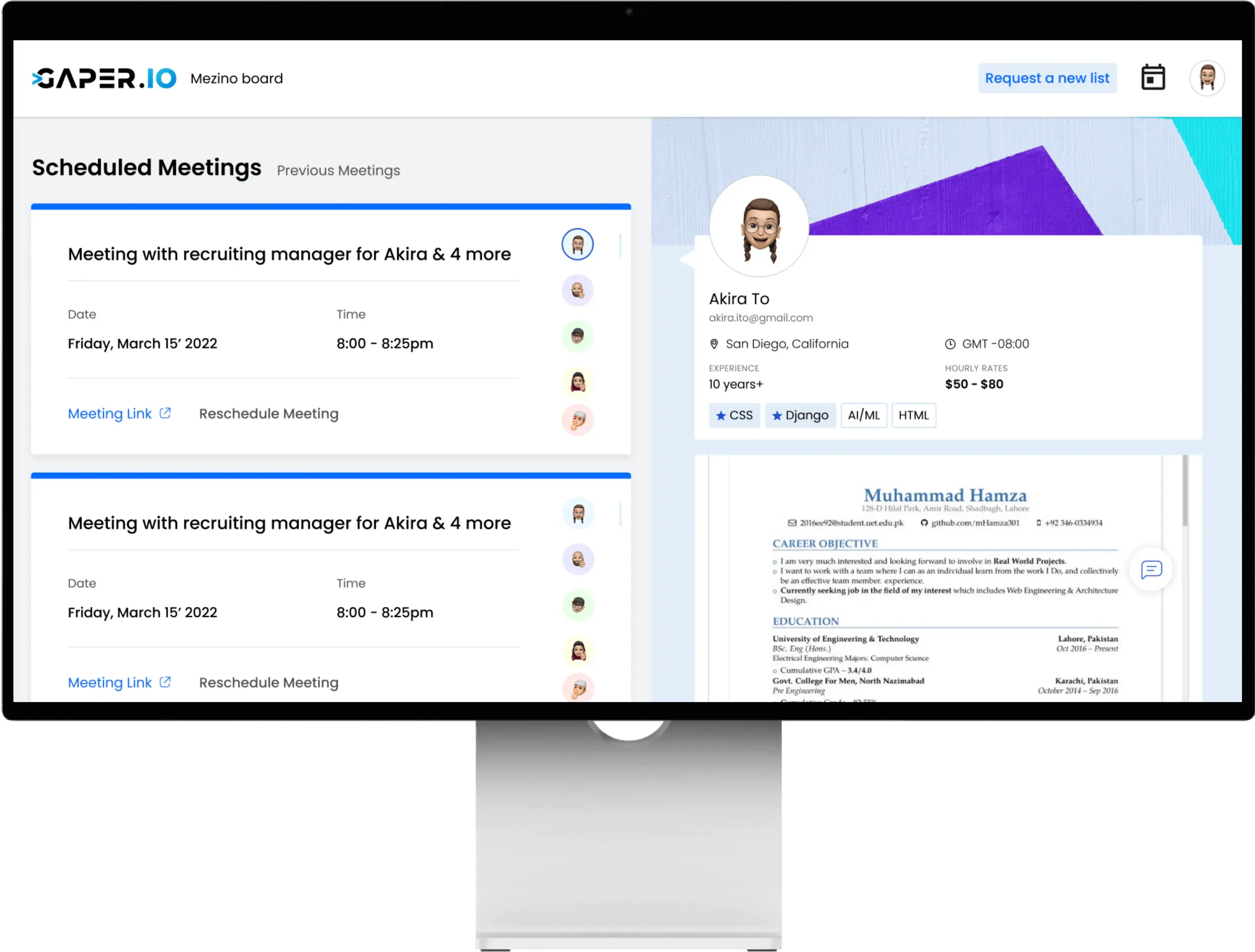
How our matchmaking works?
Get Matched in 48 Hours

Understanding your development project
Explain to us what you need and don’t shy away from giving even the smallest details

Find the best developers for your business
Get matched with qualified developers for your project

Hire the best developers for your business
Hire developers and engineers when you are ready! It can be in as less as 48 hours
Hire the Best Software Developers in Detroit, Michigan with Gaper and Save on Hiring Costs
Browse through hundreds of profiles and find your dream match
Hiring Guides
[
Published - April 15, 2026
Why Staffing Agencies Are Leaving Traditional HR Software](https://gaper.io/why-staffing-agencies-are-leaving-traditional-hr-software/)
[
Published - April 8, 2026
Build a Private Insurance Platform Instead of Paying Monthly SaaS Fees](https://gaper.io/build-a-private-insurance-platform-instead-of-paying-monthly-saas-fees/)
How hiring developers with Gaper works
Advantages of hiring developers from Gaper
Our developer network allows you the opportunity to access and hire top talent from across the globe. Engineers and developers can be hired for any tech stack that your business has a need for.

Our Engineers have worked for
Our Engineers have worked for

Hire the top Developers from all around US

Austin
Texas is one of the biggest names in technology; Apple, Amazon, and Google reside and have a workforce highly skilled in software development and engineering.

Anchorage
Some of the most successful software developers are based in Alaska, which is gradually becoming a state that leads the way in technology.

Oklahoma City
Oklahoma is home to some of the biggest companies in technology from AT&T to Oracle leading the way for the future growth of this field.

Miami
Florida has become one of the fastest-growing technology sectors in the US. Florida houses the finest talent pool of computer programmers and coders.

Kansas City
Kansas is growing with its investment in the technology field thereby producing some of the best engineers in the world.

Newyork
New York has become a technology hub and home to thousands of startups. New York is now the second-largest startup ecosystem in the world driving innovation in the digital world.
There is an estimated 15% raise in the hiring rates for software engineers every 3 years around the globe.

Frequently asked questions
What are the four main industries driving software development demand in Detroit?
What does it cost to hire a senior software developer in Detroit?
What technical skills are most in demand in Detroit?
How much can AI coding tools improve developer productivity in Detroit?


Ready to turn AI into execution?
Book a free assessment of one workflow. We map it, make an honest build versus buy call before any code, and if an off the shelf product covers the job we will tell you so.